Can You Install a New Garage Door on Old Tracks?
Quick answer
Do not assume that old tracks can be reused with a new garage door, even if the opening is the same size and the tracks look straight. Follow the new door manufacturer’s requirements for its matched track and hardware system. For Clopay replacement doors, the manufacturer explicitly advises against reusing the old tracks, hardware, or springs.
Compatibility is not a visual guess. Do not bend, drill, or reposition old tracks to make a new door fit. Installation and any system changes belong to a trained door-systems technician.
Same opening does not mean the same system
The opening’s width and height describe only part of the installation. The new door also has a particular construction, weight, panel geometry, roller arrangement, and hardware specification. Tracks are part of how that system moves and is supported; they are not simply interchangeable metal channels.
A reused component might appear to fit while failing to meet the new assembly’s requirements. DASMA warns that similar-looking components can differ in strength and function, and that unauthorized substitutions can affect a certified assembly. That is why “we have always reused these” is not the same as documented manufacturer compatibility.
The right question is not “Can the new rollers slide into this track?” It is “Does the manufacturer approve this complete installed configuration, and who has verified that it meets the required specifications?”
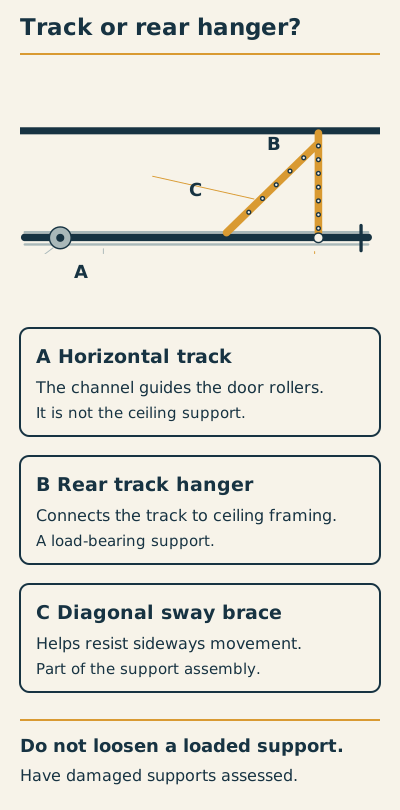
Distinguish tracks from supporting hangers
Scroll the diagram sideways when needed. Keyboard: focus the diagram, then use the left and right arrow keys.
Open full-size wide diagramOpen full-size mobile diagram
What the diagram shows
The horizontal track is the channel that guides the door rollers. It is not the ceiling support.
The rear track hanger connects the track to ceiling framing and carries its load. The diagonal sway brace helps resist sideways movement as part of the support assembly.
Do not loosen a loaded support. Have damaged supports assessed. This identifies the parts; the manufacturer’s installation instructions determine the required mounting.
Door system vs building supports.
Keeping a rear hanger is not the same as reusing an old track.
New door system
Clopay’s door package includes:
- Door sections
- Matching tracks
- Spring assembly
- Required door hardware
supported by
→
Rear track hangers
Separate supports connect the rear of the horizontal track to the building.
Clopay says existing hangers can generally remain only after checking their condition and position for the new installation.
Have the installer assess them.Give each quoted component its own decision
| Component | Question for the installer | Insufficient answer |
|---|---|---|
| Tracks and door hardware | Which specified parts match the new door model, weight and geometry? | “The old tracks look straight.” |
| Rear hangers / building attachments | Are condition, location and support suitable for this new installation? | “We always leave them.” |
| Any proposed substitution | Which manufacturer document permits it in this assembly? | “The roller fits the channel.” |
Leave removal, compatibility assessment and installation to the trained installer. Do not pull on supports or tighten nearby hardware to test them.
Clopay FAQ: package components and rear hangers · Clopay installation guide: new matching tracks and hardware · DASMA TDS183: appearance does not establish substitution safety.
People sometimes use “tracks” to mean every piece of metal near the ceiling. Ask the installer to label what will be replaced and what may remain. The vertical and horizontal tracks guide the rollers. Rear hangers are separate supports attached to the building.
Clopay’s FAQ says existing rear track hangers can generally be reused after checking condition and position, while its replacement guidance calls for new door tracks and hardware. These statements are not contradictory: they concern different components. Do not turn permission to retain suitable hangers into permission to retain the old track system.
Any retained support still needs professional assessment for the new installation. Do not inspect attachment strength by pulling on it or tightening nearby fasteners yourself.
Safe assessment before accepting a quote
- Identify the proposed new door. Request its exact manufacturer, model, size, and applicable installation instructions. Expected outcome: a defined product, not a generic replacement promise.
- Ask for a component list. Have the quote distinguish sections, tracks, rollers, springs, seals, opener connection, and rear supports. Expected outcome: clarity about what is new and what is retained.
- Request the basis for any reuse. Ask which manufacturer document permits the retained component in this configuration. Expected outcome: evidence beyond appearance or convenience.
- Report site changes and damage. Mention impact, corrosion, water damage, low headroom, and any earlier modification. Do not move a damaged door to show the problem. Expected outcome: relevant conditions included in the survey.
- Confirm final verification. Ask who checks the completed assembly and documents operational and safety testing. Expected outcome: responsibility for the whole installation, not just the panels.
If no one can establish compatibility, pause the reuse proposal. Do not authorize a mixed system based solely on a lower quote or an assurance that it will “probably work.”
Why a new-track quote may be the clearer comparison
A complete matched-system proposal gives you a defined starting point. Compare other proposals against it line by line. If a bidder omits track replacement, ask whether that omission is allowed by the new door manufacturer and whether it changes the warranty or certification status.
Also ask about removal and disposal. A quote that includes new components but leaves old-system removal to you is not a complete professional replacement scope. High-tension dismantling should not become a homeowner preparation task.
If a special low-headroom or other nonstandard configuration is needed, ask for the approved configuration to be identified. “Custom adjustment” should not be a vague substitute for a specified system. The installer should explain which components are required and how the proposal meets the site’s constraints.
Mark up the quote, not the hardware. Use a simple list with “replace,” “retain after inspection,” and “not included.” Have the installer complete it before you approve the work.
FAQ
What if the old tracks are nearly new?
Age and appearance do not establish compatibility. The new door’s requirements still control. Ask for the exact approved configuration.
Can I keep the old opener?
Possibly, as a separate compatibility and condition decision. A suitable opener does not make incompatible tracks acceptable, and new tracks do not prove the opener is suitable.
Is replacing only the door sections the same question?
No. A manufacturer-approved replacement section for an existing model is different from installing a new door assembly. Ask the manufacturer about the exact repair or replacement being proposed.
Should I remove the old tracks to save labor?
No. Leave dismantling to the installer as part of the agreed scope. Track work interacts with a heavy, counterbalanced system and should not be approached as simple demolition.
Explore guides · About this guide
Was this guide useful?
Your choice stays in this browser only. It is not sent to us.
Sources & manuals3
Manufacturer instructions and references for this guide. Match the document to your exact product.
- Clopay FAQ: package components and rear hangerswww.clopaydoor.com
- Clopay installation guide: new matching tracks and hardwarewww.clopaydoor.com
- DASMA TDS183: appearance does not establish substitution safetywww.dasma.com