Garage Door Cost: How to Compare Complete Installation Quotes
Quick answer
The useful price is a written installed quote for your exact door and opening—not a door-only advertisement or an unexplained national average. Ask for the door specification, matched hardware, installation, removal, site work, taxes, and warranty scope to be clearly identified. This guide does not assign an unsupported current price range to your project.
Clopay says cost depends on the model, size, material, decorative choices, and site conditions, and directs buyers to local distributors for current installed pricing. That is the right starting point for a decision you can actually make.
Ask the same question three times. “What is the total installed price for this exact written specification?” makes competing quotes much easier to compare.
Separate the door from the project
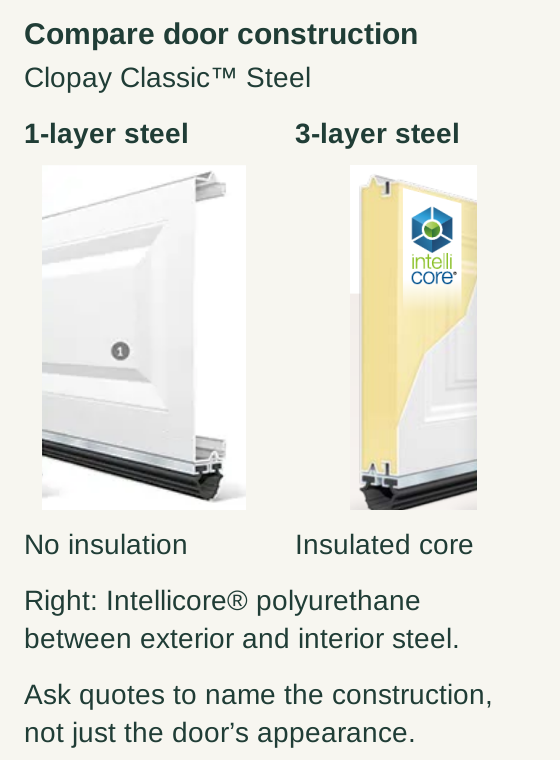
Scroll within the image if needed, or open the full-size view. The key details are also written below.
These Clopay Classic Steel cutaways compare uninsulated 1-layer steel with a pictured 3-layer steel option containing Intellicore polyurethane between exterior and interior steel. Not every 3-layer door uses that insulation.
Ask quotes to name the door construction, not just its appearance. These examples are not a complete specification, price quote, savings estimate or thermal-performance promise.
A garage door purchase is a system and installation decision. A low advertised panel price may not describe the track, counterbalance hardware, reinforcement, seals, labor, or removal included. A replacement in a sound existing opening is also a different project from a new opening that needs building work.
Before comparing totals, define the job in one sentence: “Replace the existing sectional door in this opening, retain the opener only if confirmed compatible, remove the old system, and leave the new system tested and ready for use.” Adjust that sentence to your project. The goal is to prevent each bidder from pricing a different scope.
Do not assume an opener is included with the door. Ask whether the quote covers reconnecting the existing unit, providing a new one, or no operator work at all. If you are comparing insulated doors, request the actual product specification rather than treating every “insulated” label as equivalent.
Gather information safely
- Find the current door’s paperwork. Record brand, model, and known installation date where available. Expected outcome: a starting point for replacement planning, not proof that the new door must match it.
- Describe the opening and garage. Provide approximate opening dimensions only if they can be obtained safely without moving a damaged door, climbing, or reaching across hardware. Otherwise request an on-site measurement. Expected outcome: a preliminary quote category, with final measurement assigned to the installer.
- List practical priorities. Include appearance, window placement, privacy, insulation, noise, maintenance preference, and budget constraints. Expected outcome: a shortlist with genuine trade-offs.
- Record site complications. Mention low ceilings, shelving, pipes, an uneven opening, visible water damage, and whether the garage has another entrance. Expected outcome: fewer surprise exclusions.
- Ask who verifies requirements. Have the installer identify applicable wind-load, permit, and local installation requirements for the address. Expected outcome: a documented responsibility rather than a guessed requirement.
Stop assessment if the current door is damaged, off track, or has a loose cable. Planning a purchase is not a reason to move an unsafe door or dismantle anything for measurements.
The line items that belong in a useful quote
| Item | What to clarify |
|---|---|
| Door | Exact model, dimensions, finish, windows, and insulation specification |
| Door system | New tracks, spring assembly, rollers, seals, and required reinforcement |
| Installation | Labor scope, access requirements, and preparation |
| Existing equipment | Removal, disposal, and any retained equipment |
| Site work | Framing repairs, mounting support, sealing, and electrical exclusions |
| Operator | New unit, compatible reconnection, or explicitly excluded |
| Completion | Testing, cleanup, documentation, and owner demonstration |
| Commercial terms | Tax, permit responsibility, deposit, payment schedule, and quote expiry |
Clopay’s installation guidance treats the new door’s track and hardware as matched components rather than an automatic reuse opportunity. Confirm this explicitly if a lower quote appears to retain old parts.
Compare base price, options, and unknowns separately
Scroll the diagram sideways when needed. Keyboard: focus the diagram, then use the left and right arrow keys.
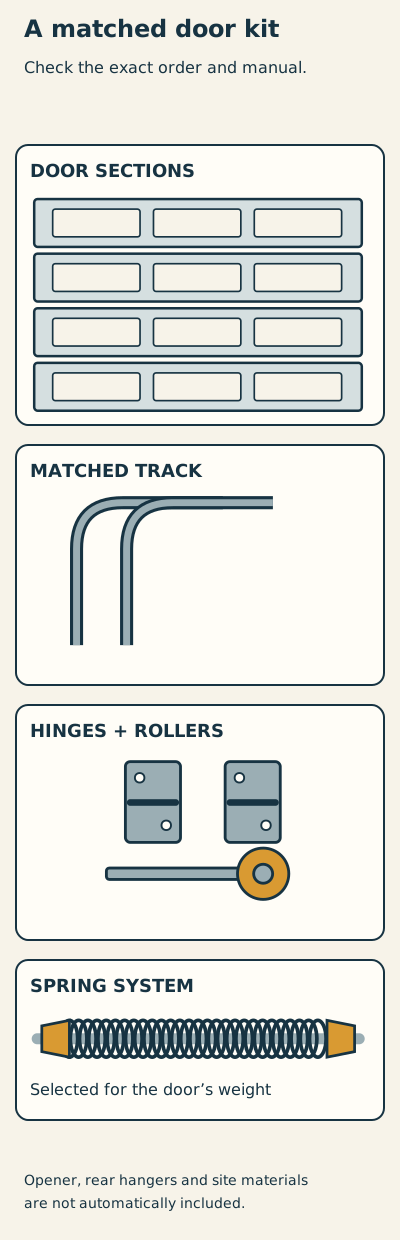
Open full-size wide diagramOpen full-size mobile diagram
What the diagram shows
A matched door kit includes specified component groups such as door sections, tracks, hardware and a spring system selected for the door.
Check the exact order and installation manual. An opener, rear track hangers and site-specific materials are not automatically included.
Same door. Different scope.
A door-only price and a completed installation are not the same offer.
Model · width × height · material and insulation · finish and windows
Example quote descriptions
| Quote wording | What it establishes | Ask before comparing |
|---|---|---|
| “Door only” | Equipment is named; installation is not. | → Are matching tracks and hardware included? Who installs it? |
| “Door + new tracks and hardware” | The system scope is clearer. | → Which model, dimensions and configuration? |
| “Installation included” | Labor is stated, but its limits are not. | → Removal, disposal, opener connection and site repairs? |
| “Warranty included” | A warranty is mentioned; coverage is not defined. | → Parts, finish, labor and future service-call charges? |
Ask each bidder to list exclusions, allowances, taxes and any work requiring a separate quote.
Sources: Clopay: door package and installed pricing · Clopay: matching replacement tracks and hardware.
The comparison questions help clarify an offer; they do not promise what a seller includes.
Ask each bidder to separate required work from upgrades. Decorative glass, a different finish, or a connected opener can then be accepted or declined without obscuring the baseline project.
Unknown site conditions should have a clear approval process. For example, if damaged framing is discovered after removal, who will document it, price the additional work, and obtain your approval? Do not accept an open-ended allowance without understanding what triggers it.
Compare warranties by their actual coverage. A long finish warranty is not the same as a labor warranty, and a parts warranty does not necessarily pay for a return service visit. Keep the product warranty and installer workmanship terms together.
Do not save money by removing the old spring system yourself. Ask for removal and disposal in the installation scope. High-tension disassembly is professional work.
FAQ
Why is one quote much lower?
First compare model, dimensions, hardware, removal, operator work, and exclusions. A difference may be legitimate, but it needs explanation before the total is meaningful.
Should I buy online and hire installation separately?
Ask an installer to confirm compatibility, delivery responsibilities, missing parts, warranty handling, and installation price before ordering. A carton price is not the completed-project cost.
Can I reuse the opener to reduce cost?
Possibly, if the installer confirms compatibility, condition, and appropriate safety performance. Retention should be a documented decision, not an assumption.
What should I have when I approve the job?
A specific written scope, total or clearly defined allowances, completion expectations, payment terms, and responsibility for measurements and required approvals. Keep all changes in writing.
Explore guides · About this guide
Was this guide useful?
Your choice stays in this browser only. It is not sent to us.
Sources & manuals2
Manufacturer instructions and references for this guide. Match the document to your exact product.
- Clopay: door package and installed pricingwww.clopaydoor.com
- Clopay: matching replacement tracks and hardwarewww.clopaydoor.com