Garage Door Spring Replacement Cost: Compare Repair Quotes

Quick answer
A reliable garage door spring replacement price comes from a written quote for the actual door system. Compare the number and specification of springs, labor, service call, stabilization if needed, related repairs, testing, and warranty. A retail spring price is not an installed repair price. We do not give an invented current national range for a job that has not been diagnosed.
Price research does not make the door usable. If a spring is broken or suspected broken, leave the door out of service while arranging repair. Do not attempt a test lift to help someone quote it.
Why two “spring replacement” quotes can differ
The phrase may describe one exposed spring, a pair, or a manufacturer-specific assembly. The door may be safely closed, or it may first need stabilization because it is open or displaced. A quote may include the service visit and testing, while another shows only a part or starting charge.
Ask each company to identify what is included and what still depends on inspection. A preliminary phone estimate can be useful, but it should be labeled as preliminary. If the scope changes on arrival, request the revised explanation and total before authorizing additional work.
Wayne Dalton’s spring-replacement information describes matching springs to the door and assessing the associated system, followed by balance and operational checks. That illustrates why the complete repair should be priced as more than a loose component.
Prepare a safe quote request
- State the door’s position. Closed, open, partly open, or tilted is important information. Expected outcome: the provider understands access and stabilization needs.
- Describe symptoms without diagnosing beyond the evidence. Mention a bang, visible spring gap, or earlier technician diagnosis. Do not operate the door for a recording. Expected outcome: an honest starting point for assessment.
- Provide existing identification. Use paperwork or a safely readable model label. Do not measure spring wire, remove a cover, or handle a cable. Expected outcome: useful model information without high-tension work.
- Ask for the base scope and likely exclusions. Request the service-call policy, whether it is credited toward repair, and whether after-hours work differs. Expected outcome: clarity before the visit.
- Request approval before extras. Ask that required repairs and optional upgrades be separated. Expected outcome: control over the final scope.
If someone requests measurements you cannot safely obtain, say so and ask for on-site inspection. A responsible estimate can retain uncertainty; it does not require you to dismantle the mechanism.
The quote comparison checklist
Scroll the diagram sideways when needed. Keyboard: focus the diagram, then use the left and right arrow keys.
Open full-size wide diagramOpen full-size mobile diagram
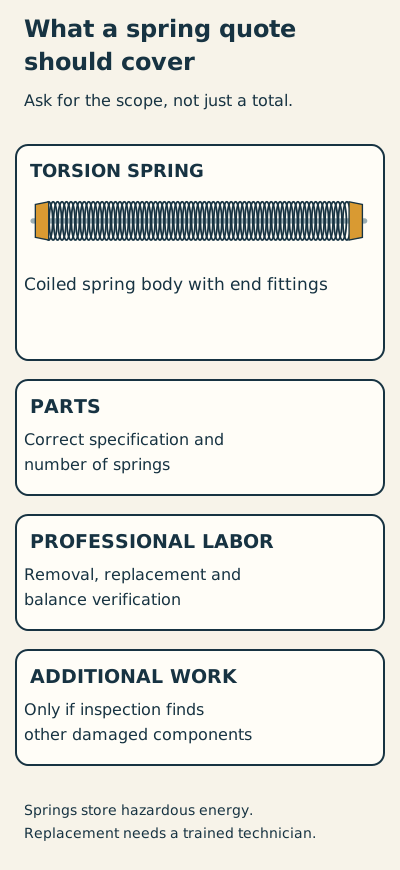
What the diagram shows
The torsion spring has a coiled body and end fittings. A quote should identify the correct spring specification and number of springs.
Professional labor covers removal, replacement and balance verification. Additional work should be explained by inspection findings, not assumed.
Springs store hazardous energy. Replacement requires a trained technician. No universal price fits every door.
One spring is not the same scope as two.
Compare quantity and service—not just the final number.
Example quote descriptions
One component is priced.
Installation is not included in this description.
Two components and installation are named.
The remaining service scope still needs checking.
Ask the technician to specify the correct assembly and quantity for your door before comparing.
Get these items in writing
Assembly, quantity and any cycle-rating option
Service-call charge; safe handling of an open or displaced door
Required repairs separate from optional work
Balance, operation and required safety tests
Parts, labor and return-visit terms
Your approval before extra work
Keep a door with a broken or suspected broken spring out of service. Do not lift it or measure loaded hardware for a quote.
Sources: DASMA: two-spring replacement and professional spring work · Genie: do not operate a door with a broken spring.
The checklist defines questions to ask, not universal package or warranty inclusions.
| Question | Why it matters |
|---|---|
| What assembly is being replaced? | A single spring and a matched pair are different scopes. |
| How is compatibility established? | Appearance alone is not a specification. |
| What cycle rating is offered? | It helps compare options without treating years as a guarantee. |
| Is labor included? | A part-only price omits the installation work. |
| Are visit and emergency charges separate? | The advertised starting price may not be the final total. |
| Are related repairs itemized? | It separates the spring job from additional findings. |
| What tests are included? | Completion should establish safe normal operation. |
| What does the warranty actually cover? | Parts coverage and labor coverage may differ. |
For a two-spring door, DASMA recommends replacing both when one breaks. Discuss that recommendation and ask the quote to state the quantity clearly. Do not compare a one-spring price to a pair as though they were the same offer.
How to evaluate a higher-cycle option
Ask for the proposed cycle rating in writing, the installed price difference, and confirmation that the option is appropriate for this door. Then compare it with your household’s actual use. Someone who rarely uses the garage and someone who treats it as the main entrance may value the option differently.
A cycle rating is not a warranty length and does not tell you the exact date a spring will fail. Avoid paying more based only on “lifetime spring” wording. Ask what the warranty replaces, whether labor is included, whether there are service-call charges, and what maintenance conditions apply.
Read component coverage and labor terms separately
- This example is from the specified Amarr complete-door owner manual, revision 99292609-07.22, for standard-lift and low-headroom applications. It is not a standalone replacement-spring warranty.
- Actual coverage depends on the exact door, original purchase documents and all contract conditions. This example does not establish eligibility, duration, current terms or a claim outcome.
- Compare the installer’s labor terms separately. Paperwork review does not require measuring or handling a spring.
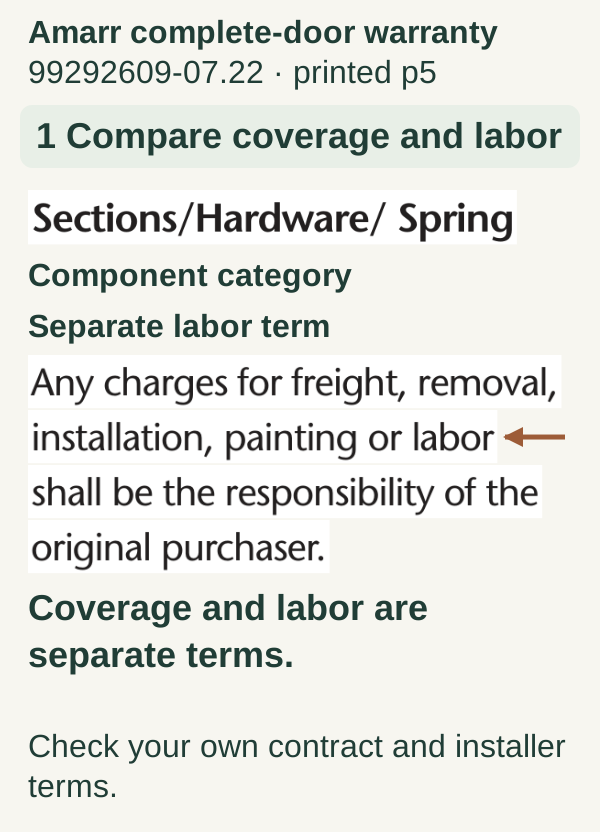
Scroll within the image if needed, or open the full-size view. The key details are also written below.
Amarr complete-door warranty example, owner manual 99292609-07.22 printed page 5. Component category: Sections/Hardware/ Spring. Separate labor term: Any charges for freight, removal, installation, painting or labor shall be the responsibility of the original purchaser. Coverage and labor are separate terms. Check your own contract and installer terms.
Keep the old and new scopes together. If the technician revises the estimate, retain both versions and the reason for the change. That makes the final invoice understandable.
Common mistakes
- Comparing a bare component price with an installed repair.
- Accepting an unspecified “heavy-duty” upgrade.
- Approving a complete overhaul without itemized findings.
- Assuming all spring arrangements use the same parts.
- Delaying a necessary repair while continuing to use the door.
- Treating a long parts warranty as full future service coverage.
FAQ
Does a broken spring mean I need a new door?
Not automatically. Ask whether the door and other components remain serviceable and why replacement is proposed if it is recommended.
Can I supply my own springs?
Ask the installer first. Compatibility, responsibility for specification, and warranty treatment must be agreed before purchase. Do not order by appearance.
What should the final invoice show?
The installed assembly and quantity, any cycle-rating option, labor, approved additional work, warranty terms, and completion checks. Keep it with the door records.
Explore guides · About this guide
Was this guide useful?
Your choice stays in this browser only. It is not sent to us.
Sources & manuals2
Manufacturer instructions and references for this guide. Match the document to your exact product.
- DASMA: two-spring replacement and professional spring workwww.dasma.com
- Genie: do not operate a door with a broken springwww.geniecompany.com