How to Choose a Gate Opener: Weight, Length, Wind and Cycles
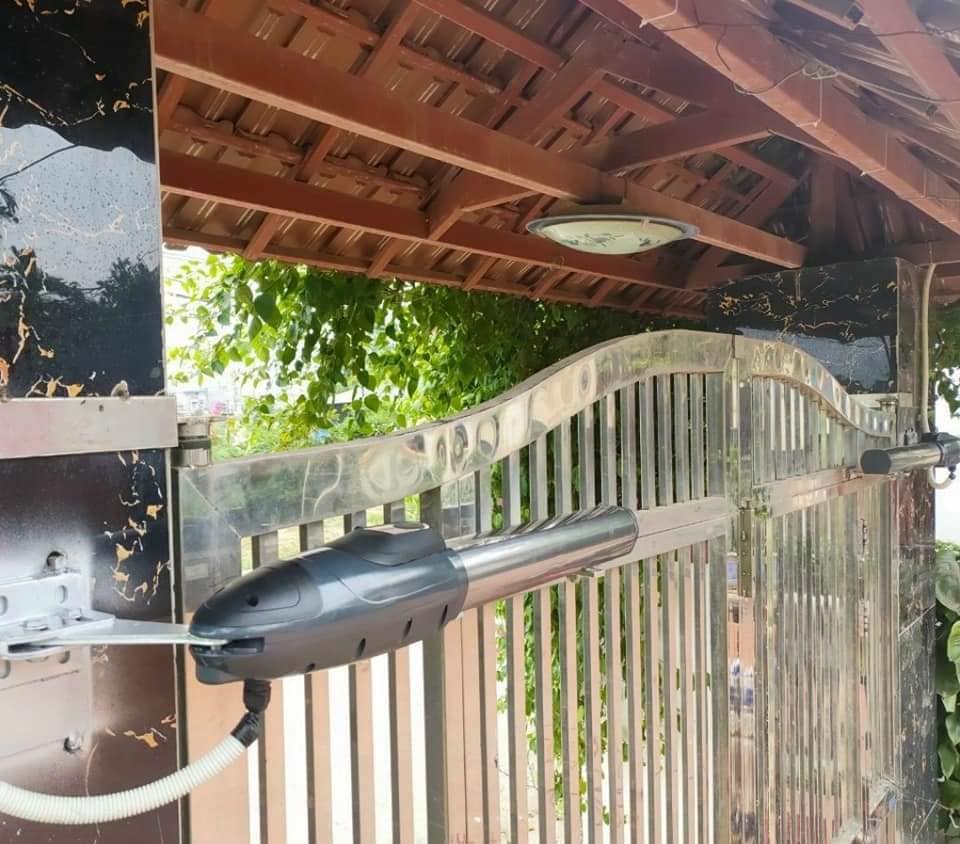
Choosing a gate opener starts with the gate it must move, not the largest weight printed on a sales page. Leaf length, wind exposure, traffic pattern and the complete safety arrangement can change which operator is suitable. The useful outcome is a documented model choice with clear limits, not a motor selected by horsepower alone.
This guide compares operator capacity and operating demands after the basic gate and site have been assessed. First have the existing gate and site assessed for automation suitability. An opener cannot compensate for unsuitable construction or damaged supporting hardware.
1. Build a selection brief for the exact gate
Record whether the gate swings or slides, how many leaves move, and the length and height of each leaf. Ask the gate fabricator or installer for a reliable weight rather than estimating from appearance. A hollow aluminum gate and a solid steel gate can look similar from the driveway while placing very different demands on equipment.
For a paired swing gate, describe both leaves separately. Do not assume that the total opening width is the length used in the operator's rating, or that a rating for one leaf automatically covers two. Include the intended opening angle and any asymmetry the installer identifies. You are collecting information, not setting installation geometry.
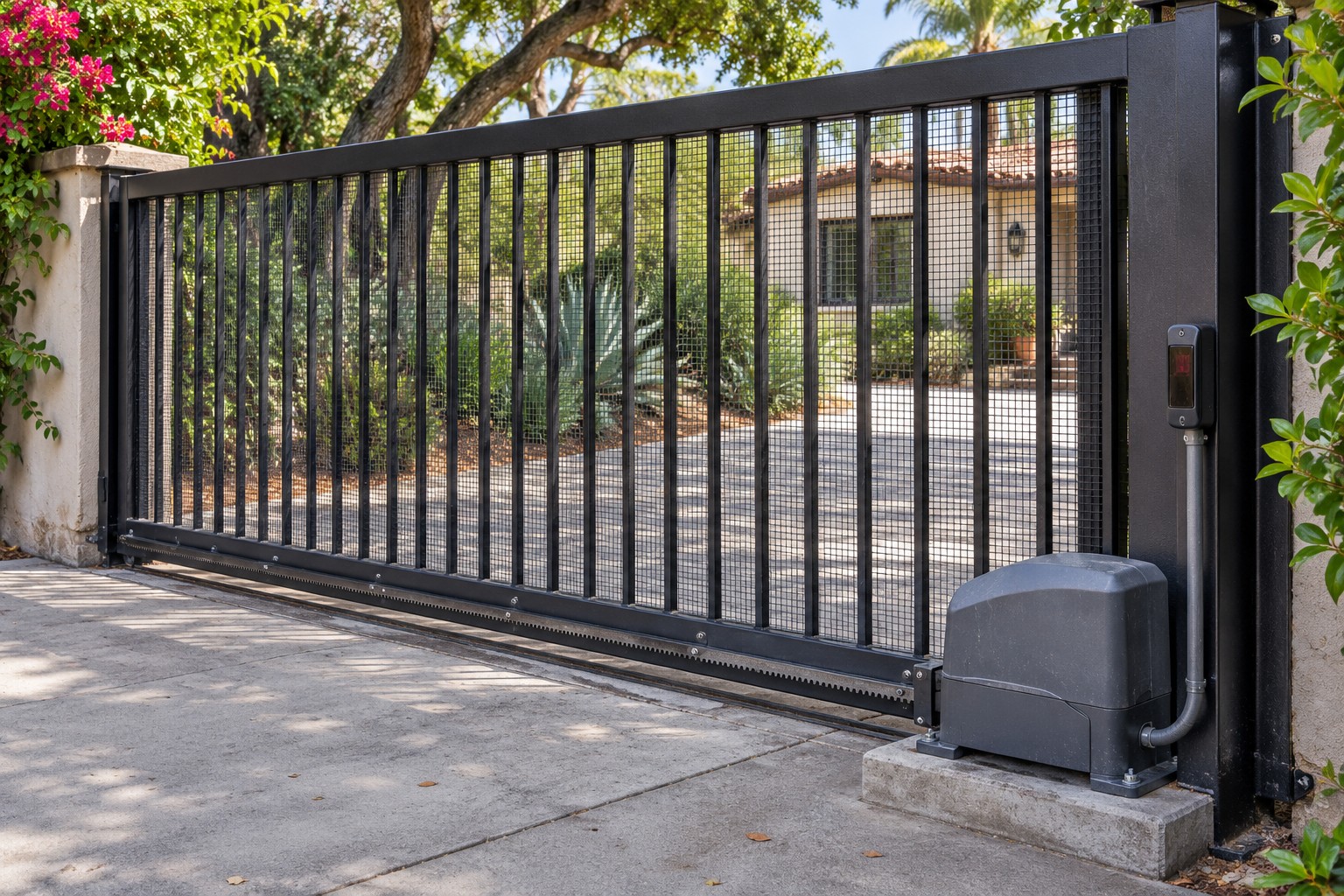
Tell the contractor what could change later: privacy infill, decorative additions, more residents or a different access system. Ask whether the proposal remains valid after those changes. The answer may be no. A selection made for the current open-picket gate should not quietly become approval for a later solid panel.
2. Read length and weight together
A maximum length and a maximum weight shown on the same page are not necessarily permitted simultaneously. The SwingSmart 535 specifications, for example, associate different allowable weights with different leaf lengths. Read the appropriate combination and every relevant footnote, then have the supplier confirm the selected configuration in writing.
Ask the installer to identify the exact model, current manual revision and applicable capacity information in the proposal. “Suitable for heavy gates” is not enough. If a seller quotes a number from another variant, request the correct documentation before comparing prices.
Do not invent a universal spare-capacity percentage. Some sites need a different operator type or a changed gate design rather than an arbitrary step up in advertised weight. Ask what allowance the designer has made for actual conditions and why that allowance is appropriate.
Also separate moving capability from safe operation. Equipment powerful enough to move a gate still needs an appropriate installation, compatible protection and commissioning. Increasing force to overcome binding is not a selection strategy.

3. Treat wind exposure as a design input
Gate weight does not describe the force of wind on a broad panel. Height, solid area, orientation and local exposure belong in the assessment. The HydraSwing specification footnotes explicitly condition capacity on wind and panel characteristics. That principle is useful; its individual product limits are not transferable to another model.
Photograph the whole gate and its surroundings from a safe position. Tell the installer if the property is on an exposed ridge, near an open field or regularly affected by gusts. Mention planned privacy slats. Do not offer a guessed wind speed as if it were a design value.
Ask who determines the wind assumptions and whether a qualified designer is needed. If the contractor cannot explain how a solid gate was considered, pause the purchase. A claim that a stronger motor will simply push through wind does not answer how the gate, operator and supporting structure will behave.
No operator should be presented as permission to keep using a damaged gate during severe weather. Follow the system's operating restrictions and the site's safety plan.
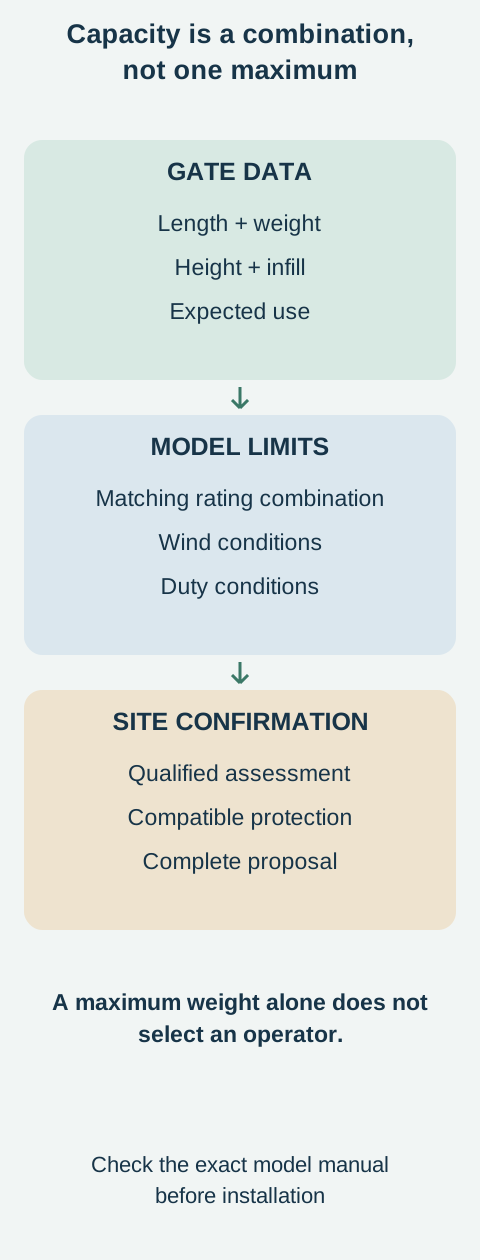 Open full diagram
4. Compare traffic peaks, not just daily totals
Describe a normal day and the busiest short period. A private driveway used a few times morning and evening differs from a shared entrance with concentrated arrivals, even if their average daily use occasionally overlaps.
Ask how the manufacturer defines a cycle for the proposed model. An opening movement, a complete open-and-close sequence and a vehicle passage are not interchangeable counts. Do not compare figures from two brochures until their definitions and operating conditions match.
List pedestrian access separately; a vehicular gate is not the pedestrian route. Include deliveries, visitors, service vehicles and any hold-open periods when discussing traffic with the installer. Ask how those patterns affect the proposed equipment and access controls without making changes to timers yourself.
A continuous-duty label does not promise unlimited traffic under every load, temperature and power condition. Ask for the model's applicable duty information, how peak use was assessed and what maintenance is expected at that level of use. HySecurity's selection guidance treats vehicle throughput as one of several site-specific inputs.
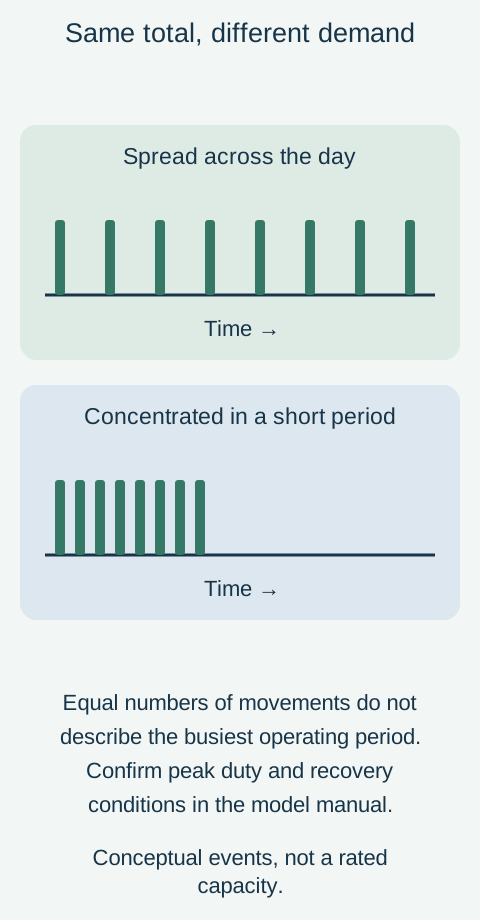 Open full diagram
5. Match power and accessories to the selected system
Identify whether the proposal uses available mains power, a supported solar arrangement or another manufacturer-approved supply. Power planning is not a reason to choose an undersized operator, and an oversized panel or battery is not a substitute for compatible charging equipment.
Ask for an accessory inventory: safety devices, vehicle detection, access control, locks, communications and any heating equipment. Their compatibility and supply requirements belong in the design. Keep mandatory protection in the scope rather than treating it as an optional item to remove when the budget gets tight.
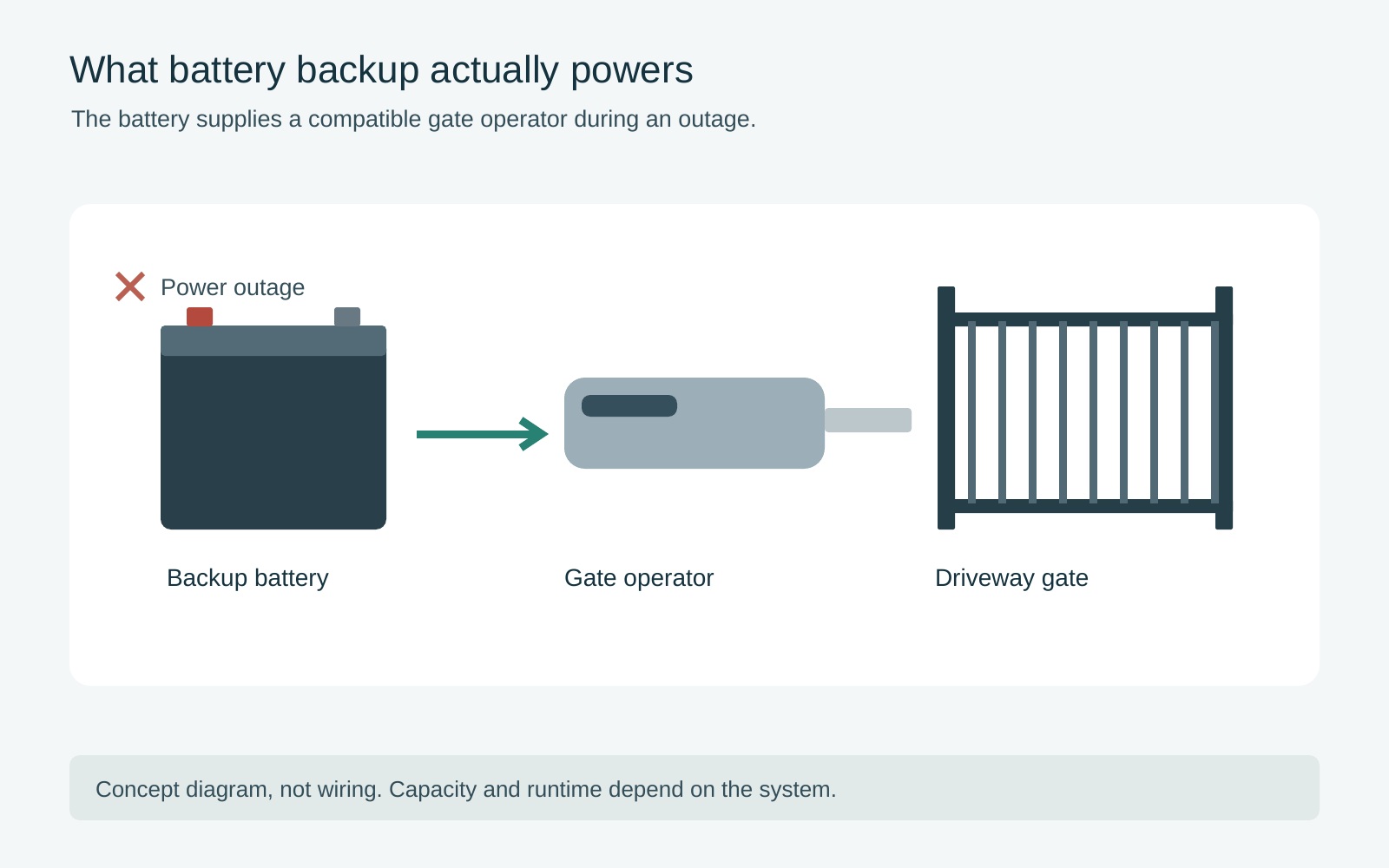
For solar, request the assessment described in the solar-gate guide. Backup operation is a separate question. Ask what behavior is expected during an outage and at low battery, not simply whether the unit “has batteries.” Do not assume the phone interface or entry intercom will remain available whenever the motor can move.
6. Compare complete proposals and service support
Request a written scope naming the operator, compatible protection, installation work, power provision, access equipment, commissioning and owner training. Ask which existing components will be retained and how their suitability will be established.
A cheaper quote can be genuinely better, but only if it addresses the same job. Clarify exclusions such as correcting gate hardware, obtaining permissions or replacing unsupported accessories. Compare maintenance access and local service availability as well as the initial total.
Ask how replacement parts and product support will be obtained, what warranty applies to the actual purchaser and installation, and who handles a call when the gate cannot be used safely. Do not treat a general brand warranty headline as a confirmed term for a particular quote.
DASMA's gate-opener guidance calls for attention to the operator listing and the gate system, not just the drive unit. A listed motor is not evidence that every completed installation is compliant.
7. Agree on the handover evidence
Before accepting the work, have the installer explain the selected model's limits, operating restrictions and maintenance instructions. Ask for the actual manuals, model identification, contact details and a record of the commissioning checks included in the job.
The demonstration should cover normal authorized operation and the intended response to relevant safety devices, performed according to the manufacturer's procedure by the appropriate person. Never use a person, pet or vehicle as an improvised obstruction test.
Make sure the household knows the separate pedestrian route and what to do when the gate behaves abnormally. Keep users out of its movement area. Do not let a successful demonstration become permission to alter force, protection, gate panels or controls later.
Frequently asked questions
Can I choose solely from the gate's weight?
No. Match the documented length-and-weight combination, wind assumptions, usage and complete system requirements. A weight figure alone leaves important selection questions unanswered.
Is the strongest opener always the best choice?
No. The best choice is appropriate to the actual gate and site. Additional power does not cure damaged hardware or replace entrapment protection.
Will privacy slats affect the choice?
They can change the solid area exposed to wind. Obtain a fresh assessment before adding them; do not assume the original operator selection still applies.
Should I buy the operator before requesting installation quotes?
Prefer a complete compatible proposal first. Buying a standalone unit can leave you with equipment that the installer cannot responsibly use for the site.
Related Posts
 Practical Guide
Gate Battery Backup: Operation, Reserve and Limits
Plan essential gate access during an outage, check backup dependencies and low-energy behavior, and avoid unsupported runtime promises.
 Practical Guide
Repair or Replace a Gate Opener? Compare the Complete Job
Compare repair scope, safety limitations, parts support and replacement work to make a documented gate-opener service decision.
Sources
Manufacturer instructions and references for this guide. Match the document to your exact product.
- SwingSmart 535 specifications · Nice | HySecurity: SwingSmart 535hysecurity.com
- HydraSwing specification footnotes · Nice | HySecurity: HydraSwing specificationshysecurity.com
- HySecurity's selection guidance · Nice | HySecurity: Six Questions to Ask When Choosing a Gate Operatorhysecurity.com
- DASMA's gate-opener guidance · DASMA: Safety Tips for Gate Openerswww.dasma.com
Photo credits
- Linear actuators on a double swing gate. Operator selection depends on the gate and site, not appearance alone. Pthvina · CC0 · Unmodified photograph. Pthvina CC0
- Mesh gate leaves at a service-yard entrance provide an example of open infill. Leaf dimensions, mass, wind exposure and operator compatibility still require a site-specific assessment. Jaggery · CC BY-SA 2.0 · Unmodified photograph. Jaggery CC BY-SA 2.0
