Garage Door Opener Lifespan: When to Keep, Repair or Replace

Quick answer
There is no age that guarantees a garage door opener is safe or tells you exactly when it will fail. Use the model’s support status, safety performance, condition, repair history, and diagnosed repair needs to decide whether to keep, repair, or replace it. A working motor alone is not enough evidence to keep an unsafe or unsupported system in service.
Safety failure overrides an age estimate. Stop powered use if required safety functions do not work. Do not bypass sensors or increase force to postpone replacement or repair.
Why a lifespan number is not a decision rule
Two openers installed in the same year can have different histories. One may have documented service and a sound door; the other may have repeated faults or unknown modifications. The useful questions are what the system does now, whether it can be properly supported, and what a complete repair would involve.
A warranty is also not a lifespan prediction. A motor warranty may cover a specific component while excluding electronics, accessories, labor, or service visits. Read the terms rather than treating a long warranty phrase as a promise that the whole installation will remain trouble-free.
For budgeting, you can set money aside without declaring the unit “expired.” For safety, you should not wait for a budgeted replacement date if a serious fault appears.
Identify the opener before assessing its future
Find the model and manufacture date from paperwork or a label that can be read safely. Do not climb on a vehicle or reach across the door mechanism. If the label is inaccessible, ask a technician to identify it during service.
Chamberlain and LiftMaster explicitly recommend replacing their pre-1993 openers rather than repairing them and state that they no longer provide repair support or replacement parts for those products. That is a specific manufacturer policy—not a claim that every opener from every brand has the same support cutoff.
Once you know the model, obtain its current manual and check manufacturer support and any applicable recall information. An inherited opener deserves the same identification work as one you bought yourself.
A safe assessment sequence
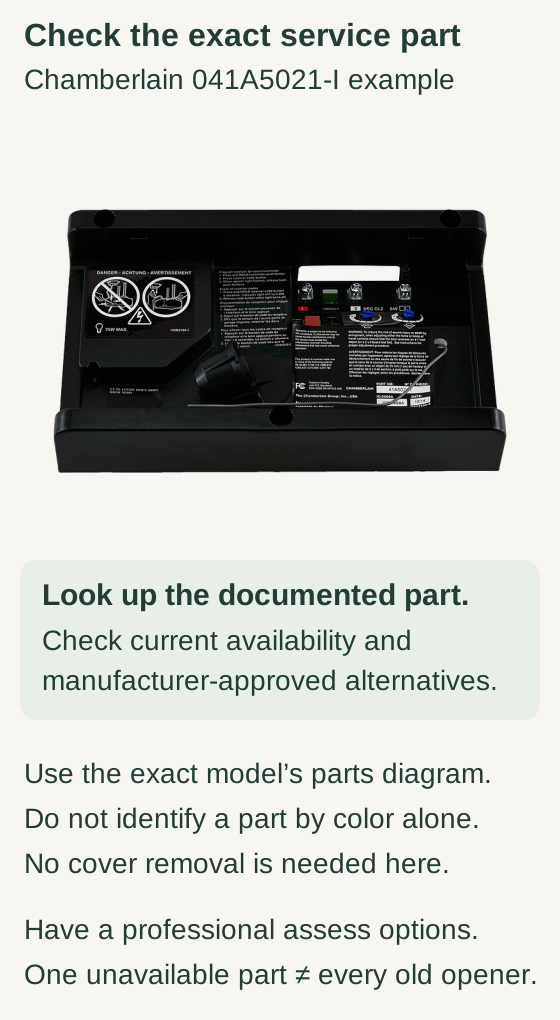
Scroll within the image if needed, or open the full-size view. The key details are also written below.
The 041A5021-I receiver logic-board assembly is a specific service-part example. Use the exact model’s parts diagram and check current manufacturer availability and approved alternatives; appearance or color does not identify a replacement.
This is not an enclosure-opening or electrical-work procedure. Have a professional assess options. One unavailable part does not establish that all older openers must be replaced.
- Collect the history. Note installation date if known, earlier repairs, recent symptoms, and any door changes. Expected outcome: a record that separates an isolated issue from repeated failure.
- Check support. Ask the manufacturer whether the model and required replacement parts remain supported. Expected outcome: a realistic repair path rather than a search for an unspecified used part.
- Record symptoms without recreating hazards. Note uncommanded movement, unusual noise, intermittent response, or existing safety-test failures. Expected outcome: evidence for diagnosis, not another risky cycle.
- Have the door assessed too. A mechanical door problem may be separate from the opener. Expected outcome: the repair proposal identifies what actually failed.
- Compare complete options. Request a diagnosed repair scope and a compatible replacement scope, including installation and testing. Expected outcome: a like-for-like decision.
If the door is visibly damaged, has a broken spring, or moves unpredictably, do not begin routine operational tests. Keep it out of service until assessed. Follow manual-approved testing only on a system whose condition permits it.
Safety performance matters more than whether it still moves
CPSC warns about non-reversing openers and recommends regular inspection and testing. If the specified reversal test fails, normal powered use should not continue pending correction. Testing is not an invitation to put a person, hand, or pet in the door’s path.
Ask a technician to explain the system’s required entrapment protection and verify it according to the exact instructions. Do not accept “it closes fine” as the whole safety assessment. Likewise, a new remote or connected accessory does not upgrade the underlying mechanical and safety functions by itself.
Keep one equipment record. Store the model, date, manuals, repair invoices, and test history together. This makes a future repair-versus-replace decision less dependent on memory.
Repair or replace: questions that clarify the choice
Scroll the diagram sideways when needed. Keyboard: focus the diagram, then use the left and right arrow keys.
Open full-size wide diagramOpen full-size mobile diagram
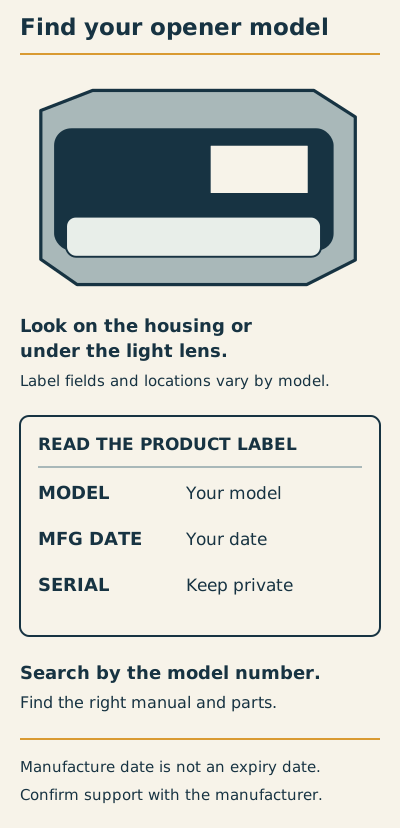
What the diagram shows
Look on the housing or under the light lens where the manual directs. Label fields and locations vary by model; use safely accessible records or ask a technician if access is unsafe.
Use the model number to find the manual and parts. Keep the serial number private.
The manufacture date is not an expiry date. Confirm current support with the manufacturer.
Judge the opener by condition and support—not age alone.
A working motor is not proof of a safe, repairable system.
Unsafe behavior or a failed required safety test?
Stop normal powered use and arrange diagnosis. Do not perform routine tests on a visibly damaged or unstable door.
Age does not override a safety failure.Identify the exact model and manufacture period
Use existing records or safely readable information. If the label cannot be read safely, have the technician identify it. Check the current manufacturer support and recall information.
Chamberlain / LiftMaster made before 1993
Those manufacturers recommend replacement rather than repair and no longer provide repair support or replacement parts for these units.
This is a brand-specific policy—not a universal lifespan cutoff.Other identified units
Check actual parts support, safety performance, diagnosed failure, repair history and compatible replacement scope.
No birthday alone decides the answer.Compare the complete options
| Repair proposal | Replacement proposal | Question to resolve |
|---|---|---|
| Diagnosed cause and available parts | Exact compatible model and required accessories | Does the proposal address the cause, not just the symptom? |
| Labor, remaining limitations and warranty | Installation, removal, site work and warranty | Are totals and exclusions comparable? |
| Required checks after correction | Required installation and safety checks | What confirms the system can return to normal use? |
Chamberlain/LiftMaster: pre-1993 policy · CPSC: non-reversing openers and failed-test correction. No guaranteed service life or remaining-years prediction.
Ask what failed, whether the repair addresses the cause, what other components remain uncertain, and what warranty applies to the completed work. Then compare the repair’s total installed cost with a suitable replacement—not just the new motor’s advertised price.
Consider whether replacement solves a specific need such as supported parts, appropriate safety features, backup power, or a compatible control arrangement. Avoid replacing solely because of a vague age rule, but also avoid spending repeatedly on an unsupported system simply because its motor still turns.
FAQ
Does a quiet opener mean it is healthy?
No. Sound is only one observation. Safety performance, mechanical condition, and support still matter.
Does a noisy opener always need replacement?
No. Diagnose the source first. The door, mounting, or another component may be involved; a new opener may not resolve the cause.
Can I extend its life by increasing force?
Do not use force adjustments to overcome abnormal operation. Have the cause assessed and use only the manufacturer’s required setup and repair process.
What is the best replacement age?
Use documented condition and manufacturer guidance rather than a universal birthday. Stop immediately for unsafe behavior, regardless of age.
Explore guides · About this guide
Was this guide useful?
Your choice stays in this browser only. It is not sent to us.
Sources & manuals2
Manufacturer instructions and references for this guide. Match the document to your exact product.
- Chamberlain/LiftMaster: pre-1993 policysupport.chamberlaingroup.com
- CPSC: non-reversing openers and failed-test correctionwww.cpsc.gov