What Size Garage Door Opener Do You Need?
Quick answer
Choose a garage door opener that its manufacturer approves for the actual door type, dimensions, construction, weight, and installation arrangement. Confirm the door is sound and properly balanced first. Do not choose by horsepower alone, and do not buy a stronger motor to overcome a heavy or binding door.
Genie identifies door size, construction, and weight as power-selection inputs. It also explains that its DC “horsepower comparable” rating is a comparison system, not a direct equivalence to AC motor horsepower. A large number on the box is therefore not a complete sizing method.
Fix the door before sizing the opener. Broken springs, cable damage, uneven travel, and binding are repair concerns, not reasons to move up a motor size.
What “size” actually includes
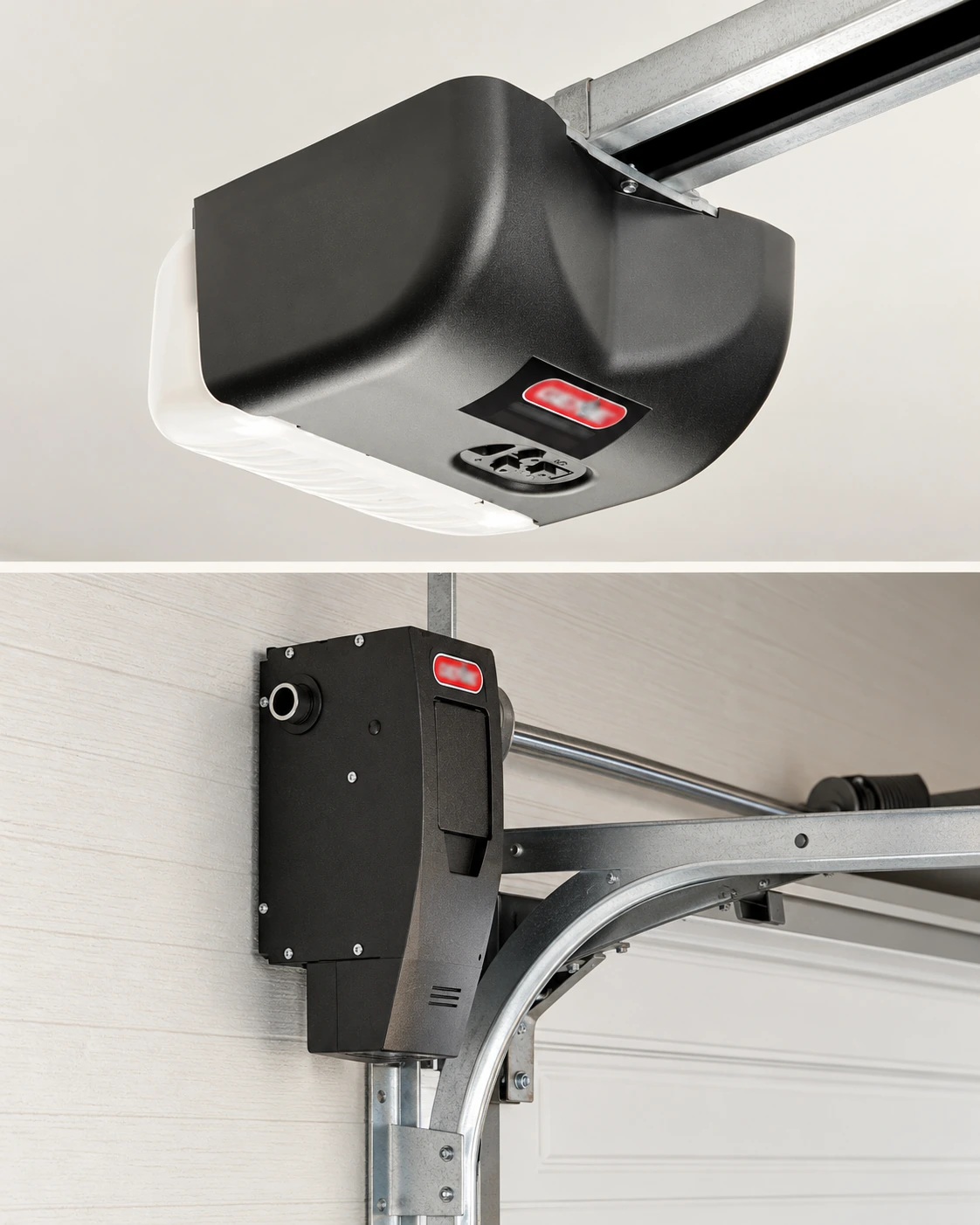
The upper view shows a ceiling-rail opener; the lower view shows a wall-mount arrangement beside the shaft. They use different installation spaces. This comparison does not establish compatibility or approve the clearances shown; check the exact model and door requirements.
Power is one part of the decision. The opener also has to accommodate the door’s travel, fit the available space, and use an approved connection or drive arrangement. The rail included in one package may not suit the same door height as another package. A wall-mounted operator is not automatically interchangeable with a ceiling-mounted model.
Start with the exact candidate’s current installation manual and compatibility statement. Treat seller descriptions such as “for most doors” as an invitation to verify, not a substitute for verification. If the door is custom, unusually heavy, or modified, ask the manufacturer or installer to establish suitability in writing.
For example, LiftMaster’s 8500 manual specifies particular compatible door configurations. That is evidence of why wall-mount selection needs a model-level check, not a general recommendation to buy that model for every garage.
Build a safe sizing worksheet
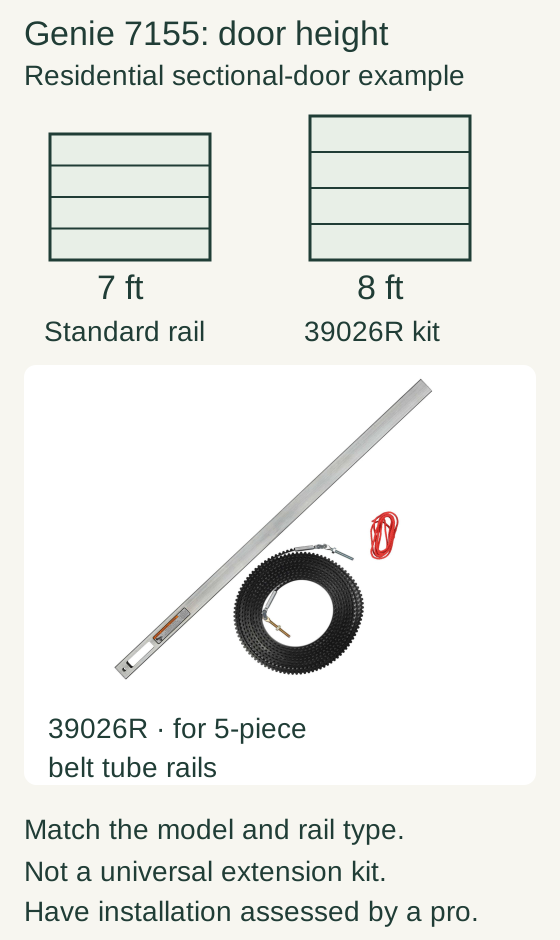
Scroll within the image if needed, or open the full-size view. The key details are also written below.
For the Genie 7155 example with a 5-piece belt-drive tube rail, the manufacturer specifies the standard setup for 7-foot sectional doors and the compatible 39026R extension kit for 8-foot doors.
Match both the exact model and rail type. The door silhouettes explain height categories, not installation dimensions or a complete sizing decision. This is not a universal extension kit or installation guide; have the site assessed by a professional.
Scroll the diagram sideways when needed. Keyboard: focus the diagram, then use the left and right arrow keys.
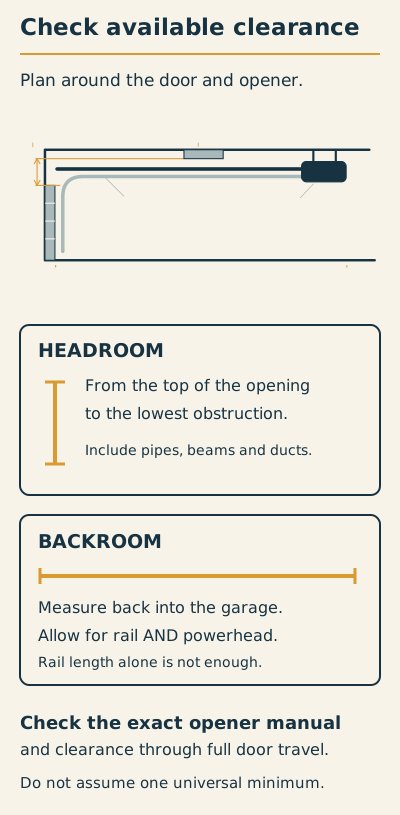
Open full-size wide diagramOpen full-size mobile diagram
What the diagram shows
Headroom runs from the top of the opening to the lowest obstruction. Include pipes, beams and ducts.
Backroom extends into the garage and must allow for the rail and powerhead. Use the opener’s overall installed length, not rail length alone.
Check the exact opener manual and clearance through full door travel. Do not assume a universal minimum.
Choose compatibility—not a horsepower shortcut.
Complete the door, site and model checks before ordering an opener.
1 · Door facts
- Door type and construction
- Width and height from records or safe measurement
- Weight from documentation—or installer to verify
- Insulation or section changes
- Condition and balance assessed before installation
Do not weigh, release or lift a suspect door.
2 · Site fit
- Headroom and backroom
- Rail length and travel needs
- Obstructions and mounting support
- Required door reinforcement
- Suitable power supply
Unreachable or unsafe to measure? Mark “installer to verify.”
3 · Exact-model confirmation
- Supported door types and limits
- Required rail or mounting system
- Height-extension accessories, if needed
- Compatible controls and safety devices
- Installation and required safety checks
Ask which manual page confirms the fit.
AC horsepower
A motor power rating—not a complete specification for your door and installation.
Genie DC “HPc”
A manufacturer comparison rating. Genie says it does not denote direct horsepower equivalence.
If the door is unusually heavy, damaged or moving unpredictably, stop use and arrange a door-system assessment—not a larger motor.
Genie FAQ: size/construction/weight, clearance, HPc and installation checks · Genie: do not install on an improperly balanced door. No universal horsepower table, door-weight estimate or model recommendation is implied.
- Door identity: record manufacturer, model, and construction from existing paperwork. Note modifications such as added insulation or replacement sections. Expected outcome: a reliable specification trail.
- Door dimensions: use existing measurements or obtain approximate opening measurements only where safe. Do not move a damaged door to measure it. Expected outcome: dimensions for preliminary selection, with final verification assigned to the installer.
- Door condition: list any abnormal movement, noise, or known repair issue. Do not disconnect or lift a suspect door to estimate weight. Expected outcome: mechanical problems are assessed before purchase.
- Available space: note ceiling obstructions, side clearance, shelving, and the location of existing equipment. Expected outcome: the installer knows which fit constraints to verify.
- Use pattern: estimate ordinary daily openings and closings, and mention unusually busy periods. Expected outcome: the proposed opener’s intended duty and use can be checked.
- Access needs: list required controls, backup power preference, and whether there is another garage entrance. Expected outcome: suitable access provisions are included rather than added as an afterthought.
Do not weigh the door yourself, disconnect springs, or estimate a spring specification from paint marks. If weight is needed and not documented, professional assessment is the next step.
Ask the installer to complete the compatibility check
A useful recommendation names the opener model and explains why it fits this door. Ask for confirmation of the door type, maximum supported dimensions or weight where specified, required rail or accessory, mounting arrangement, and any door reinforcement requirement.
Ask about unusual use explicitly. A residential unit’s feature list does not prove suitability for every high-frequency application. Similarly, a quiet-drive preference should be considered after compatibility, not used as a reason to overlook it.
If two compatible models remain, compare convenience features separately: noise preference, lighting, battery backup, remote access, and available controls. This avoids paying for extra power because it is bundled with a feature you actually wanted.
Ask for the manual page, not a sales slogan. “Which compatibility statement covers my door?” is a practical way to verify a recommendation.
Common mistakes
- Using a single-car versus double-car rule as the entire sizing decision.
- Treating AC horsepower and every DC comparison label as identical.
- Assuming an included rail accommodates any door height.
- Choosing wall-mount equipment solely to clear ceiling space.
- Reusing an old rail or safety accessory without compatibility confirmation.
- Buying first and asking the installer to make it fit afterward.
FAQ
Is a more powerful opener always better?
No. It must be compatible with the door and site. Extra advertised power does not repair an unsafe door or remove installation requirements.
Can I use the old opener’s rating as my target?
It is a reference, not proof. The old unit may have been unsuitable, the door may have changed, and ratings may not be directly comparable across models.
What if the door feels unusually heavy?
Stop use and arrange a door-system assessment. Do not use that feeling to select a bigger motor.
What should I have before ordering?
A verified door specification, an exact opener model, confirmed site fit and required accessories, and an installation scope that includes setup and safety checks. If any is unresolved, pause the purchase rather than guessing.
Explore guides · About this guide
Was this guide useful?
Your choice stays in this browser only. It is not sent to us.
Sources & manuals2
Manufacturer instructions and references for this guide. Match the document to your exact product.
- Genie FAQ: size/construction/weight, clearance, HPc and installation checkswww.geniecompany.com
- Genie: do not install on an improperly balanced doorwww.geniecompany.com