Garage Door Opener Installation Cost: Compare Complete Quotes

Quick answer
An installed opener quote should identify the exact opener, compatible rail or mounting system, labor, accessories, removal, electrical exclusions, and safety testing. The opener’s shelf price alone does not describe the job. Get a current local quote after the door and site have been assessed rather than relying on an unsupported universal installation price.
Compare “ready to use,” not “box delivered.” Ask whether the quoted total leaves a compatible, tested opener with the controls you actually need.
Start with the door, not the motor
Before buying an opener, establish that the door is sound and suitable for powered operation. A new motor is not a solution for a broken spring, binding track, or badly balanced door. If the existing door has visible damage or abnormal movement, stop using it and have that problem assessed first.
Genie’s installation FAQ calls for checks of door condition, alignment, balance, height, mounting area, and electrical availability. Those are useful quote inputs, not optional details to discover after the installer arrives.
Ask the installer to separate door repairs from opener installation on the proposal. Then you can see whether a higher total reflects a different opener, more site work, or a necessary mechanical repair.
Safe preparation for an estimate
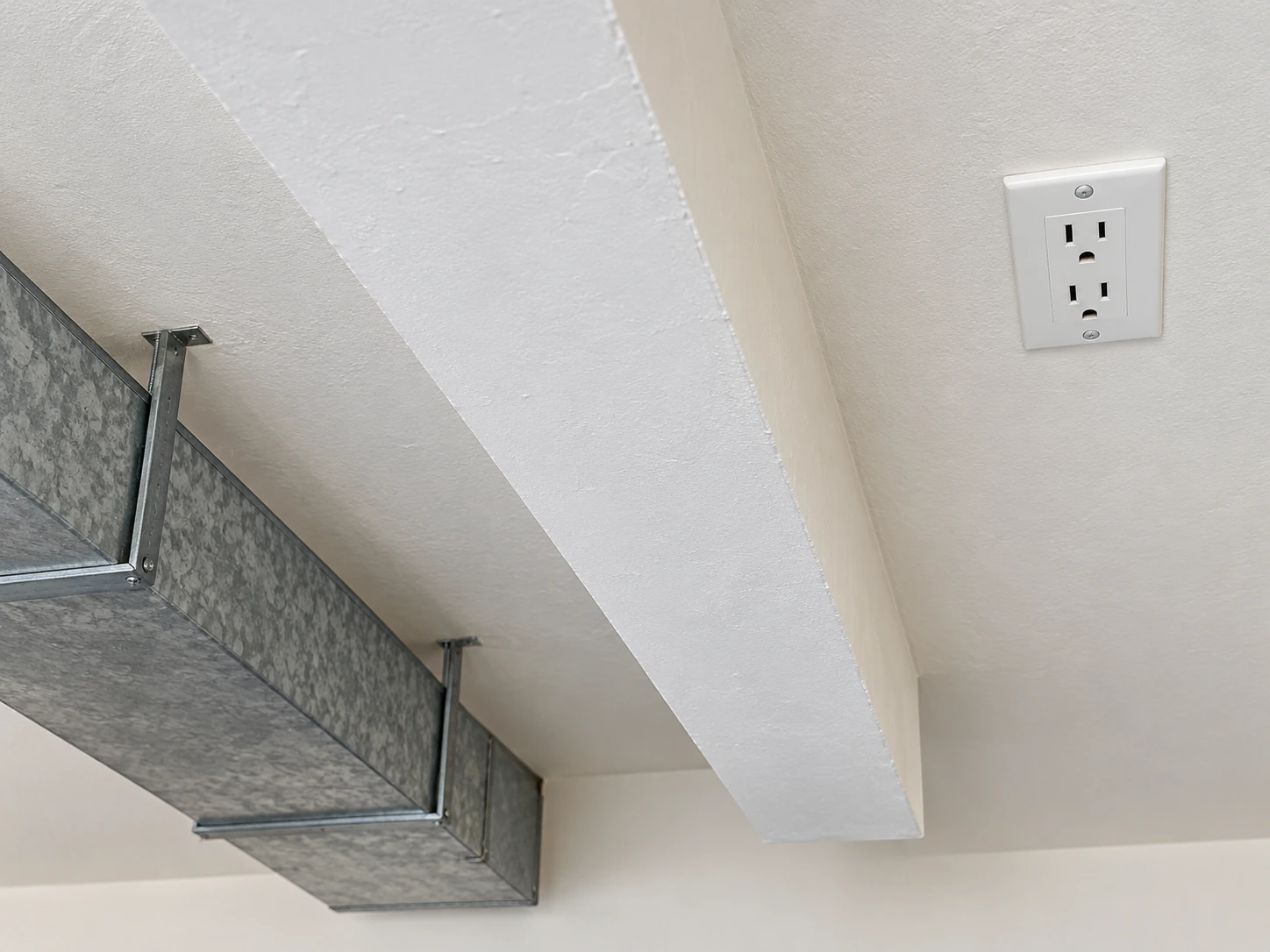
Record overhead beams, ducts and the location of the existing outlet from a safe observation point. A visible outlet does not establish a suitable circuit, working power, correct grounding or adequate installation clearance. Have the installer assess the site.
- Identify existing equipment. Record the current opener and door models from paperwork or safely readable labels. Expected outcome: a clear replacement starting point.
- Describe the door and space. Mention approximate door dimensions, material, low ceilings, storage racks, or obstructions. Do not climb to measure around a moving mechanism. Expected outcome: issues that need an on-site check are flagged early.
- Describe electrical readiness without touching wiring. Is there an existing outlet near the opener location? Is the installation new or a replacement? Expected outcome: the bidder knows whether electrical assessment may be required.
- List required controls. Include remotes, keypad, wall control, vehicle integration, and any desired connected features. Expected outcome: the quote includes your intended access methods.
- State backup and connectivity needs. Ask about suitable battery backup, offline operation, and any ongoing feature charges. Expected outcome: a complete ownership decision rather than a surprise after installation.
Do not remove the old opener, open an electrical housing, or alter mounting supports to prepare for the quote. If reaching a label is unsafe, an installer can identify it during the visit.
What belongs in the written price?
Scroll the diagram sideways when needed. Keyboard: focus the diagram, then use the left and right arrow keys.
Open full-size wide diagramOpen full-size mobile diagram
What the diagram shows
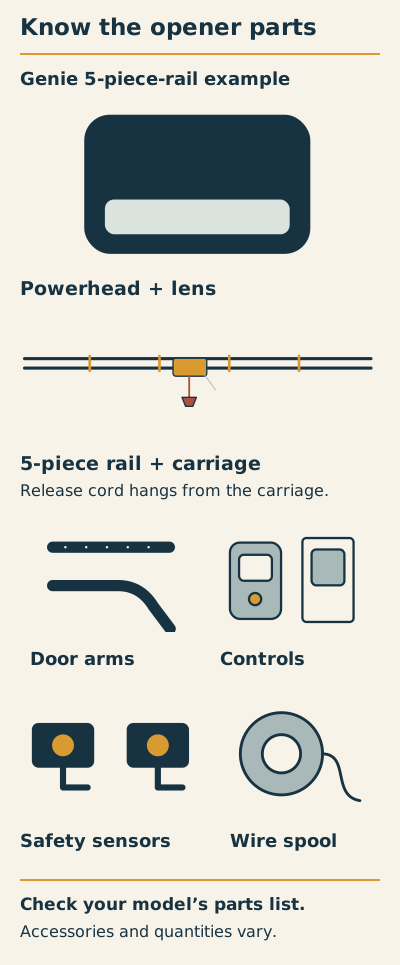
The Genie five-piece-rail example includes a powerhead and lens, a header rail section plus four rail sections, and a carriage with a release handle.
Other illustrated components are door arms, a remote, a wall console, a safety-sensor pair and a wire spool.
These are selected components, not an exact housing drawing or a complete packing checklist. Check the parts list for your model and SKU; accessories and quantities vary.
A boxed opener is not an installed system.
Work through three scopes before comparing an installed price.
Verify the equipment list
- Exact opener model
- Compatible rail or mounting system
- Listed controls and their quantities
- Listed safety devices
- Required door-height accessories
Use the actual package list—not a generic bundle picture.
Have the site surveyed
- Door condition and balance
- Door height and rail clearance
- Sound mounting structure
- Compatible door connection
- Suitable grounded outlet within cord reach
A new opener does not fix an unsafe door.
Write the installation scope
- Labor, mounting and setup
- Old-equipment removal
- Required safety testing
- Electrical or structural work
- Controls, handover and warranty terms
Separate included work from extras and exclusions.
A new outlet or structural alteration is not implied by an opener purchase. Electrical work belongs to an appropriately qualified electrical professional.
Sources: Genie: model selection, mounting area, door checks and grounded power · DASMA: operator inspection and electrical readiness.
No particular model or kit contents are assumed; verify the exact product and written installation offer.
Equipment: exact model, drive or mounting type, rail configuration, required door-height accessories, included safety devices, wall control, and remote quantity.
Installation: assembly, appropriate mounting, compatible connection to the door, setup, and the manufacturer-required checks. Ask who verifies that existing support and door reinforcement are suitable.
Removal: disconnection and disposal of the old opener and any replaced components. If parts are retained, ask exactly which and why they are compatible.
Electrical work: identify what is included and what must be performed separately by an appropriate electrical professional. An extension cord is not a planned substitute for a suitable receptacle. DASMA’s inspection checklist calls for an outlet within the operator cord’s reach and an electrician where a suitable outlet is absent.
Completion: programming of agreed controls, owner demonstration, manuals, warranty registration responsibilities, cleanup, and written results of required safety checks.
Compare options without buying features twice
Scroll within the image if needed, or open the full-size view. The key details are also written below.
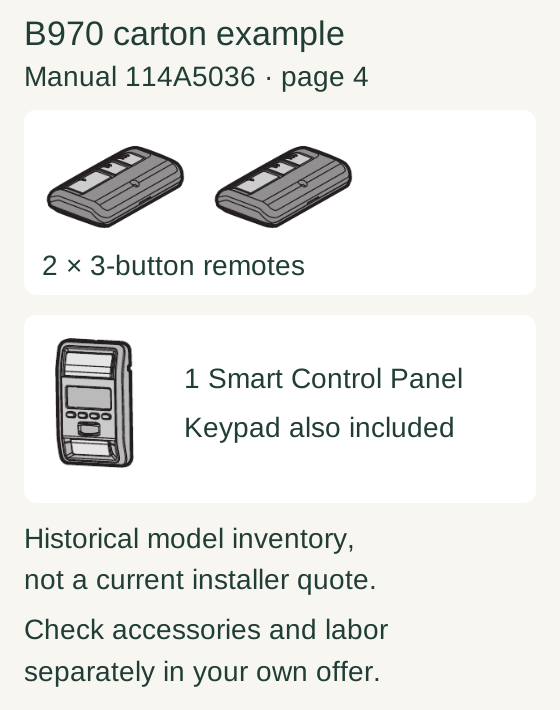
The historical Chamberlain B970 manual carton example lists two 3-button remotes, one Smart Control Panel and a keypad. The keypad is listed, not pictured.
This is not a current installer quote or the contents of every opener package. Compare included accessories and installation labor separately in your own offer.
A quiet-drive preference, battery backup, a camera, and connected access are separate decisions. Ask which features are included in the quoted model and which need an accessory or subscription. Confirm compatibility with existing vehicle buttons rather than assuming that a new opener will work with every built-in transmitter.
For a wall-mounted proposal, ask the installer to verify compatibility with the door and counterbalance arrangement. Freeing ceiling space can be attractive, but mounting location alone does not determine suitability. Do not compare that proposal with a rail-mounted unit as though installation scope were identical.
Electrical readiness is not a DIY wiring invitation. If the site needs a receptacle, grounding work, or circuit changes, have the appropriate professional assess it. This cost guide does not provide mains-wiring instructions.
Ask about changes and warranty before approving
A useful quote explains what happens if the existing support, door reinforcement, or wiring proves unsuitable. Require approval for additional work rather than accepting an undefined final charge. Also ask whether an assessment fee is payable if you decline the installation.
Read motor, belt, electronics, accessory, and labor coverage separately. “Lifetime motor warranty” does not necessarily mean every future failure is repaired at no charge. Keep the itemized invoice, product model, installation date, and warranty documents together.
FAQ
Is replacement cheaper than a first installation?
It may involve different work, but do not assume everything can be reused. Ask which existing components are compatible and serviceable.
Can I buy the opener first?
Only after the installer confirms suitability, included parts, and their policy for customer-supplied equipment. Otherwise the apparent saving may disappear in missing accessories or incompatible hardware.
What is the right stopping point before purchase?
Wait if door condition, model compatibility, electrical readiness, or mounting requirements are unresolved. A complete quote should make those responsibilities clear.
Should safety testing be an extra?
Ask for required setup and safety verification in the installation scope. An installed opener is not ready for normal use merely because the motor runs.
Explore guides · About this guide
Was this guide useful?
Your choice stays in this browser only. It is not sent to us.
Sources & manuals2
Manufacturer instructions and references for this guide. Match the document to your exact product.
- Genie: model selection, mounting area, door checks and grounded powerwww.geniecompany.com
- DASMA: operator inspection and electrical readinesswww.dasma.com