How Long Do Garage Door Springs Last? Understand Cycles and Condition
Quick answer
Garage door spring life is better discussed in operating cycles than in guaranteed years. The installed spring’s rating, daily use, environment, correct matching, installation, and maintenance all matter. Use a documented cycle rating for rough budgeting—not to predict a failure date or decide that a damaged spring is safe to keep using.
Condition overrides the calculation. A broken spring, sudden heaviness, loose cable, or abnormal door movement means stop use and arrange professional assessment, even if the spring is relatively new.
What is one spring cycle?
One full opening and closing = one cycle.
Count normal use. Do not add test cycles to measure it.
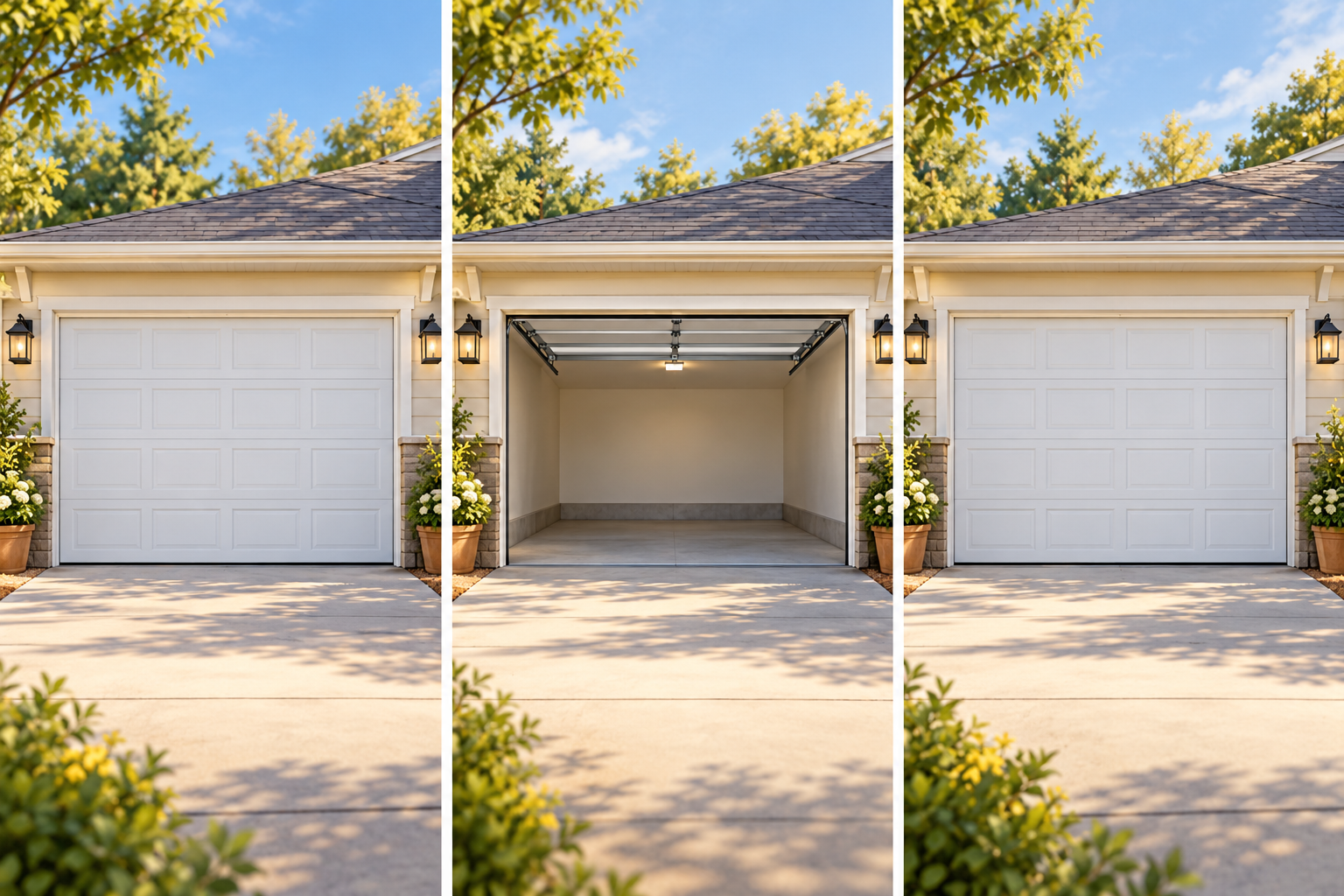
Hypothetical 10,000-cycle example
This does not identify the rating of your springs. Get the installed specification from your records or service provider.
At 2 complete cycles a day
10,000 ÷ 2 ÷ 365 ≈ 13.7
Usage-equivalent yearsAt 4 complete cycles a day
10,000 ÷ 4 ÷ 365 ≈ 6.8
Usage-equivalent yearsIt assumes steady use and ignores condition, installation, environment and unknown past cycles. A cycle rating is not the same as warranty coverage.
Damage, sudden heaviness, loose cable or uncontrolled movement overrides the calculation: stop use and arrange assessment.
DASMA TDS190: handling, application, installation and environmental effects on cycle life · Genie: no operation with broken spring. Do not operate a damaged door to count cycles.
One complete opening and closing is a cycle. Clopay describes 10,000 cycles as a usual spring rating in its homeowner guidance, but that does not identify the spring installed on your door. Ask for the actual specification from the installation invoice or service provider. Higher-cycle options must still be suitable for the door.
Count door cycles, not car trips or people. If the door opens for a departure, closes, later opens for a return, and closes again, that is two cycles. Extra openings for deliveries, children, pets, or workshop access add to use. You do not need to operate the door more often to measure this; a simple household log is enough.
A planning calculation, not a countdown
For a hypothetical spring rated at 10,000 cycles:
- At two complete cycles per day, 10,000 ÷ 2 ÷ 365 is about 13.7 years.
- At four complete cycles per day, 10,000 ÷ 4 ÷ 365 is about 6.8 years.
These are arithmetic examples, not expected-life promises. They assume steady usage and do not account for conditions that can change performance. They also do not tell you how many cycles a spring has already accumulated if its installation history is unknown.
A useful budgeting formula is:
Documented rated cycles ÷ estimated annual cycles = estimated usage-equivalent years.
Label the result that way in your notes. Avoid turning it into “replace in June” or “safe for another five years.” A visible inspection cannot reliably produce a precise remaining-cycle count either.
Why actual life can differ
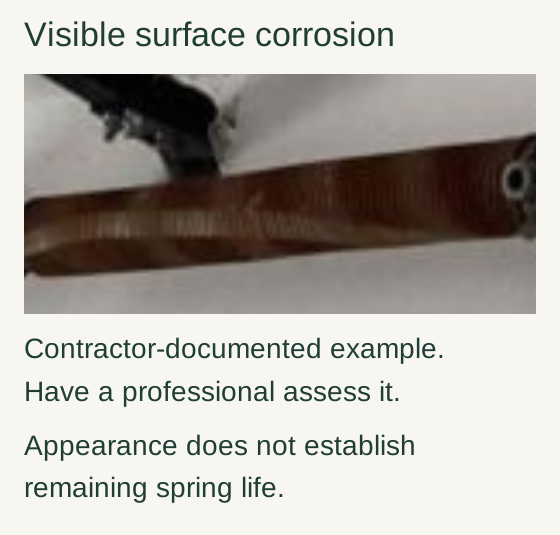
Scroll within the image if needed, or open the full-size view. The key details are also written below.
The detail shows visible surface corrosion in a contractor-documented spring photograph. Have a professional assess the condition without touching or adjusting the spring.
Appearance does not establish age, remaining cycles or service life. This example does not quantify corrosion severity or establish the cause of a spring failure.
DASMA identifies handling damage, corrosion, incorrect application, installation factors, environmental exposure, and maintenance as influences on spring cycle life. It also distinguishes spring life from the life of the complete door assembly. A new spring therefore does not reset the age of every other component.
For a homeowner, the practical response is to keep records, avoid unauthorized changes to the door, and follow the specific maintenance instructions. Do not alter spring tension, coat springs with an arbitrary product, or attempt to correct corrosion by grinding or sanding loaded hardware.
Tell a technician about added insulation, replacement sections, water exposure, or recurring binding. These are useful facts for assessment. Do not try to calculate a new spring size from the added material yourself.
Safe assessment steps
- Find the installation record. Look for the spring replacement date, quantity, manufacturer specification, and cycle rating. Expected outcome: known facts, with missing information marked unknown.
- Estimate normal use. Record complete opening-and-closing cycles during a representative period without adding test cycles. Expected outcome: a realistic planning estimate.
- Note environmental and door changes. Record moisture concerns and modifications, without touching the hardware. Expected outcome: context for the next service visit.
- Observe only from a safe location. Visible damage, a sudden gap, or unusual movement already noticed during use is a reason for service. Expected outcome: warning signs are acted on rather than rationalized by age.
- Discuss inspection and options. Ask a technician whether the current system is serviceable and what a compatible higher-cycle replacement would involve when replacement is needed. Expected outcome: a condition-based plan.
Write the rating on the invoice, not on memory. Ask the installer to document the chosen assembly and cycle specification alongside the warranty terms.
Higher-cycle springs and warranty language
A higher-cycle option may be worth considering for frequent use, but compare the installed scope, compatibility, and warranty. “Lifetime” is a warranty phrase whose meaning depends on the written terms; it is not proof of unlimited cycles or no future labor charges.
Ask whether the quote covers a matched pair where appropriate, whether related worn components need attention, and what maintenance is required. A higher rating does not excuse ignoring symptoms or skipping a technician’s diagnosis.
Do not replace an intact system solely because a generic online arithmetic example says its time is up. Equally, do not keep using a damaged system because it has not reached the rating printed on the invoice.
FAQ
Can you tell remaining life by looking at a spring?
A visual assessment can identify some problems, but it cannot provide a trustworthy exact failure date. Ask for condition findings, not a precise percentage of life remaining.
Does lubrication guarantee a longer life?
No. Follow the door manufacturer’s instructions and ask for help if safe access or the correct product is unclear. Maintenance does not repair broken metal.
Should both springs be replaced together?
Discuss the complete arrangement with the technician and compare the written repair scope. See the spring replacement cost guide for questions about quantity and compatibility.
What if the spring breaks before its rating?
Stop use, retain the invoice, and ask the installer to assess the failure and applicable warranty. Do not handle or remove the spring to document a claim.
Explore guides · About this guide
Was this guide useful?
Your choice stays in this browser only. It is not sent to us.
Sources & manuals2
Manufacturer instructions and references for this guide. Match the document to your exact product.
- DASMA TDS190: handling, application, installation and environmental effects on cycle lifewww.dasma.com
- Genie: no operation with broken springwww.geniecompany.com