How to Recognize an Unbalanced Garage Door
Quick answer
Balancing a garage door means correcting its counterbalance system so the door operates as its manufacturer intends. Spring adjustment belongs to a trained door-systems technician. Homeowners can record symptoms and identify visible warning signs, but should not release or manually test a suspect door, change spring tension, or increase opener force to compensate.
Do not use a stronger opener as the repair. A motor that can move a difficult door does not establish that the door is balanced or safe.
Balance and smooth travel are related, but different
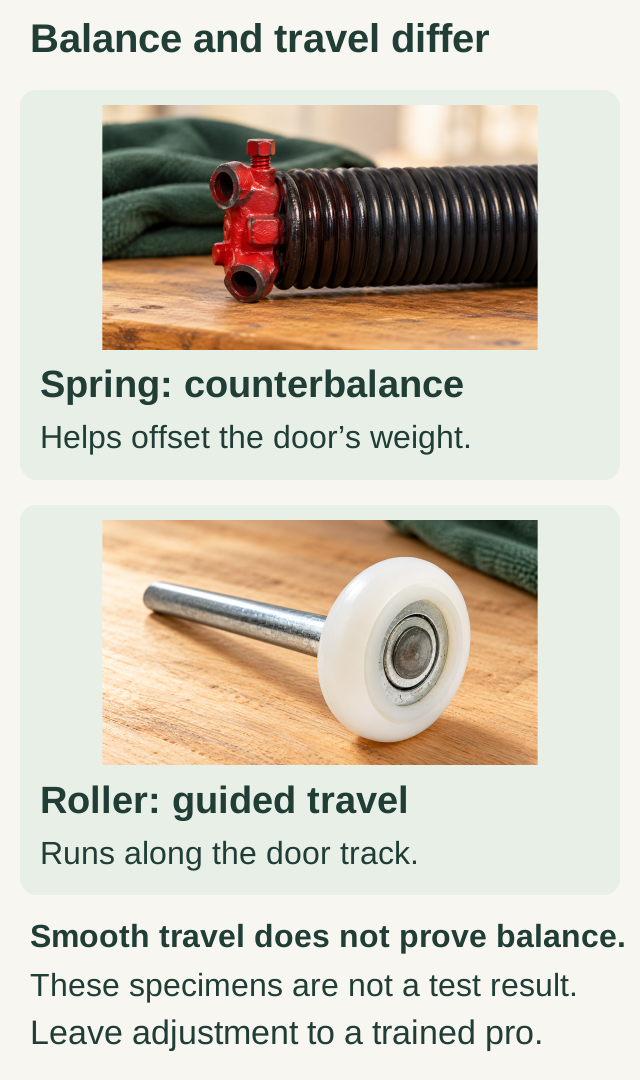
Scroll within the image if needed, or open the full-size view. The key details are also written below.
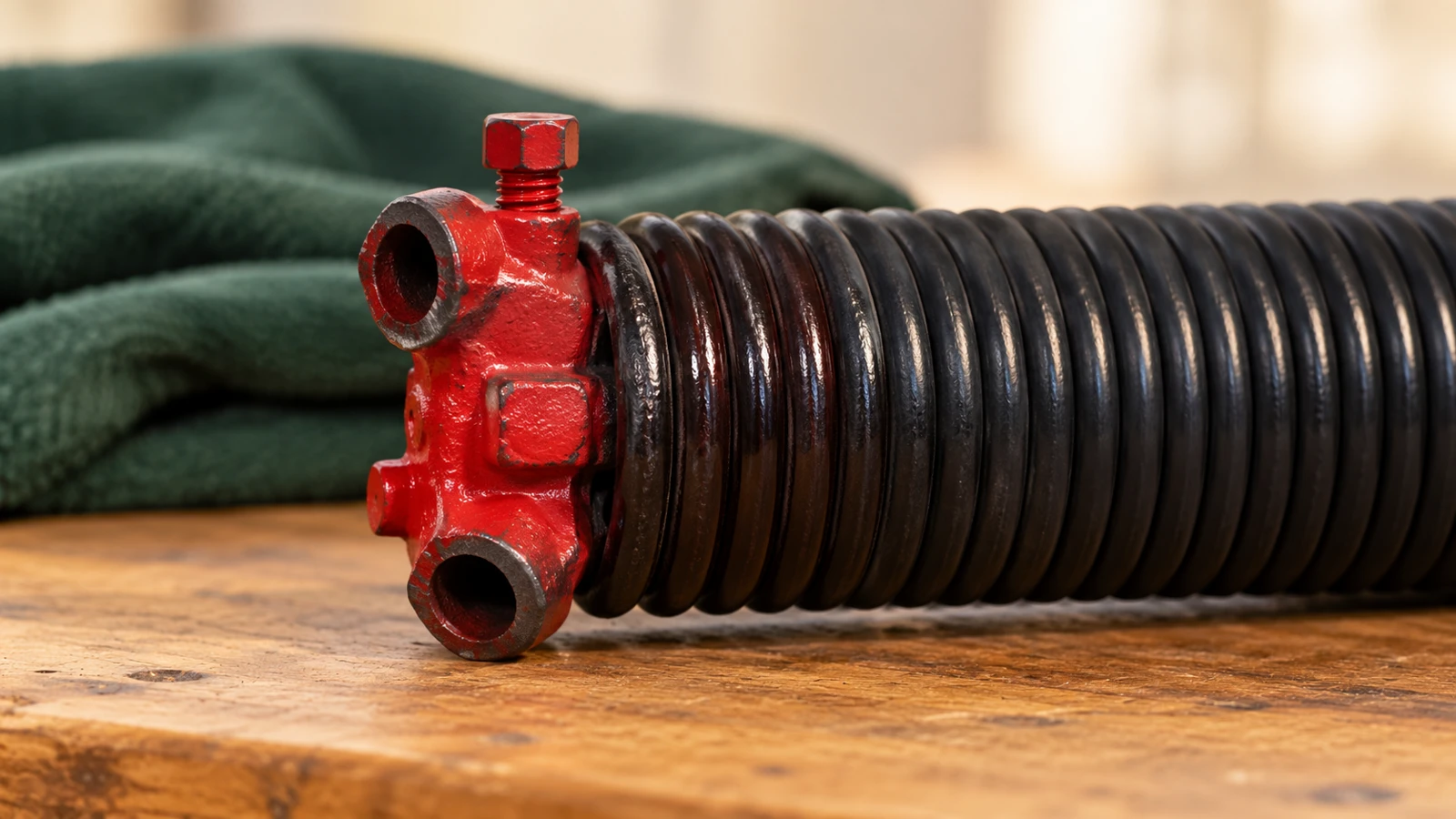
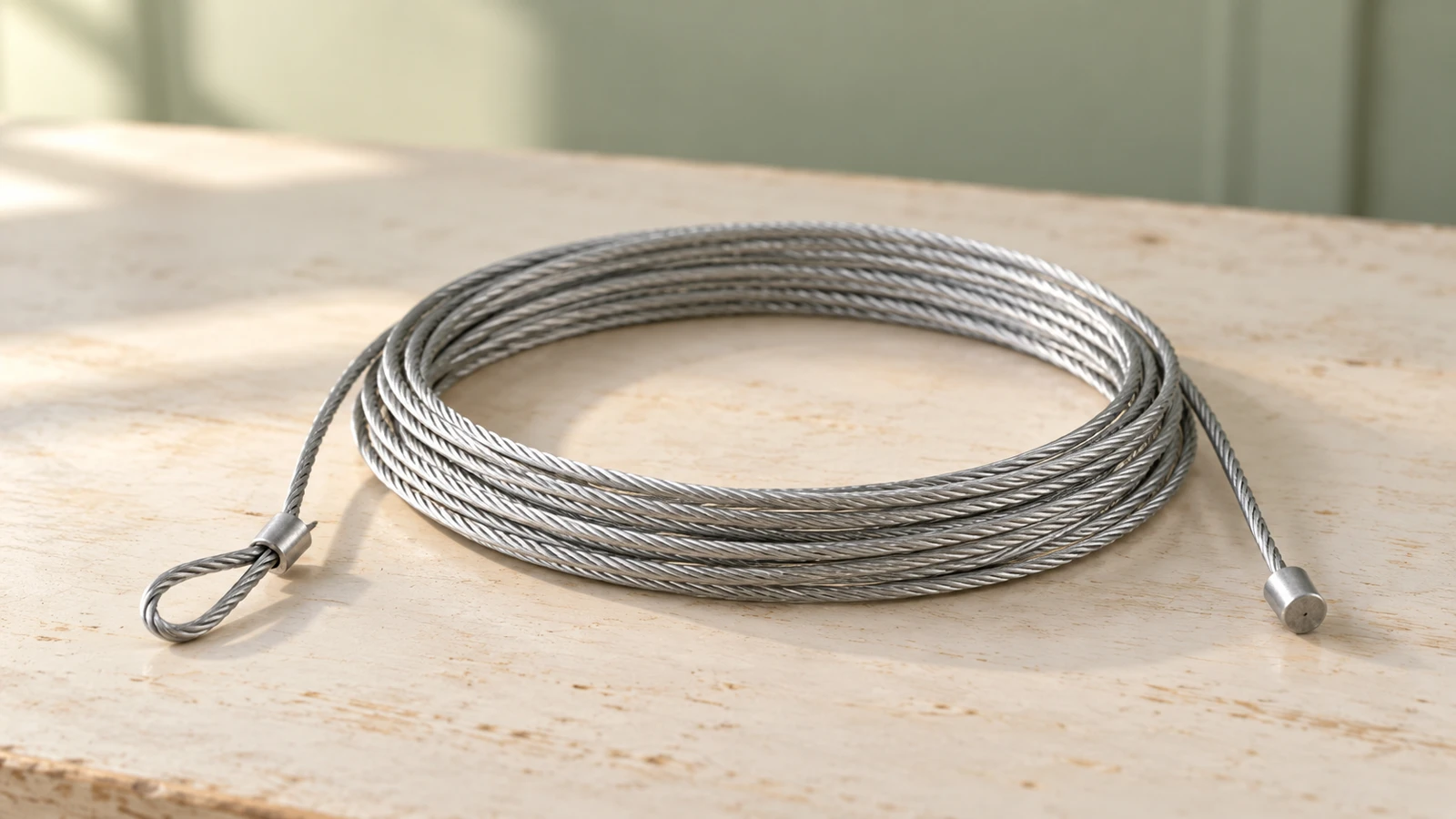
A spring helps counterbalance the door’s weight. A roller guides travel along the track. These are different roles: smooth travel alone does not establish correct balance.
The separate specimens are not a balance-test result or a fit guide. Leave adjustment to a trained professional; no test lift or disassembly is shown.
The counterbalance system offsets the door’s weight. Tracks, rollers, and other hardware guide its motion. A problem with either can affect how the door moves, and more than one fault may be present. “It feels heavy” is a useful symptom, not a complete diagnosis.
Manufacturer instructions may describe routine balance checks for an intact door. They do not make spring adjustment a homeowner task. Wayne Dalton directs spring adjustment to trained technicians and describes abnormal upward movement or difficulty lifting as reasons for service. This guide takes the conservative route when a problem is already suspected: leave the functional assessment to the technician.
An opener can conceal how the door feels during manual movement. Conversely, a remote or power problem can stop a perfectly serviceable door from responding. Diagnosis should separate the door’s mechanics from the opener rather than assuming either is responsible.
Gather useful evidence without making a new hazard
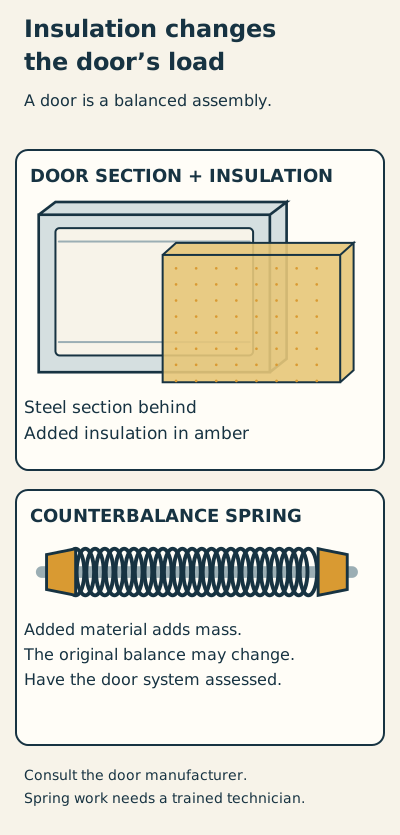
Scroll the diagram sideways when needed. Keyboard: focus the diagram, then use the left and right arrow keys.
Open full-size wide diagramOpen full-size mobile diagram
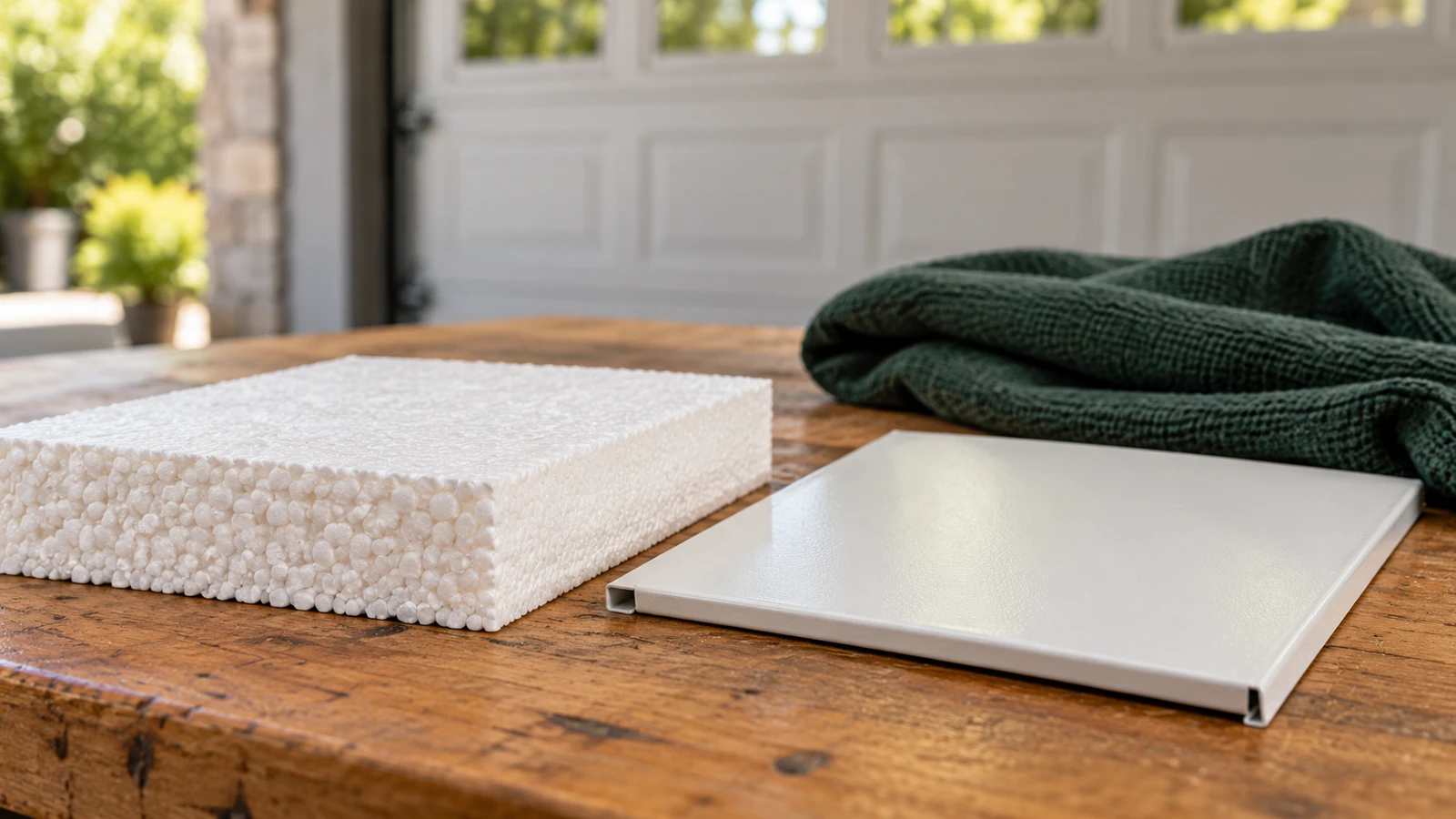
What the diagram shows
The section detail separates the steel door section from the added insulation. Added material adds mass and can change the original balance.
Consult the door manufacturer and have the door system assessed. Spring work requires a trained technician; this is not an adjustment procedure.
Heavy movement is a symptom—not a spring setting.
Give the technician a history, not an adjustment prescription.
Do not release or lift a suspect door to reproduce heaviness, drift or sudden movement.
| Known observation | Useful question for the technician | Do not conclude |
|---|---|---|
| “It felt unusually heavy during earlier manual use.” | Is this a counterbalance problem, binding, damage or a combination? | “It needs a stronger opener.” |
| “It drifted or moved unexpectedly.” | What caused the uncontrolled movement, and what must be repaired before use? | “I should release it again to test.” |
| “Insulation or a replacement section was added.” | Does the changed door still match its counterbalance and hardware specification? | “A fixed number of extra spring turns will solve it.” |
| “It is noisy or the opener hesitates.” | Is the source the door, the opener, mounting or another component? | “Noise alone proves imbalance.” |
Broken spring, damaged cable, crooked or uncontrolled movement, sudden heaviness or displaced hardware: stop use and arrange assessment.
What the handover should establish
A diagnosed cause; correctly matched door components; smooth, controlled operation; and the manufacturer’s required safety checks. Ask for the findings in writing.
Do not increase opener force, adjust springs or repeatedly cycle the door to compensate.
CPSC: professional service for unbalanced or binding doors · DASMA: balanced door, operator and protection work together · Genie: correct balance and professional spring work.
- Write down changes you already noticed. Examples include unusual heaviness during previous authorized manual use, drifting, jerking, or a sudden change after a repair. Do not reproduce the symptom to make the record more precise. Expected outcome: a timeline.
- Look for obvious damage from the floor. A visibly broken spring, loose cable, crooked door, or displaced hardware means stop use. Do not climb near the spring assembly. Expected outcome: a clear yes/no on visible warning signs, with uncertainty reported honestly.
- Review recent changes. Tell the technician about added insulation, decorative hardware, a replacement section, or other changes to the door. Expected outcome: relevant history rather than a guess about spring size.
- Separate known facts from assumptions. “The opener stopped halfway yesterday” is a fact. “The springs need two more turns” is an unsupported and unsafe conclusion. Expected outcome: a symptom-based service request.
- Arrange assessment before further testing. Ask for both door mechanics and opener operation to be evaluated. Expected outcome: a diagnosis that explains the symptom and the appropriate correction.
DASMA’s consumer checklist treats safe operation as dependent on the door, operator, and entrapment protection working together. It also requires stopping an inspection when a problem appears. That supports a system-level assessment instead of a quick adjustment chosen from one symptom.
What the technician should explain
Ask whether the problem is counterbalance, binding, damage, an incorrect component, an opener fault, or a combination. You do not need to direct the repair. You do need an explanation connecting the proposed work to the observed condition.
A useful assessment establishes whether the spring arrangement matches the door, whether supporting and moving components are sound, and whether operation meets the relevant manufacturer’s criteria. If a recent modification changed the door, ask whether that affects the original configuration.
After authorized repair, request a demonstration from a safe viewing position and a record of the operational and safety checks. The handover should clarify any remaining limitations, recommended maintenance, and whether the opener settings or connection were affected by the work. The technician should handle any adjustments required.
Keep a change log. “New insulation installed in March; dragging noticed in April” gives better context than “the door has always been bad.” Include dates only if you know them.
Common mistakes that confuse the diagnosis
- Assuming a noisy door must be out of balance.
- Disconnecting a partly open door to see whether it falls.
- Holding a door at a test height while another person inspects springs.
- Adjusting the opener because the door seems difficult to move.
- Treating lubricant as a cure for a broken or mismatched component.
- Accepting a repair description that says only “adjusted” with no explanation.
FAQ
Can I do a routine balance test if my door seems normal?
Use the exact door and opener manuals only after confirming their prerequisites and your ability to perform the check safely. This article addresses suspected imbalance and does not provide a universal release-and-lift procedure. If uncertain, ask a technician to demonstrate the approved maintenance check.
Does the door need stronger springs?
Not necessarily. More spring force is not automatically better. The correct system must match the door and its intended operation; a technician should determine the specification.
When should I stop using it completely?
Stop at a broken spring, cable damage, crooked movement, uncontrolled movement, sudden heaviness, or visibly displaced hardware. Do not keep cycling the door while waiting for an appointment.
Can the opener be damaged even if it still runs?
Possibly, but that requires assessment. Ask the technician to distinguish any opener damage from the original door problem rather than replacing equipment without a diagnosis.
Explore guides · About this guide
Was this guide useful?
Your choice stays in this browser only. It is not sent to us.
Sources & manuals3
Manufacturer instructions and references for this guide. Match the document to your exact product.
- CPSC: professional service for unbalanced or binding doorswww.cpsc.gov
- DASMA: balanced door, operator and protection work togetherwww.dasma.com
- Genie: correct balance and professional spring workwww.geniecompany.com