Garage Door Off Track? What to Do Before Professional Repair
Quick answer
Stop using an off-track garage door. Do not lift, push, straighten, or try to put a roller back into the track. Keep people away and arrange professional stabilization and inspection. If the door is partly open, do not release the opener or pass underneath it. A visibly displaced roller or tilted door is enough reason to stop; you do not need to perform a test.
Do not “help” the opener. Running the motor while someone pushes the panel can expose both people to sudden movement and worsen the damage.
What off track can look like
You may see a roller outside the metal track, a door hanging unevenly, a bent track, or a panel that no longer follows the opening. You may instead notice that something is visibly out of position without being able to identify the part. Treat that uncertainty as a reason for a professional assessment.
DASMA’s damage-inspection guidance says that a problem found during visual inspection is a reason to stop rather than progress to operational testing. Deformed panels, tracks, or hardware can make the door’s operation questionable. That is the relevant principle here: a visibly damaged door does not need another opening cycle to prove the problem.
Noise alone does not establish that a door is off track. But if scraping is accompanied by visible displacement, leaning, or damaged support, stop use rather than treating it as a lubrication issue.
Immediate safe assessment
Off track? Change the plan—not the door.
Visible displacement is enough to stop. Do not run another cycle to prove the fault.
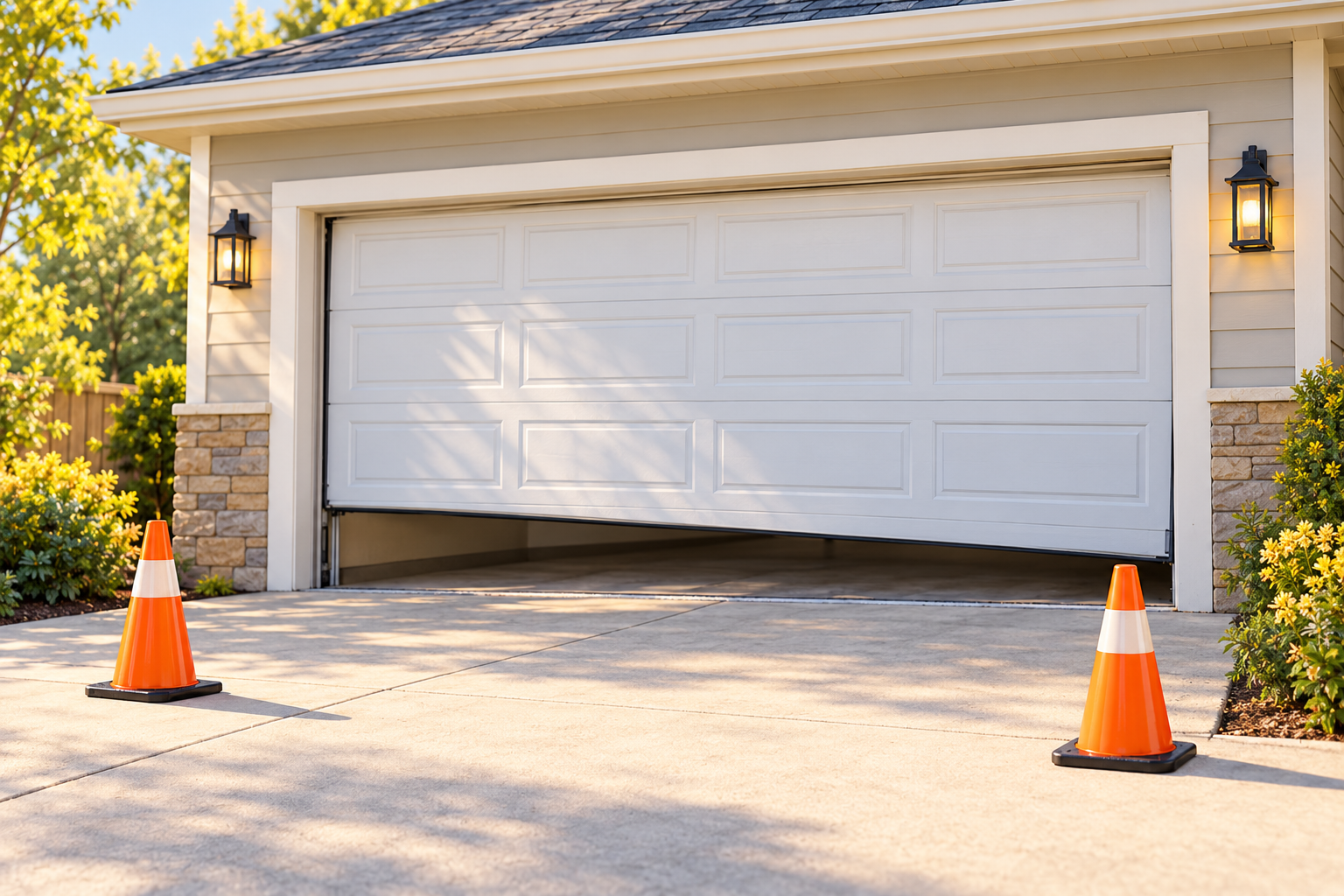
No opener commands. No emergency release on the unstable door. No passing underneath.
1 · Keep routes away from the hazard
Use another entrance and tell other users the door is unavailable. Do not approach the wall control if that requires passing beneath the door.
2 · Report the condition as it stands
From an existing safe location, report “partly open,” “tilted,” “roller visibly displaced” or “not safely visible.” Mention known impact or recent work; do not move it for photographs.
3 · Ask for professional stabilization and diagnosis
The service company needs to know this is an unstable door, not simply a remote fault. Ask for track, roller, attachment, panel and counterbalance assessment before normal operation resumes.
No pry bar, hammer, loosened bracket, roller insertion, ladder, timber support, jack or group lift. If someone is trapped or injured, contact local emergency services rather than moving the door yourself.
DASMA TDS174: visible damage stops operational inspection; trained repair · Genie: do not operate jammed doors.
First, stop commands to the door. Put remotes away and tell all users that the door is unavailable. Avoid app commands or automated routines. Use the manufacturer’s safe shutdown method only if doing so does not require approaching or passing beneath the damaged door.
Second, define a keep-clear area. Keep people, pets, and visitors away from the opening and any area beneath the raised door. Do not park or stand where the door or loose components could fall. A note at an alternate entrance can help prevent someone approaching from the other side.
Third, observe from a safe location. Record whether the door is open, the bottom edge is tilted, a roller is visibly displaced, or a cable is hanging. Do not touch hardware to determine what is loose. The expected result is a safe handoff description, not a complete mechanical diagnosis.
Fourth, report what happened before the fault. Mention a vehicle impact, object caught in the opening, recent work, or a sudden sound. Do not attempt to recreate the movement on video. Existing security-camera footage may be useful without requiring another cycle.
Finally, arrange service for the actual condition. Say “partly open and tilted” rather than simply “not working.” Ask whether the technician can stabilize an off-track door. If someone is trapped or injured, contact local emergency services rather than attempting a rescue by moving the door yourself.
What not to attempt
Do not hammer the track straight, pry its edge open, loosen track supports, remove hinges, or insert a roller. Do not use a jack, ladder, timber prop, or vehicle to support the door. Do not cut a cable that appears to be tangled. These actions can change how the door’s weight and spring force are being held.
Wayne Dalton’s operation and maintenance instructions specifically warn against loosening bottom corner brackets and counterbalance hardware. A displaced door makes those boundaries more important, not less.
Protect access without approaching the hazard. Arrange deliveries at another entrance and move people’s routes, rather than trying to move the door for convenience.
What professional repair should establish
A satisfactory repair needs more than a roller back inside the track. Ask how the technician will determine the initiating problem and inspect related components. Depending on the damage, that assessment may include track condition and mounting, roller and hinge integrity, panel damage, cable condition, and the counterbalance system.
Before approving work, ask which parts are repairable, which require replacement, and why. If there was an impact, ask whether hidden attachment or section damage changes the recommendation. Keep photographs and the written diagnosis for your records; insurance questions can then be addressed with actual evidence rather than a guess.
The expected end state is a sound, correctly supported door that travels normally, followed by manufacturer-specified operator safety checks. Ask for the technician’s explanation before regular use resumes. Do not judge completion solely by a straight-looking bottom edge.
FAQ
Only one roller is out. Can I pop it back?
No. A single displaced roller is still a sign that the support and movement of the door need assessment. Do not manipulate the track or bracket.
Should I close the door for security?
Not by moving an unstable system. Secure other accessible entrances and ask the technician about safe stabilization. Property security does not justify standing beneath a compromised door.
Does off-track damage always mean a new door?
No. The decision depends on the actual components and damage. Request an itemized repair option and an explanation if replacement is proposed.
Explore guides · About this guide
Was this guide useful?
Your choice stays in this browser only. It is not sent to us.
Sources & manuals2
Manufacturer instructions and references for this guide. Match the document to your exact product.
- DASMA TDS174: visible damage stops operational inspection; trained repairwww.dasma.com
- Genie: do not operate jammed doorswww.geniecompany.com