How Garage Door Springs Are Replaced: A Homeowner’s Safe Planning Guide
Quick answer
A garage door spring should be replaced by a trained door-systems technician. The useful homeowner steps are to stop using a suspect door, keep the opening clear, document symptoms from a safe location, and obtain a repair scope that includes system assessment and operational testing. This guide explains the job without instructions for releasing or applying spring tension.
Stored energy is the hazard. Do not loosen spring anchors, drums, bottom brackets, or connected hardware. Do not assume a broken spring means the whole system is free of tension.
Why spring replacement is not a simple parts swap
The springs are part of the door’s counterbalance system. Replacing one requires more than finding something with a similar length or color. Door configuration, weight, hardware, and the manufacturer’s requirements all matter. An opener is not a substitute for a correctly functioning door.
Genie warns against homeowner removal, adjustment, or repair of high-tension springs and the hardware attached to them, and notes that a door upgrade needs a properly matched spring. Those limits also apply when a replacement part is sold online with a reassuring description.
Your role is to help the technician understand the failure and agree on the finished result—not to measure or dismantle a loaded assembly.
What you can assess safely
Scroll the diagram sideways when needed. Keyboard: focus the diagram, then use the left and right arrow keys.
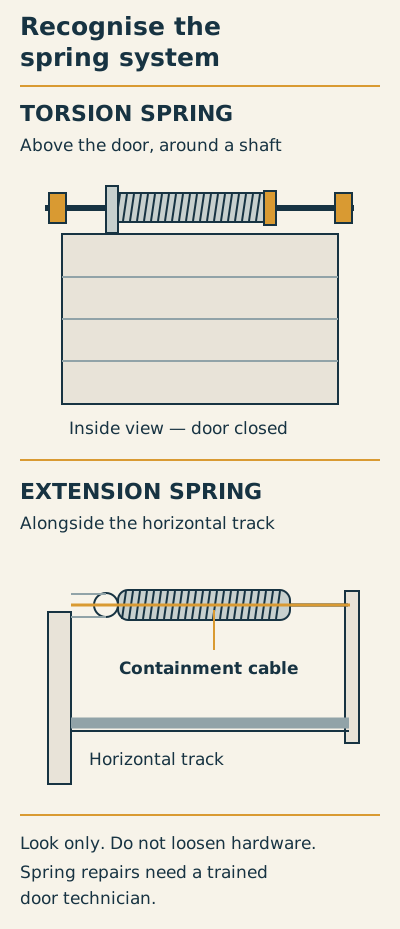
Open full-size wide diagramOpen full-size mobile diagram
What the diagram shows
A torsion spring coils around a shaft above the door. An extension spring runs alongside the horizontal track; the diagram also identifies its containment cable.
Identify by location and shape without touching the system. Do not loosen brackets, cables or spring hardware. Spring inspection and repair belong to a trained door technician.
Report what happened. Leave the spring alone.
A useful service request does not require a test lift or a close-up at any cost.
Keep people away from the opening and raised-door area. Use another entrance. Do not pull the release on an open or unstable door.
Example observations to report
- Position
- “The door is fully closed.”
- Event
- “I heard a loud bang this morning.”
- Since then
- “We have not operated the door.”
- Identification
- “The model is on our installation invoice.”
- Uncertainty
- “I cannot safely see the spring; the cause is unconfirmed.”
Do not gather evidence this way
- No lifting to “see how heavy it is.”
- No wire, coil or spring-length measurement on loaded hardware.
- No removing covers, anchors, drums, cables or bottom brackets.
- No climbing beside damaged hardware for photographs.
- No repeated opener commands to recreate the fault.
Ask the service company to address…
1 · Current condition
Tell them if the door is open, tilted or blocking a vehicle. Ask whether stabilization is needed.
2 · Repair scope
Request the diagnosed cause, correctly matched assembly and itemized related damage—not a guessed part.
3 · Return to service
Ask for balance, operation and required safety checks after repair, plus written findings and warranty terms.
Genie: broken-spring operation and high-tension hardware warnings · DASMA: stop inspection at faults; professional repairs.
The report is a communication example, not a real customer record or a confirmed spring diagnosis.
Record the door’s current position. Is it fully closed, partly open, or visibly tilted? Report that before the appointment. An open or displaced door changes the access and stabilization problem. Do not move it to produce a more convenient photograph.
Describe the event. A loud bang, sudden failure to open, or unusual movement may be relevant. Avoid declaring a spring broken solely from the sound. Write what happened, when it happened, and whether the door has been operated since.
Look from a safe distance. A visible separation in an exposed spring or hanging cable is useful information, but you do not need to prove the diagnosis. Some spring systems are enclosed. Do not remove covers or climb beside hardware to find an answer.
Collect existing paperwork. A door model, installation invoice, earlier repair record, and any listed cycle rating can help. Use a label only if it is safely readable without reaching into the mechanism. The expected outcome is an accurate description, not a homeowner spring specification.
Keep the situation stable until service
Stop remote, keypad, and app use. Tell everyone who has access that the door is out of service. Follow a safe manufacturer-approved method of preventing accidental powered movement if it can be done without approaching damaged hardware. Do not open an electrical cover or touch wiring.
Keep children, pets, and visitors out of the area. Use another entrance. If a car is trapped, arrange alternate transportation rather than trying a group lift. If the door is open, do not release the opener, stand underneath, or improvise a support. Ask for a technician equipped to stabilize that condition.
Send context, not close-ups at any cost. An existing photo of the whole door can be more useful than a risky close-up of a spring. Tell the service company if safe photography is impossible.
What a thorough replacement visit should address
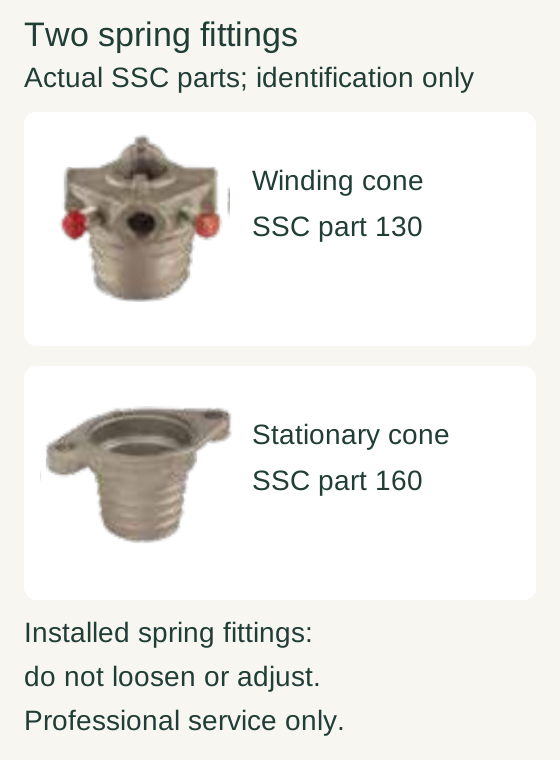
Scroll within the image if needed, or open the full-size view. The key details are also written below.
The loose SSC specimens identify part 130, a winding cone, and part 160, a stationary cone. They are different spring fittings, not a replacement specification or compatibility guide.
Do not loosen or adjust installed spring fittings. Professional service only; no tool selection, insertion, assembly or removal procedure is shown.
Ask the technician to explain the diagnosed failure and identify the replacement specification on the work order. Discuss whether the rest of the system shows damage or wear that affects safe operation. Cables, rollers, tracks, attachment points, and the opener connection should not be ignored simply because one spring is visibly broken.
Where the door has two springs, discuss replacing the pair. DASMA recommends replacing both when one fails on a two-spring door. Ask how that recommendation applies to the installed system rather than assuming that a single advertised part covers the complete repair.
The handover should explain what was replaced, what remains serviceable, and what was tested. Ask for the door’s balance and travel to be checked by the technician and the opener’s safety functions to be verified using its instructions after the mechanical repair.
Questions that improve a quote
- Is this for one spring, a matched pair, or a manufacturer-specific assembly?
- What identifies the correct replacement for this door?
- Are diagnosis, labor, service call, and disposal included?
- Is any additional work required, and what observation supports it?
- What cycle rating is being offered, and is it written down?
- Which warranty covers parts, which covers labor, and what exclusions apply?
- Will the final invoice record safety and operation checks?
Compare the same scope across quotes. A lower total for a different spring specification or parts-only coverage is not an equivalent offer. Avoid choosing a higher-cycle option until compatibility and the installed price are clear.
FAQ
Can I replace only the broken piece?
Do not attempt a spring repair or splice. Ask about the correct replacement assembly and whether associated components need attention.
Should I replace the opener too?
Not automatically. Ask whether it was damaged or is otherwise unsuitable. A spring failure and an opener replacement are separate diagnoses.
Can I keep using the door until the appointment?
No, not with a suspected broken spring or unsafe movement. The safe stopping point is to leave it out of service and arrange access around the repair.
Explore guides · About this guide
Was this guide useful?
Your choice stays in this browser only. It is not sent to us.
Sources & manuals3
Manufacturer instructions and references for this guide. Match the document to your exact product.