How to Handle a Damaged Garage Door Cable Safely
Quick answer
Do not rethread, tighten, cut, or reconnect a damaged garage door cable yourself. A loose, frayed, or displaced cable calls for stopping door use and arranging a trained technician’s inspection. Keep people away from the door, especially if it is tilted or partly open. The cable problem may be a symptom of another failure, so repair should include finding the cause.
A loose cable is not proof of zero tension. Do not touch the cable, its drum, pulley, or bottom attachment. Do not pull the emergency release on an open or unstable door.
Which cable are you looking at?
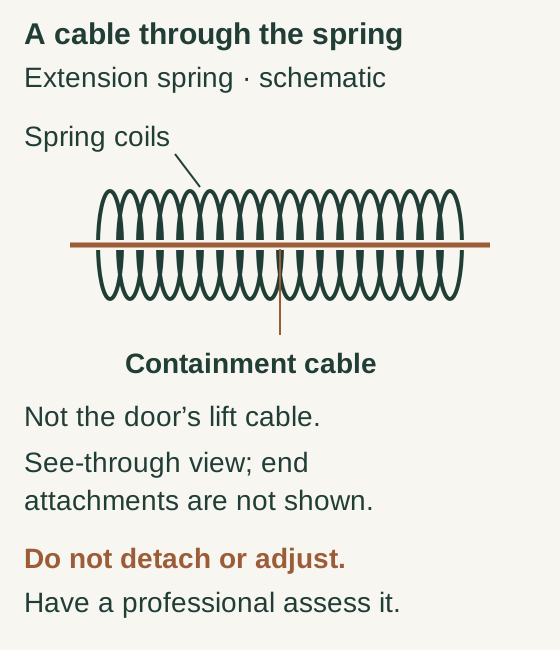
Scroll within the image if needed, or open the full-size view. The key details are also written below.
This see-through extension-spring schematic identifies a containment cable running through the spring, distinct from the door’s lift cable. End attachments are not shown.
Do not detach or adjust it; have a professional assess the system. This identification view does not provide installation routing, tie-offs or dimensions, and does not apply to every spring type.
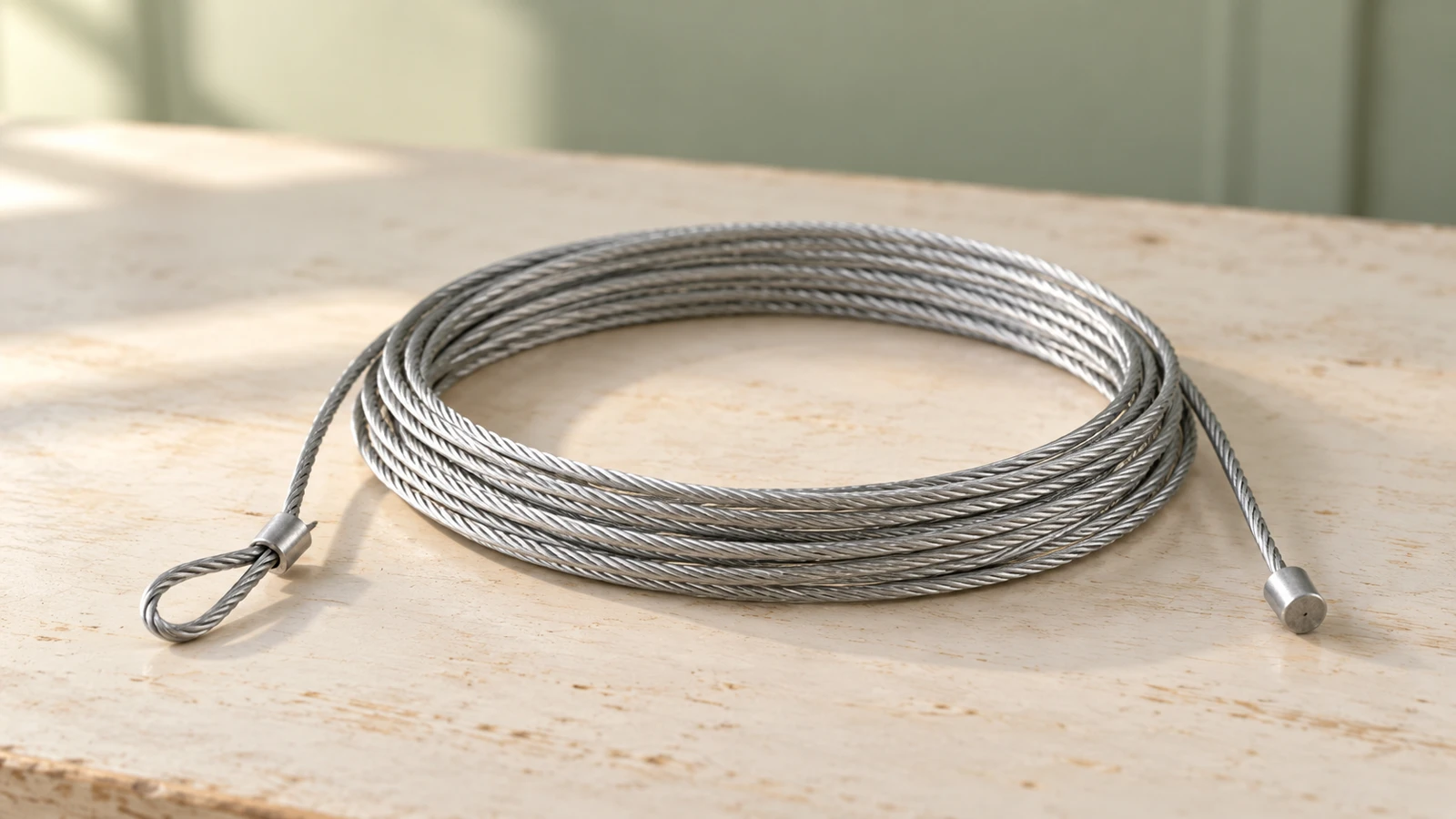
Homeowners may use “garage door cable” for several different parts. Lift cables are part of the mechanism that transfers counterbalance support to the door. Some extension-spring systems also have containment cables intended to restrain broken spring components. The opener’s release cord is another part entirely.
DASMA distinguishes the cable associated with the spring system from extension-spring containment protection. If you cannot confidently identify what you see from a safe place, report its location rather than naming it. “A metal cable is hanging near the lower left corner” is more useful than an uncertain diagnosis.
A picture in an online listing cannot establish which replacement belongs on your door. Length, end fittings, system layout, and the manufacturer’s specification need professional verification. Do not detach a cable to take it to a store.
Safe assessment steps and expected outcomes
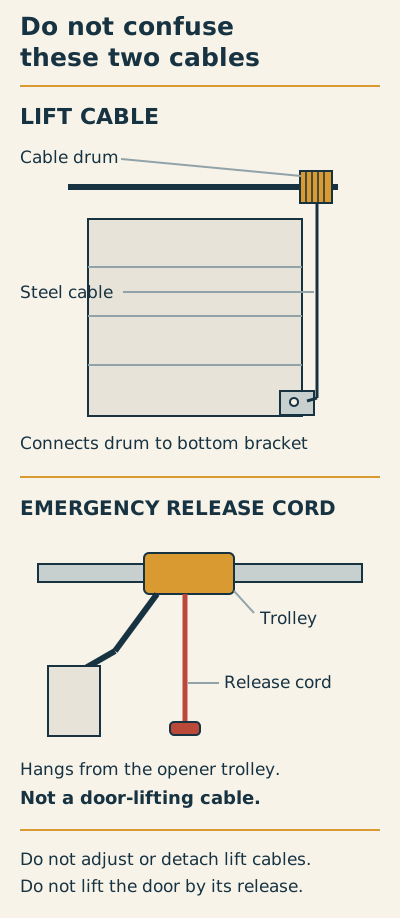
Scroll the diagram sideways when needed. Keyboard: focus the diagram, then use the left and right arrow keys.
Open full-size wide diagramOpen full-size mobile diagram
What the diagram shows
The steel lift cable connects the cable drum to the door’s bottom bracket in the shown torsion system.
The emergency-release cord hangs from the opener trolley. It is not a door-lifting cable or a handle for moving the door.
Do not pull, detach or adjust lift cables. Do not lift the door by its release cord.
Describe the cable. Do not touch it.
Fraying, slack or displacement is a reason to stop use—not to reseat a cable.
Stay in your existing safe position. Do not pass beneath a raised door, approach damaged hardware or move the door for a better view.
Turn an observation into a clear service request
- Viewpoint
- Say “viewed from inside” or “viewed from outside.” Do not change sides if access is unsafe.
- Location
- Describe the visible side and height: for example, “a metal cable hangs near the lower left corner.”
- Appearance
- Report only what you can already see: loose loop, broken strands, detached end—or “not safely visible.”
- Door state
- Closed, partly open, tilted or unknown. Do not move it to check.
- History
- Report a remembered impact, loud bang or recent work. Do not recreate the event.
The word “cable” is not enough to identify a part
Lift cable
Part of the door’s counterbalance system, connected with the bottom attachment.
Containment cable
On an extension-spring system, runs through the spring to help contain broken spring parts.
Release cord
Operates the opener’s manual release; it is not a replacement for either steel cable.
No pulling, probing, lubrication as a “repair,” drum winding or bottom-bracket removal. Ask a technician to establish the failed part and the cause.
DASMA: lift/containment cables and high-tension hardware · Genie: attached hardware and no-operation limits. Identification is by function here; no generic routing or replacement geometry is prescribed.
- Stop operation. Do not press the opener again to see whether the cable reseats itself. Tell other users not to operate it. Expected outcome: no additional movement while the condition is unknown.
- Stay outside the travel area. If the door is hanging open, do not walk underneath for a photograph or to reach a wall control. Use another entrance. Expected outcome: people are separated from the unstable system.
- Record only what is visible. Useful details include fraying, a loop of slack cable, a cable no longer following its normal path, and a door sitting unevenly. No pulling, probing, or close inspection is needed. Expected outcome: a concise symptom description.
- Note the sequence. Did the problem follow a collision, a loud bang, freezing weather, or a previous repair? Did it appear on opening or closing? Use what you remember; do not recreate the event. Expected outcome: information that helps investigate cause.
- Arrange a suitable visit. Tell the company whether the door is open, crooked, or blocking a vehicle. Expected outcome: the technician arrives aware that stabilization may be required before repair.
Why putting the cable back is not enough
A cable can be damaged in its own right, but a cable out of place may also accompany problems elsewhere in the assembly. The repair needs to answer two questions: what failed, and why did it fail? A door that looks straight after someone manipulates the cable has not necessarily been made safe.
Clopay identifies frayed cables as a breakage risk and directs their replacement to a professional. It also distinguishes track and hinge concerns that may require service. These are reasons to assess the system rather than treating a hanging cable as an isolated cosmetic defect.
Do not use the opener to straighten the door. Do not grip the cable with pliers, wind it around a drum, or remove a bottom bracket. Lubrication cannot restore broken strands. A cable that looks less alarming after being moved is not evidence of a successful repair.
Describe left and right clearly. Say whether you are viewing the door from inside or outside. That avoids confusion when the service provider asks which side is affected.
What to ask the technician
Ask for the condition of both sides to be assessed and for any proposed additional parts to be explained. A useful work order identifies the cable assembly, the reason for replacement, associated damage, and the tests required before returning the door to service.
Questions worth asking include:
- Was the cable worn, broken, displaced, or affected by another fault?
- What evidence points to the underlying cause?
- Are matching parts required on both sides of this system?
- Do the springs, drums or pulleys, tracks, and attachments need attention?
- Does the price include stabilization, labor, testing, and disposal?
- What should I watch for after the repair, without touching the hardware?
Request a written distinction between required repairs and optional maintenance. This helps you compare proposals without approving a vague “full overhaul.”
FAQ
Can I open the door once to get the car out?
Not with a damaged or displaced cable. Arrange another way to travel and tell the technician about the trapped vehicle.
Is a containment cable the same as a lift cable?
No. Their functions differ. Do not substitute one for the other or assume that the presence of one makes damage to the other harmless.
The door is closed. Is it safe to ignore the cable?
A closed door removes neither the defect nor stored-energy hazards. Leave it closed and out of service until assessed. If the condition changes or parts move unexpectedly, retreat and keep others away.
Explore guides · About this guide
Was this guide useful?
Your choice stays in this browser only. It is not sent to us.
Sources & manuals2
Manufacturer instructions and references for this guide. Match the document to your exact product.
- DASMA: lift/containment cables and high-tension hardwarewww.dasma.com
- Genie: attached hardware and no-operation limitswww.geniecompany.com