Can You Open a Garage Door With a Broken Spring?
Quick answer
Do not open a garage door with a broken spring, either with the opener or by hand. Do not recruit helpers, use a jack, or pull the release on an open door. Keep the system out of service and arrange a trained technician’s repair. If a vehicle is trapped, choose alternate transportation rather than attempting one risky opening.
Genie explicitly warns against both manual and powered operation when a door spring is broken. That instruction is more useful than an estimate of how many people might lift the door.
“Just once” is still an unsafe operation. The urgency of getting the car out does not restore the missing counterbalance support.
First decide whether this is an emergency
Broken spring? Choose another way in—or out.
Do not lift the door manually or use the opener to overcome a broken spring.
Choose the response that matches the situation
A person is trapped, injured or in immediate danger
Contact local emergency services. Do not attempt a rescue by moving or releasing the door yourself.
Only the vehicle is trapped; no immediate danger
Arrange alternate transportation. Tell the service company the vehicle is inside. A trapped car is not a reason for a group lift or extra opener force.
The door is open, tilted or unstable
Keep everyone away from the opening and beneath-door area. Do not pull the emergency release or improvise a prop. Request professional stabilization.
The door is fully closed
Leave it closed and out of service. Tell other users not to operate remotes, wall controls or apps while repair is arranged.
Report the symptoms without testing a lift. A loud bang alone is not a diagnosis; visible damage or abnormal movement still requires assessment.
Genie: no manual or powered operation with a broken spring · DASMA: broken spring and professional repair warnings.
If someone is injured, trapped, or in immediate danger, contact local emergency services. Do not attempt a rescue by manipulating the door, spring, cable, or opener. Move everyone else away and tell responders that the garage door system may be unstable.
If the issue is a missed appointment, an unavailable car, or an exposed garage, it is an urgent inconvenience rather than permission to move the door. Separate the access problem from the mechanical problem. Solving access another way creates time for a controlled repair.
If you are outside and cannot access the garage, do not force a panel or attempt to defeat a lock. Tell the service provider that there is no alternative entrance so they can discuss an authorized access plan.
Safe assessment without a test lift
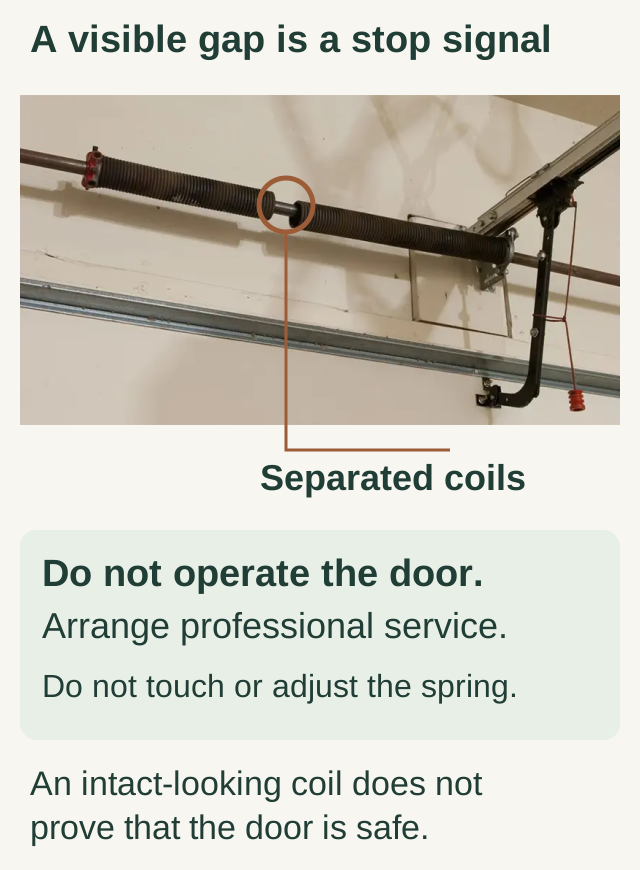
Scroll within the image if needed, or open the full-size view. The key details are also written below.
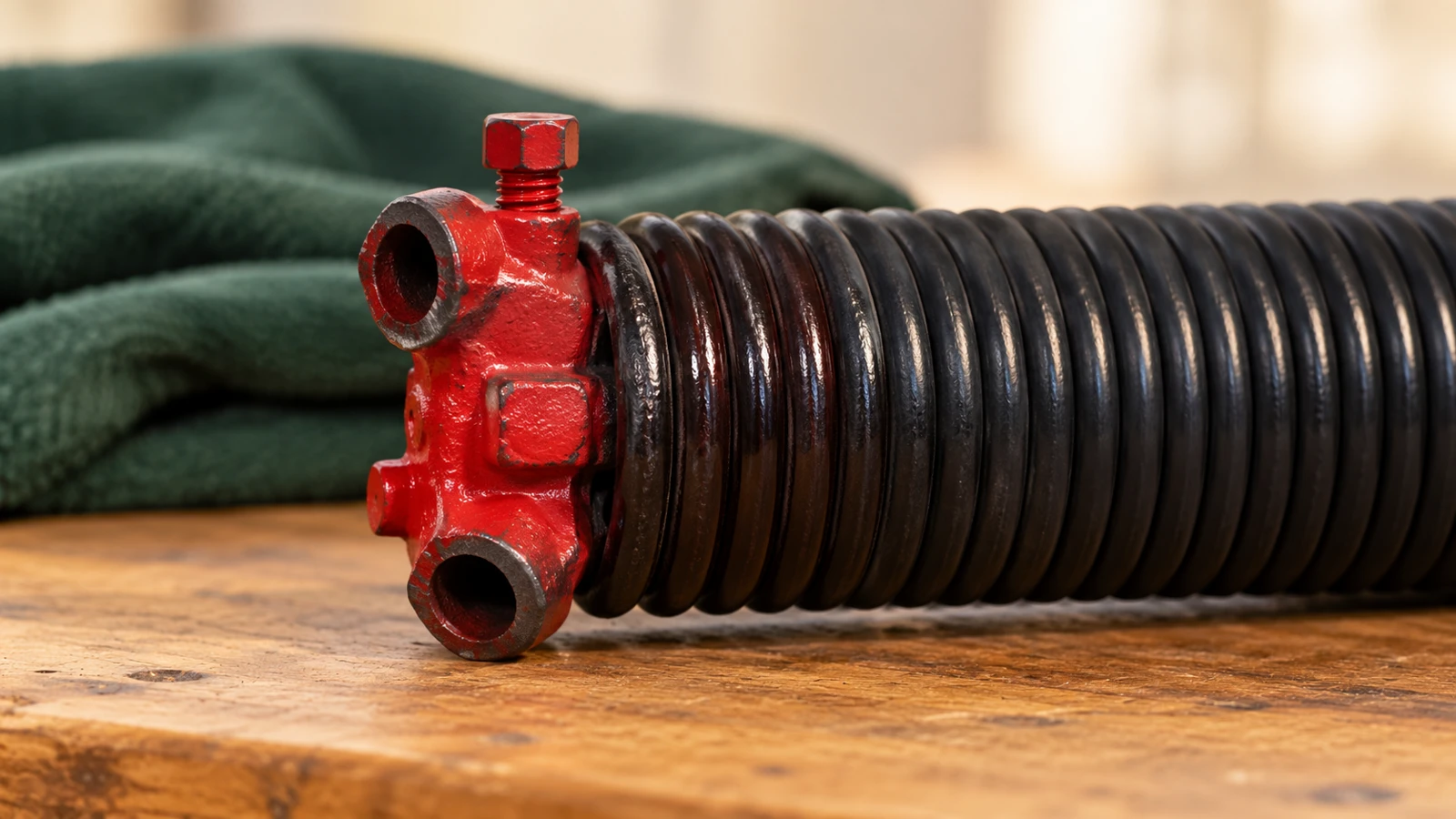
The callout identifies visible separation between torsion-spring coils in the manufacturer photograph. Stop operation and arrange professional service; do not touch or adjust the spring.
An intact-looking coil, or the absence of a visible gap, does not prove that the door is safe. Do not perform a test lift to investigate a suspected broken spring.
Use the evidence you already have. A visible gap in an exposed spring, a loud bang followed by failure, or a previous diagnosis may suggest a broken spring. Do not lift the door to find out how heavy it is. You do not need to prove a suspected failure before stopping use.
Record the door position. Tell the technician whether it is fully closed, partly open, fully open, or tilted. An open door needs a different stabilization plan. Do not change its position to make the repair easier.
Keep clear of the mechanism. Do not climb near the spring or reach toward a cable. Use an existing photograph or a safely readable model label if available. Expected outcome: enough information for the service request, without turning assessment into hands-on work.
Prevent other people from trying it. Put a clear note at accessible controls and notify household members. Use a manufacturer-approved shutdown method only if it can be done safely from outside the hazard area. Battery backup is another reason not to assume a power outage has made operation impossible.
DASMA’s inspection checklist says not to operate a door with a broken spring until replacement. It also emphasizes that springs and attached hardware remain a professional repair area.
If the car is inside
Start with the trip, not the door. Could you use another household vehicle, a ride, public transit, a rental, or a rescheduled appointment? If the car contains essential medication or another urgent item, ask whether it can be retrieved through an ordinary safe access route without passing beneath a compromised door. If not, explain the situation to the appropriate emergency or service provider.
Do not run the vehicle engine in the garage while waiting. Do not attach a tow strap to the door or try to use a vehicle’s lifting equipment as a door support. The door technician should determine whether access can be restored safely during the service visit.
Give the dispatcher two separate facts. “The spring appears broken” explains the repair concern; “the car is needed for a medical appointment” explains your scheduling priority. Neither requires you to move the door.
If the door is open
Keep everyone out from beneath it. Do not pull the emergency release, disconnect the door arm, or attempt to lower it manually. Do not rely on an improvised ladder, timber, clamp, or jack to hold it up.
Ask for professional stabilization and make clear that the door is open. For security, lock other entrances where you can do so safely, move people’s access route, and keep valuables out of view only if that does not require entering the hazard area. Avoid trading a personal-safety risk for property protection.
What to request at the repair visit
Ask the technician to confirm the failure, identify the correct replacement system, and check related cables and hardware. If there are two springs, discuss the scope for the pair rather than approving a one-part price without explanation. Request a written description of parts, labor, warranty, and completion checks.
Before regular use resumes, ask for an explanation of the completed mechanical repair and the manufacturer-required operational and opener safety checks. Keep the invoice with the door’s records; it can support future service and any warranty claim.
FAQ
Can several strong adults lift it safely?
Do not attempt it. Additional people do not control damaged hardware or establish that the door can be held and moved safely.
Will increasing opener force help?
Do not change force settings to move a door with a broken spring. The mechanical defect must be corrected first.
What if I am not sure the spring is broken?
Treat sudden heaviness, abnormal movement, or visible damage as a stop-use condition and request diagnosis. Guessing is not necessary to make the safe decision.
Explore guides · About this guide
Was this guide useful?
Your choice stays in this browser only. It is not sent to us.
Sources & manuals2
Manufacturer instructions and references for this guide. Match the document to your exact product.
- Genie: no manual or powered operation with a broken springwww.geniecompany.com
- DASMA: broken spring and professional repair warningswww.dasma.com