Garage Door Roller Replacement: What to Check and What to Ask
Quick answer
Plan garage door roller replacement as a professional repair, especially if a roller is displaced, the door binds, or the bottom roller hardware is involved. You can document noise and visible wear from a safe location and ask for manufacturer-compatible parts. Do not bend the track, loosen hinges, or remove roller brackets to perform the replacement yourself.
Bottom hardware is not an ordinary hinge. It may be connected to the spring system. Do not loosen it, even if your goal is only to replace a wheel.
Start with the symptom, not the shopping list
A noisy door does not automatically need a new set of rollers. Noise can accompany several kinds of wear or mechanical trouble, and the right response depends on what is actually wrong. Record when the noise occurs and whether it changed suddenly. Do not repeatedly operate a suspect door to find the loudest point.
Clopay notes that rollers that no longer move smoothly and quietly may need lubrication or replacement. Its guidance also cautions against removing bottom brackets under tension. We recommend professional replacement rather than giving a generic method that could be applied to the wrong bracket or door configuration.
If a wheel is outside the track, skip routine maintenance and use the off-track response guide. If a cable is loose or the door is tilted, the urgent issue is the whole system, not the choice between steel and nylon.
A safe assessment sequence
- Identify the change. Was there a new squeal, grinding sound, visible wheel damage, or rough movement? Use observations already made during ordinary operation. Expected outcome: a description that distinguishes a longstanding sound from a sudden failure.
- Check the stationary door from a safe place. Look for obvious broken wheels, displaced rollers, bent hardware, and uneven door position. Do not rotate wheels by hand, pull stems, or place fingers in the track. Expected outcome: visible concerns documented without handling parts.
- Locate the door identity. Existing paperwork is best. A label can help if it is readable without a ladder or reaching into hardware. Expected outcome: the manufacturer and model, where available.
- Describe the use pattern. Tell the technician if the door serves a busy household, a workshop, or frequent daily trips. Mention unusual moisture exposure. Expected outcome: context for selecting an appropriate compatible part, not a promise about lifespan.
- Request diagnosis before replacement. Ask whether the noise comes from rollers, tracks, hinges, the opener, or another component. Expected outcome: a proposal tied to evidence.
Choosing compatible rollers
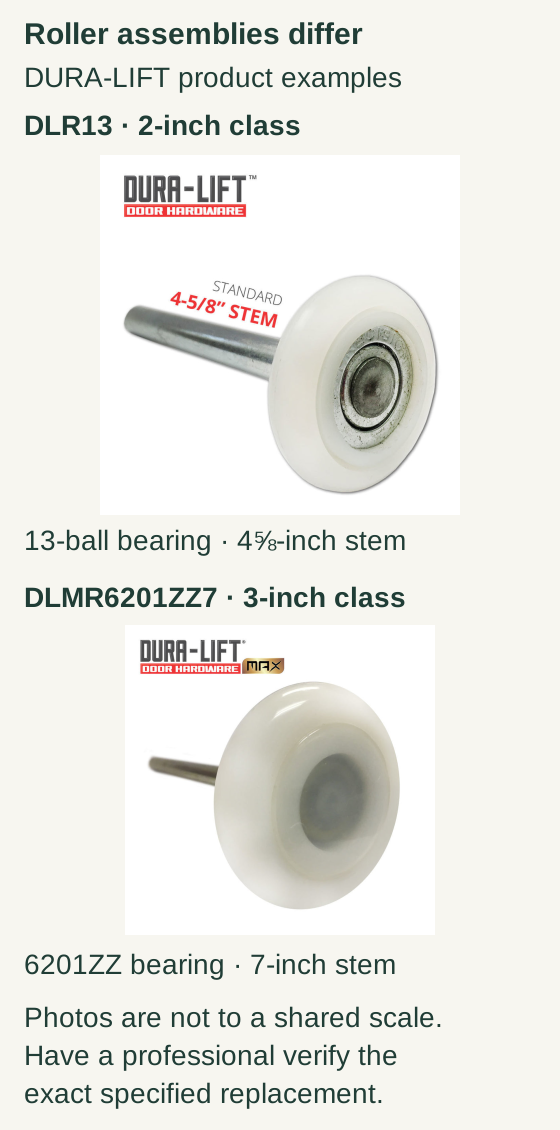
Scroll within the image if needed, or open the full-size view. The key details are also written below.
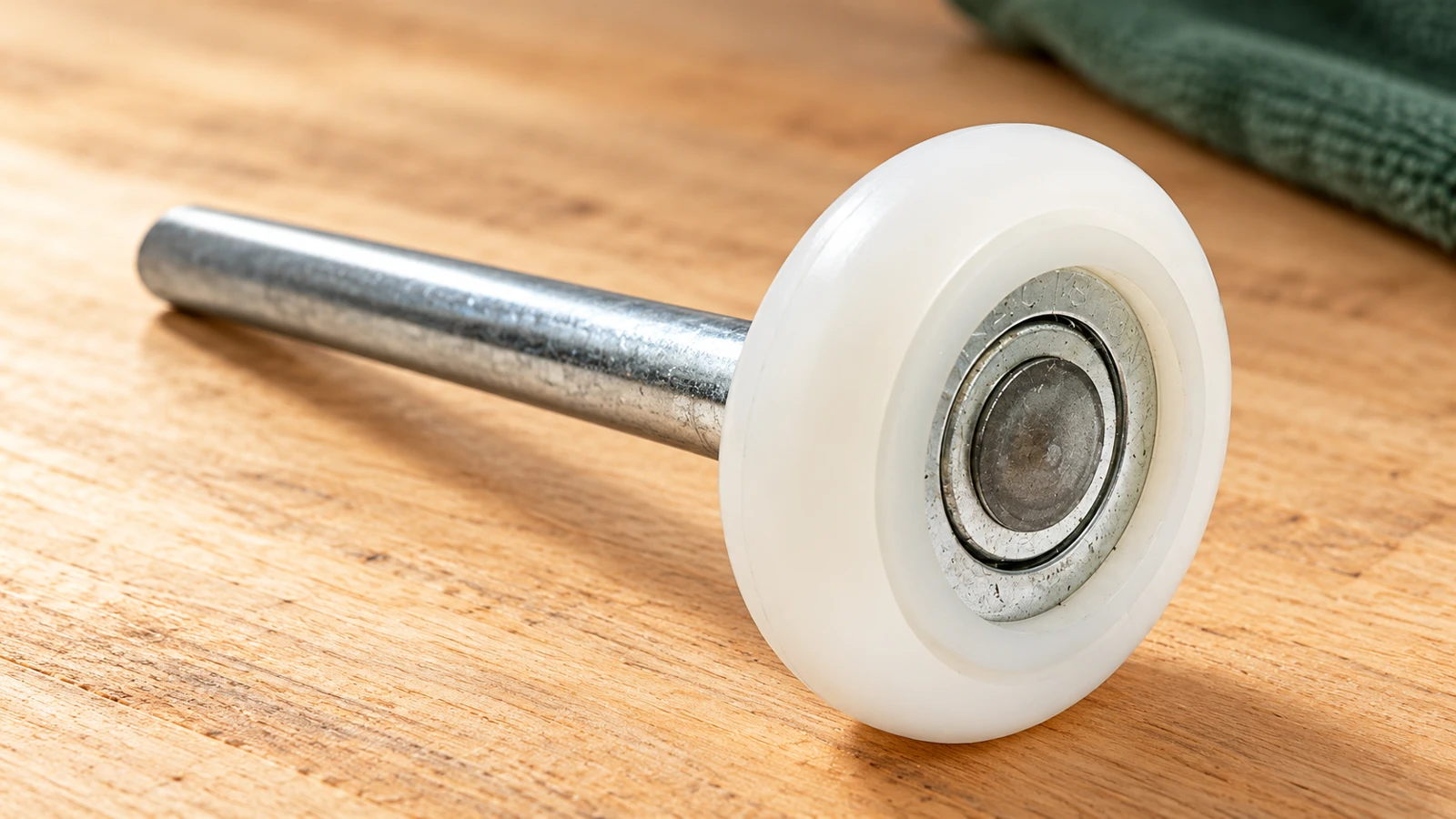
The DURA-LIFT DLR13 example is a 2-inch-class roller with a 13-ball bearing and a stated 4⅝-inch stem. The DLMR6201ZZ7 example is a 3-inch-class roller with a 6201ZZ bearing and a stated 7-inch stem.
The photographs are not to a shared scale, and perspective prevents measuring from them. Nominal wheel classes differ from stem dimensions. Have a professional verify the exact specified replacement rather than choosing by appearance.
Scroll the diagram sideways when needed. Keyboard: focus the diagram, then use the left and right arrow keys.
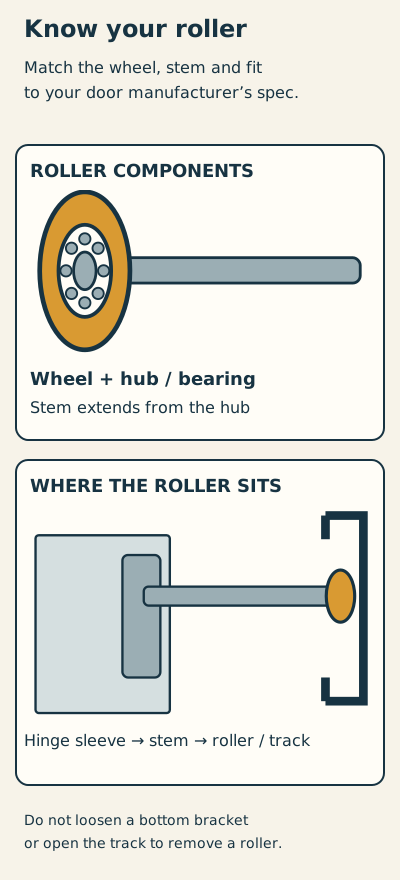
Open full-size wide diagramOpen full-size mobile diagram
What the diagram shows
The roller consists of a wheel, hub or bearing, and a stem. The stem sits in the hinge sleeve while the wheel runs in the door track.
Match the wheel, stem and fit to the door manufacturer’s specification. Do not loosen a bottom bracket or open the track to remove a roller.
A roller that fits is not automatically compatible.
Plan the replacement around the door specification—not a similar-looking wheel.
Your part: describe existing symptoms
- Where was noise or rough movement already noticed?
- Is cracking or displacement visible from a safe existing position?
- Was there an impact or previous repair?
Do not operate a damaged door to demonstrate the symptom or remove a roller to identify it.
Stop and arrange assessment
Roller outside track, cracked bracket, loose cable, crooked door or sudden movement?
No extraction, track spreading or bottom-bracket removal.Ask the technician to document the replacement
| Specification | What the written scope should establish | Why appearance is not enough |
|---|---|---|
| Door and hardware system | Manufacturer/model and approved replacement basis | Similar parts can differ in strength or function. |
| Roller specification | Wheel type, stem dimensions and compatible track/bracket position | “Nylon roller” alone does not identify the required part. |
| Quantity and related work | Which rollers; which damaged brackets or track parts; why | New wheels do not correct a bent track or failed support. |
| Completion | Required operating/safety checks and warranty terms | A quiet door is not the entire safety assessment. |
Clopay allows some roller repairs under its specific instructions; this is not a claim that every manufacturer bans all homeowner roller work. Do not apply a generic removal method to an unidentified bracket.
Clopay: roller condition and repair scope · DASMA TDS183: component substitution. Dimensions are for the technician to verify, not a request to dismantle your door.
Wheel material is only one consideration. Ask the installer to verify the required stem dimensions, wheel geometry, load suitability, bearing design, and any special requirements for the door. You do not need to measure these by removing a roller yourself.
DASMA warns that apparently similar substitute components may differ in strength and function; some important differences are not visually obvious. This matters particularly where a door’s tested assembly or wind rating depends on specified parts. “It fits the hole” is not an adequate compatibility standard.
Ask what the proposed roller changes and what it does not change. A quieter compatible part may be worthwhile, but it cannot correct a damaged track or a loose structural attachment. Avoid a blanket claim that every nylon roller is better than every steel roller, or that a certain bearing count guarantees a fixed life.
Compare complete specifications. A quote that names the roller model and quantity is easier to evaluate than one that says only “premium roller upgrade.”
What should the work order include?
Request the diagnosed problem, roller quantity and specification, labor, any related hardware work, and the planned operational checks. Ask whether all rollers need replacement or whether the proposal addresses a localized issue. There is no universal answer; the technician should explain the condition found.
If hinges, tracks, or panels also need repair, ask for those items separately. That makes it clear whether an apparent roller price difference is really a difference in scope. Ask which parts warranty applies and whether labor to replace a failed warranted part is included.
At handover, the technician should explain the completed work and demonstrate appropriate operation from a safe viewing position. Ask for care instructions specific to the installed roller. Do not assume every wheel or bearing should receive the same lubricant; use the door and component instructions.
Stop conditions
Stop door use if a roller is displaced, the door is leaning, a cable is loose, a bracket is separating, or movement becomes abrupt or uncontrolled. Do not attempt a temporary track bend, adhesive repair, or bracket tightening. Keep the opening clear and report the door’s position when arranging service.
FAQ
Can I replace just one roller?
Possibly, after professional assessment. Ask whether the other rollers and related hardware are serviceable and whether the replacement meets the same specification.
Will new rollers eliminate all noise?
Not necessarily. Get the source of the noise identified before buying parts. Ask which sound the proposed repair is expected to address.
Should I buy the parts before the appointment?
Only after compatibility and the installer’s parts policy are confirmed. A technician may not warrant customer-supplied parts or may find that a different repair is required.
Explore guides · About this guide
Was this guide useful?
Your choice stays in this browser only. It is not sent to us.
Sources & manuals2
Manufacturer instructions and references for this guide. Match the document to your exact product.
- Clopay: roller condition and repair scopewww.clopaydoor.com
- DASMA TDS183: component substitutionwww.dasma.com