Open an Electric Gate During a Power Outage: Manual Access Safely
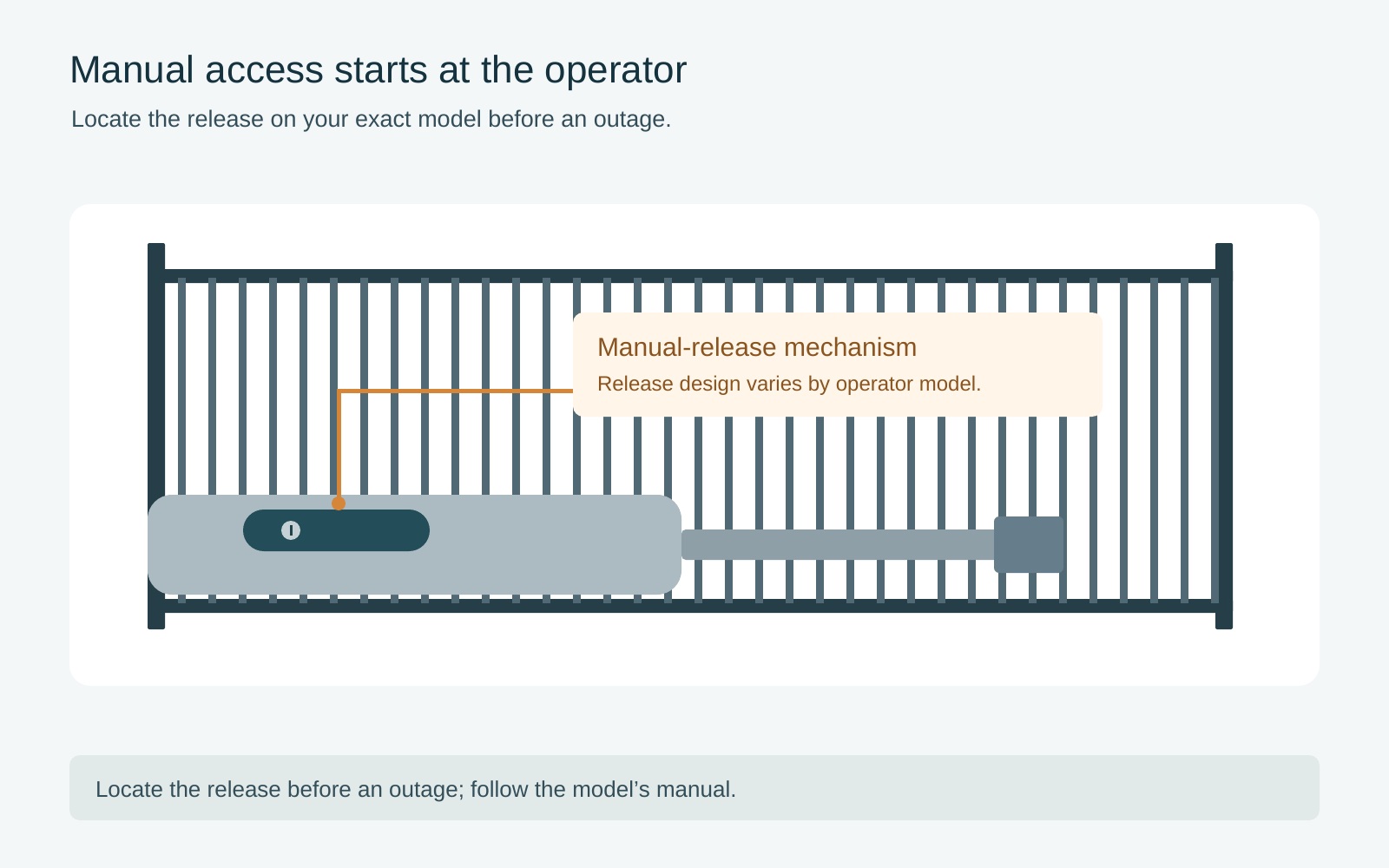 Open full diagram
Use a separate entrance when possible
During a power outage, the safest immediate access may be a separate pedestrian entrance rather than releasing a heavy vehicle gate. Check the site’s established outage plan and contact its responsible manager. If someone needs urgent rescue or there is an immediate threat, call emergency services instead of attempting an unfamiliar release mechanism.
This guide helps you decide whether manual access is appropriate. It does not supply a universal key-turn, lever or power-switch sequence. Swing actuators, sliding operators and different control systems release differently. A procedure copied from another gate can leave a leaf uncontrolled or cause unexpected movement when power returns.
A mains outage does not necessarily stop the operator
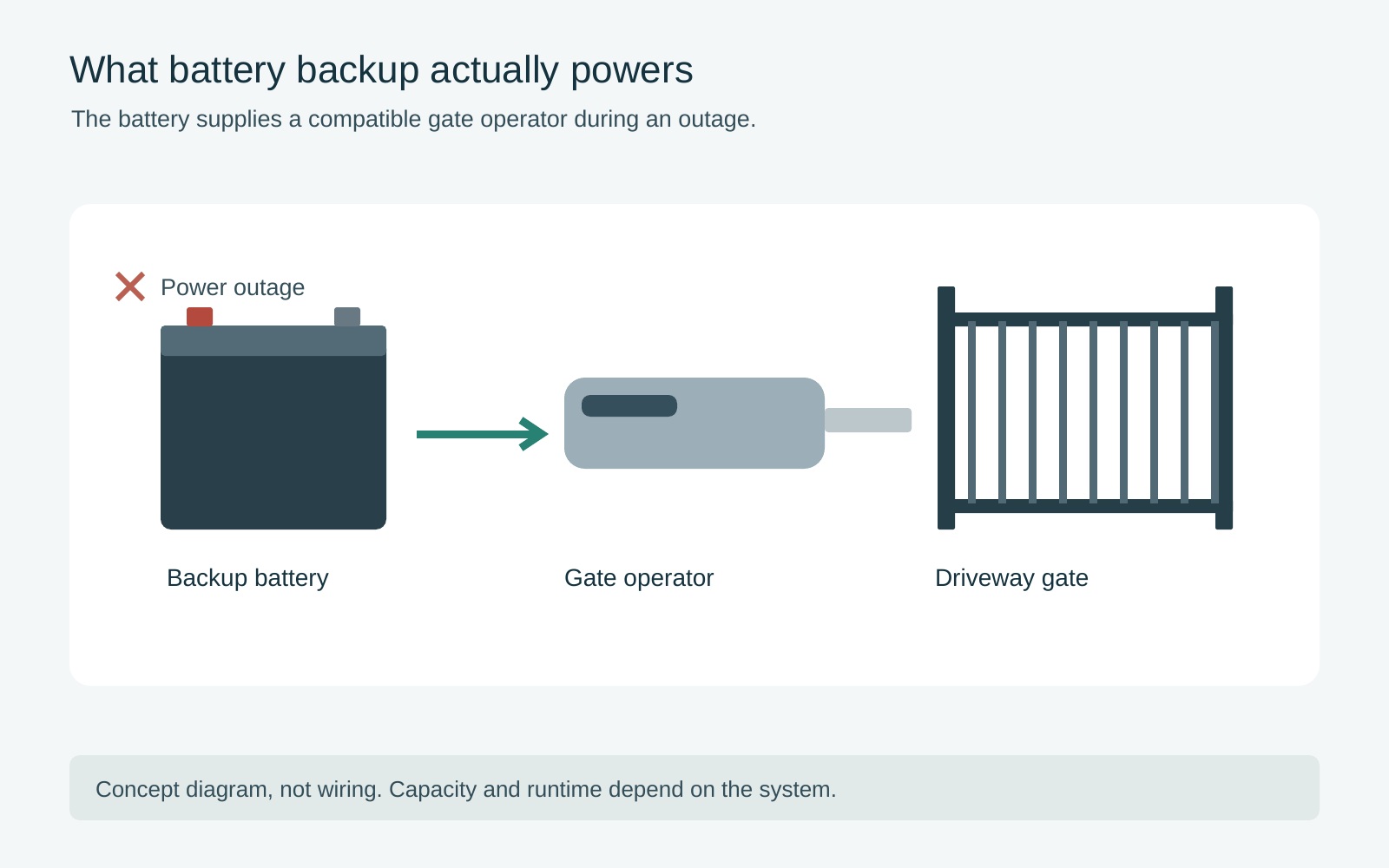
Battery-backed and solar-charged operators may remain capable of moving after the property loses mains power. An unlit house or a switched-off AC supply is not proof that the gate is isolated. Remote controls, timers and other inputs may still be active while backup energy is available.
If the gate operates normally on its approved backup system and the path is clear, follow the site’s normal authorized access procedure. Do not consume the reserve with repeated tests. The number of remaining cycles is not something to infer from a generic battery specification or from one successful opening.
Behavior can depend on configuration and battery condition. The LA400UL manual, for example, describes a battery-failure selection that affects whether the gate latches at an open or closed limit when voltage becomes critically low. That is a model-specific feature, not a universal promise that every gate opens automatically during an outage.
Find the instructions and release access before acting
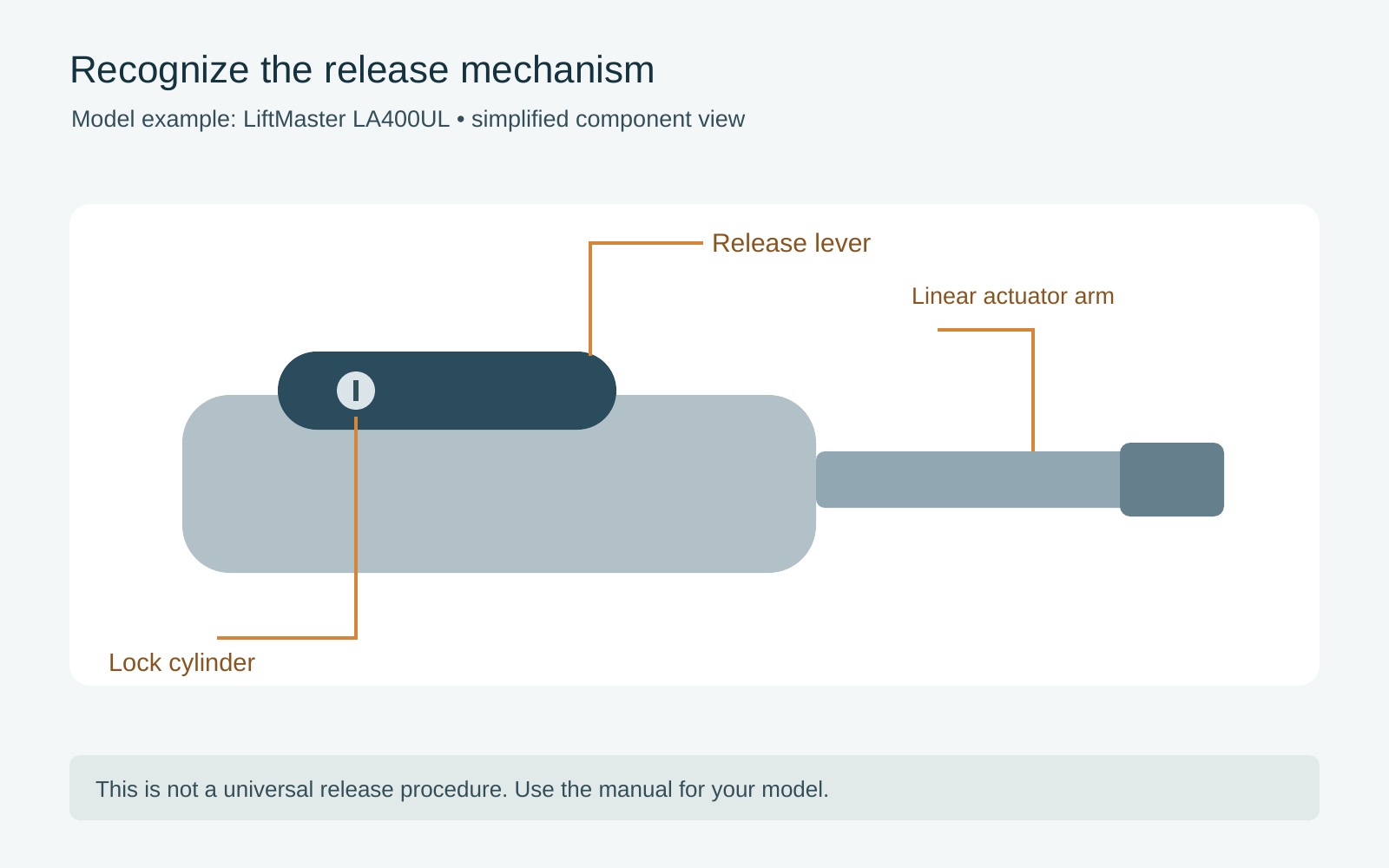
Identify the actual operator model from accessible paperwork or an exterior label. Find its manual-release or emergency-operation section and the site handover instructions. For a two-leaf system, identify whether each operator needs a separate action and how any gate lock is handled by the documented procedure. Do not guess from the release hardware on one leaf.
Use only a release key or access method you are authorized to use. If the required key is unavailable, call the property manager or gate service company. Do not drill a lock, detach an actuator, remove a chain or improvise a tool to defeat access security.
Read the restoration instructions before releasing anything. Knowing how to disengage is only half the job. You also need to understand how the gate will be secured, how engagement is confirmed and what movement may occur when the system is returned to automatic service.
Decide whether the gate can be controlled safely
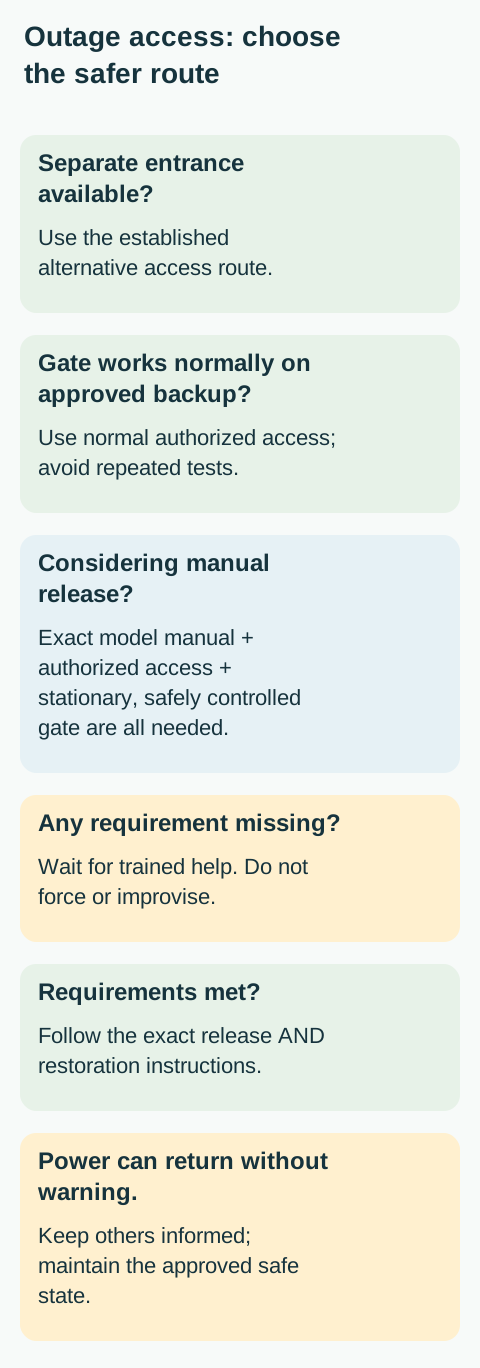
Do not release a moving gate. Keep people and vehicles clear of its full travel and trapping areas. Before disengagement, the leaf must be safely controlled or secured using the site’s approved method, so that releasing the drive cannot allow it to swing, slide or roll unexpectedly. Do not rely on a person standing in its path to catch it.
Wind can move a swing leaf, and a sliding gate on a slope can become difficult to restrain. Weight, poor rollers, damaged hinges, impact damage or a gate already pressing against an obstruction increase uncertainty. A heavy, sloping, damaged or hard-to-control gate belongs with trained professionals, not a trial push.
If the only way to reach the release requires entering an entrapment space, climbing over the gate or leaning through moving hardware, stop. The ability to reach a handle does not establish safe access. Use another route and arrange assistance rather than exposing yourself between the gate and a fixed structure.
 Open full diagram
Separate manual-operation instructions from servicing isolation
Unexpected automatic movement must be prevented using the procedure for the installed model before manual handling. Do not treat an ordinary stop command, a quiet motor or a mains switch as universal isolation. Batteries and solar sources may remain active, and different operators handle manual movement differently.
The distinction matters in the manufacturer manuals. LiftMaster’s LA400UL servicing instructions require all power sources to be disconnected and explicitly state that its AC switch does not remove battery power. HySecurity’s SlideSmart DC emergency-release instructions describe a particular DC-power-off state for manual movement and warn that the drive remains engaged when DC is on even if AC is off.
These are not interchangeable instructions. Complete isolation for electrical servicing and the operating state prescribed for a particular manual-release feature are different questions. Do not open a cabinet or disconnect batteries because another model’s instructions mention them. If establishing the required safe state involves exposed electrical work or an unfamiliar internal control, call the service company.
Release and move only as the matching manual allows
Proceed only if you have the correct instructions, authorized access, a stationary and safely controlled gate, a clear area and the ability to carry out the specified owner procedure without exposure to hazards. Otherwise, the appropriate outcome is to wait for trained help, not to improvise a different release.
The LA400UL uses a keyed release and lever arrangement; the SlideSmart DC example handles manual movement differently. This guide deliberately does not give their button or lever sequences as general steps. Use the precise manual for your installed equipment, including its cautions about power state and engagement.
Once the drive is correctly disengaged, move the gate only in the manner the manufacturer permits. Do not force resistance, use a vehicle to pull it, stand near rollers or hinges, or place hands in a closing gap. Stop if movement is difficult or cannot be controlled. Resistance may indicate a mechanical problem rather than an incomplete release.
Keep the gate secured through the approved site arrangement while in manual mode. An unlatched leaf must not be left where wind, slope or another user can move it. Do not invent a rope, wedge or parking arrangement and describe it as a safe substitute for proper restraint.
Plan for power returning while the gate is still manual
An outage can end without warning. Keep other users informed that the gate is not in normal service and do not leave the system in an ambiguous state. The site manager should control access and prevent remote commands until engagement and restoration have been addressed.
Follow the exact re-engagement and return-to-service instructions with the gate stationary and everyone clear. Do not assume that turning power on is the complete procedure. HySecurity warns that after both AC and DC are turned off, restoring them can cause the operator to cycle while searching for its target magnet. This is why the restoration section must be read in advance.
If the release does not positively re-engage as documented, the leaf does not hold as expected, or normal operation is abnormal, stop and obtain service. Do not change travel limits or increase force to compensate for the state created during manual operation.
Finish with safe operation, not simply restored electricity
After the documented restoration, verify the system through the manufacturer’s prescribed process from a safe position. A gate moving once is not a complete safety check. If an obstruction, impact or sensor issue existed before the outage, restoring power does not repair it.
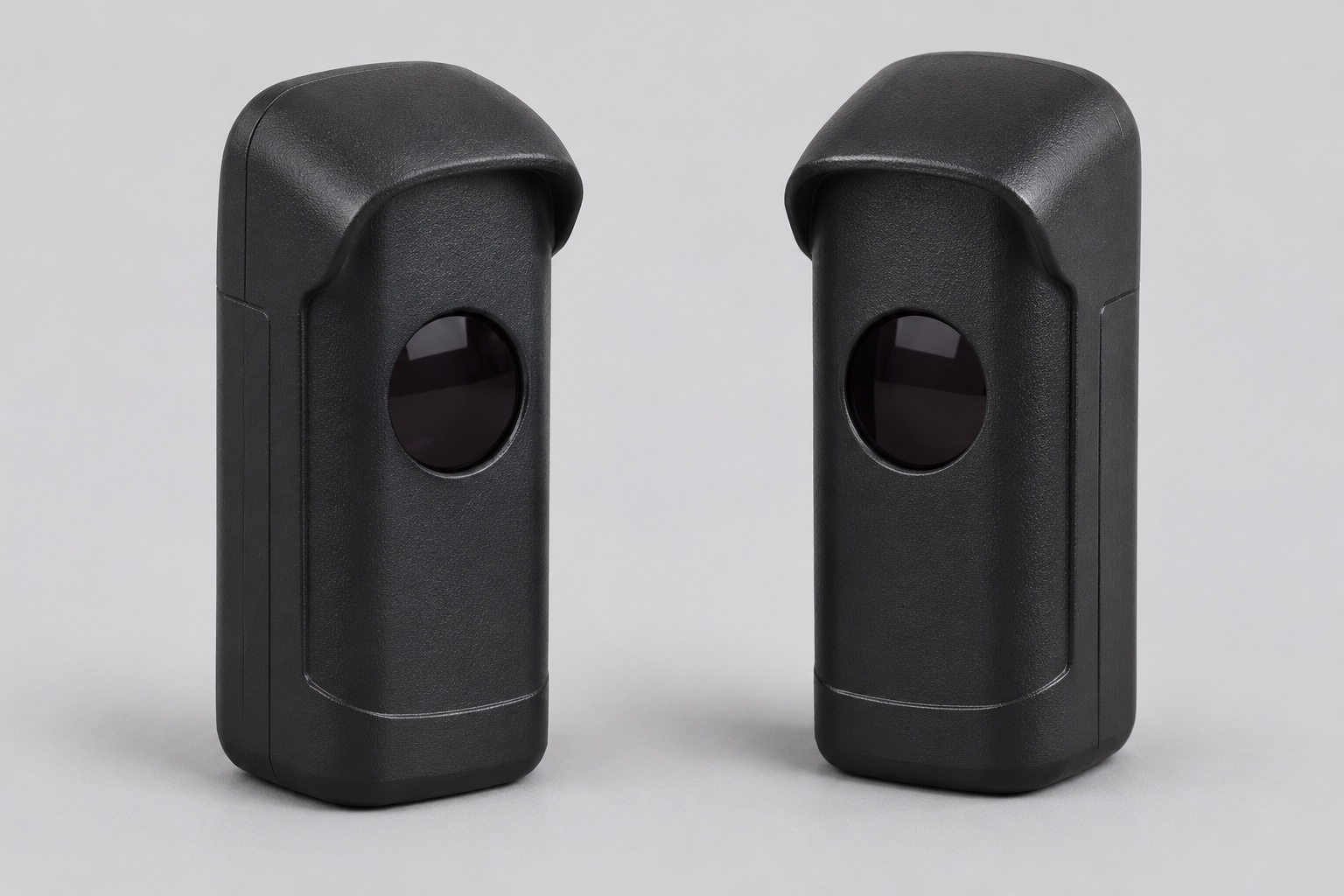
For unresolved photoeye concerns, use the gate photoeye guide and arrange the required protective-system verification. If the gate remains unresponsive despite restored supply, use general safe fault triage rather than repeatedly cycling power.
Before the next outage, ask the installer to demonstrate your own release, safe restraint and restoration arrangements. Keep the correct manual and authorized key accessible to responsible adults, but secure from children and unauthorized users. Agree on a separate pedestrian route and a service contact while conditions are calm.
Frequently asked questions
Can a gate still move when the house has no power?
Yes. A battery-backed or solar-charged operator may still have power. Follow the installed model’s procedure to prevent unexpected movement.
Can I release a gate without its key?
Use only an authorized method documented for the actual operator. If the required key is missing, contact the property manager or gate service company; do not defeat the lock.
Will power restoration automatically return the gate to normal?
Not necessarily. Re-engagement and restoration are model-specific, and some systems can move during restoration. Read the return-to-service instructions before releasing the gate.
Related Posts
 Practical Guide
Gate Battery Backup: Operation, Reserve and Limits
Plan essential gate access during an outage, check backup dependencies and low-energy behavior, and avoid unsupported runtime promises.
 Practical Guide
Gate Sensors Not Working: Photoeye Checks Without Bypassing Safety
Identify a gate photoeye problem, distinguish blocked optics from a system fault, and know when cleaning must give way to professional diagnosis.
Sources
Manufacturer instructions and references for this guide. Match the document to your exact product.
- LiftMaster LA400ULsupport.chamberlaingroup.com
- HySecurity SlideSmart DCsupport.hysecurity.com