Damaged or Dented Garage Door Panels: Repair or Replace?
A shallow cosmetic dent may not require a new door. A buckled section, damaged joint or torn hinge mounting needs professional assessment before use. One section can sometimes be replaced, but only with a manufacturer-approved match and a sound remaining door system.
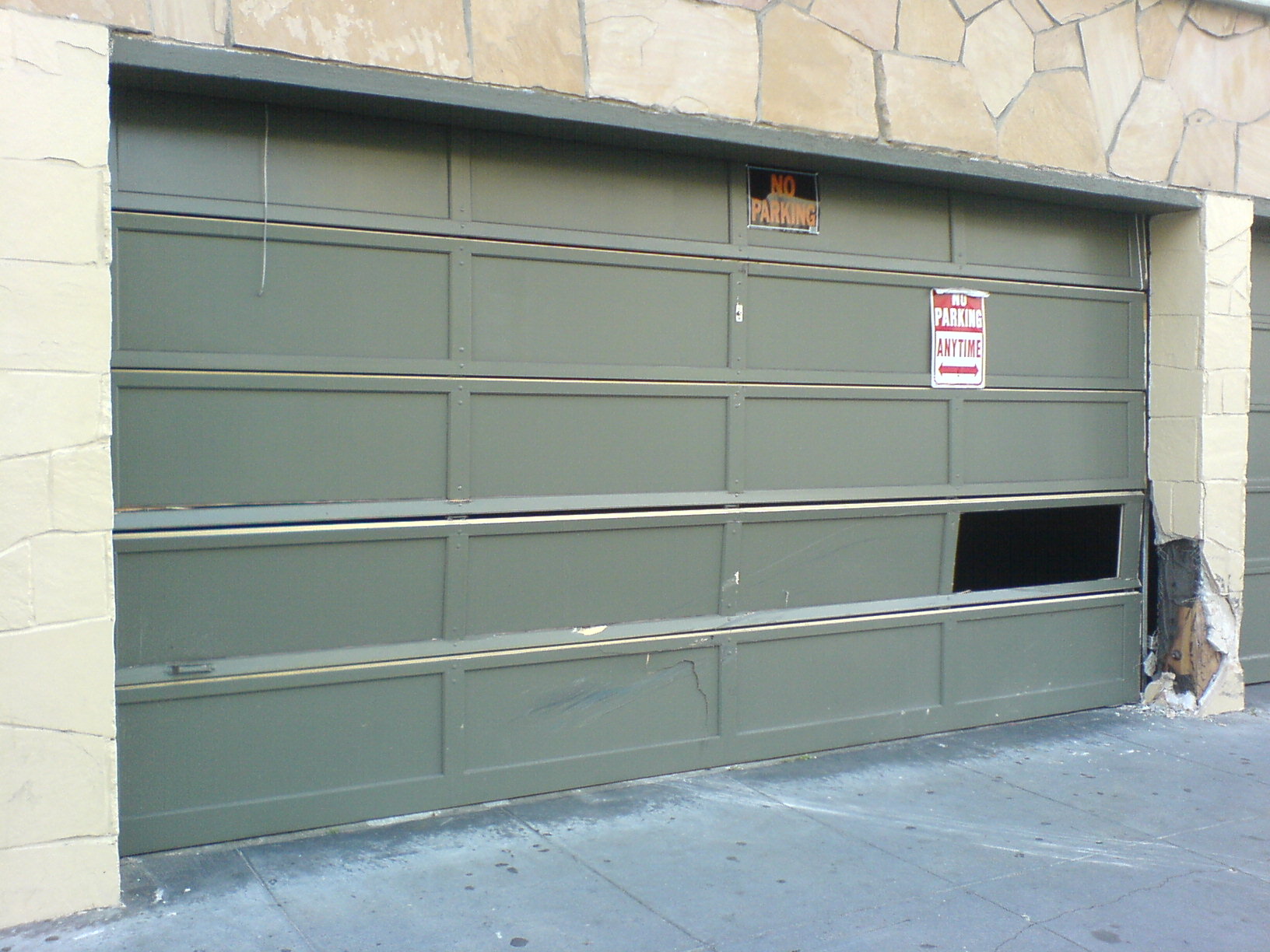
A dent is a description, not a repair specification. Before ordering a panel, separate three questions: is the door safe to move, can the damaged section be repaired or replaced correctly, and does that option make sense compared with a complete replacement? This guide helps you prepare those decisions; it does not provide section-removal instructions.
On a sectional overhead door, a section is a full-width horizontal piece connected to the next piece by working hinges. The small rectangular patterns stamped into its face are often called panels too. When requesting a quote, say which full-width section is damaged so you are not asking for a decorative rectangle as though it were a separate replacement part.
1. Stop operation after an unsafe impact
If a vehicle struck the door, a section has folded, the door hangs unevenly, a roller is displaced, or hardware has pulled away, stop using it. Do not run an opening cycle to find out whether the opener can overcome the damage. Keep remotes, app commands and other users from starting the door. Use another entrance.
If it is open or partly open, do not pull the emergency release, walk underneath, try to close it for photographs or prop it up. Tell the service company its current position and request stabilization. If anyone is trapped or injured, contact emergency services. Preventing an accidental command is not the same as making a damaged door mechanically safe; battery backup can also remain active.
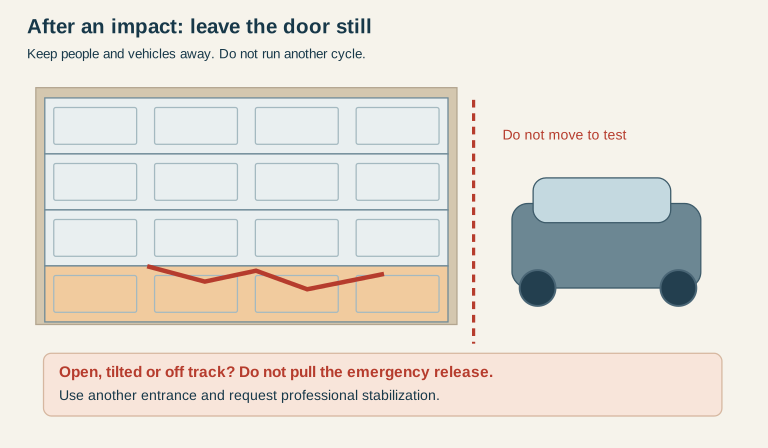 Open full diagram
DASMA's occupant damage guide treats observed deformation as a reason for professional evaluation rather than an invitation to operational testing. For an already closed door, use the opener manufacturer's safe shutdown procedure only if it can be done without approaching the hazard. Do not reach around springs, cables or bottom corner fixtures.
2. Separate a surface blemish from a damaged section
A light mark in paint is different from a dent in the metal skin. A shallow skin dent away from the edges may be primarily an appearance issue after assessment. A sharp fold, cracked joint, bowed section, split wood or loose attachment is a different repair question. There is no reliable universal rule that a dent below a certain number of inches is safe.
- Finish-only concern: ask about the manufacturer's cleaning or touch-up instructions after the door has been cleared for use. A scratch is not automatically a reason to replace the whole assembly.
- Local dent: ask whether a professional cosmetic treatment is appropriate for the material and finish, what appearance to expect, and whether the repair will affect warranty coverage.
- Crease, buckle or damaged joint: request section and system assessment. A smoother outer surface would not prove that the original shape or strength had been restored.
- Hinge or roller mounting damage: the surrounding section matters as much as the visible hardware. Ask whether the material that carries the fasteners remains sound.
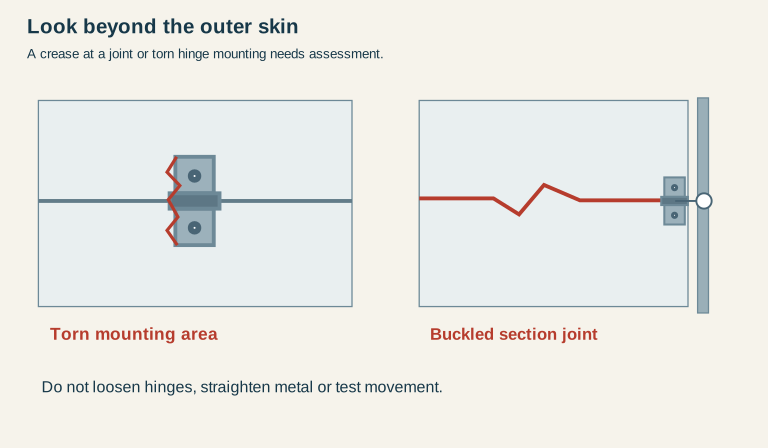 Open full diagram
Steel, aluminum, wood and composite doors do not have one shared dent-repair method. An insulated section also has construction behind the visible face that a front photo cannot assess. Do not hammer, heat, freeze, drill or pull the dent, and do not remove a section, hinge or reinforcement to improve access. Avoid automotive-style repair recipes presented as suitable for every garage door.
3. Collect the information a dealer can actually use
Start with the purchase paperwork rather than the damaged door. Find the manufacturer, model, installation date if known, and any wind-load paperwork. If the door is already closed and can be viewed safely from the floor, photograph its label with zoom. If the label is inaccessible, report that instead of moving the door.
- Take one overall view showing which full-width section is affected.
- Record its position: bottom, intermediate or top. For an intermediate section, count upward from the floor and explain your numbering.
- Take a closer view of the dent and adjacent joint only from a safe location. Leave the original image intact; annotate a copy if helpful.
- Note the cause and any new scraping, binding or tilt already observed. Do not recreate the event for a video.
- Include the door size from existing paperwork and ask the dealer to verify section dimensions. Do not squeeze fingers into joints or climb to measure an upper section.
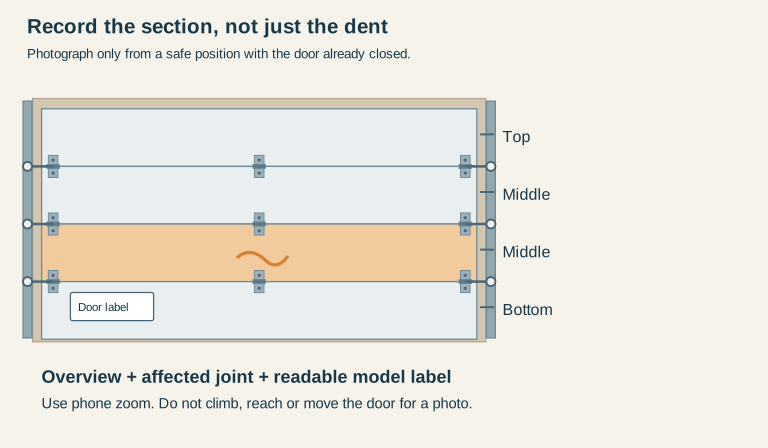 Open full diagram
A useful message is: “The second full-width section from the floor was hit while the door was closed. Here are the overall view, damaged area and model label. We have stopped using it. Please inspect the system and quote an approved section replacement if feasible.” If the door is unstable, omit close-up photos and describe its position first.
4. Confirm an exact replacement, not a look-alike
One-section replacement can be practical when damage is localized, an approved replacement is available and the rest of the system is serviceable. Clopay advises checking availability with a dealer; discontinued models and weathered finishes can complicate a match.
Ask the dealer to put the following in writing:
- The existing door model and the replacement section's part or order reference.
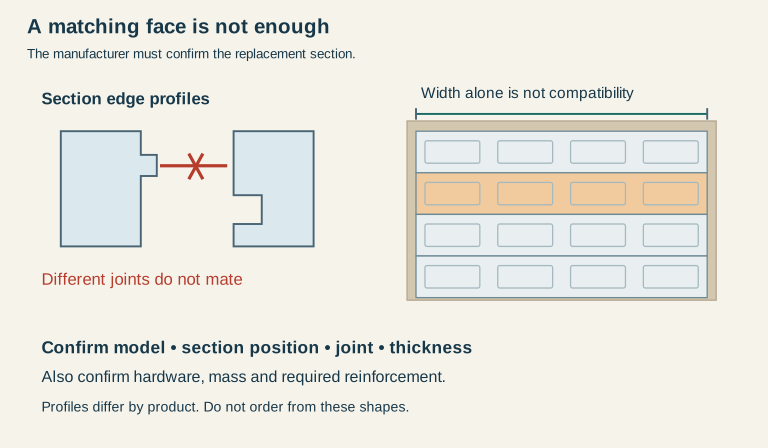
- The section's location, width, height, thickness, joint profile and construction.
- The specified hinge, roller and reinforcement configuration, including any opener attachment affected by a top-section replacement.
- Whether the replacement changes weight and what the technician will do to verify the complete door's balance.
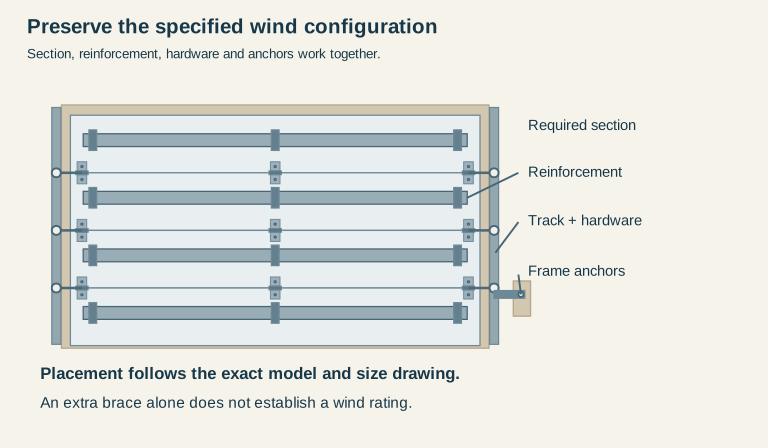
- How the replacement preserves any required wind-load configuration.
 Open full diagram
A similar raised-panel pattern, the same overall width or a shared brand name does not answer all of those questions. Ask for manufacturer confirmation of any substitute. Do not buy a used “close enough” section first and expect an installer to modify the door around it. Replacing a specified section within an existing door is also different from putting an entirely new door on old tracks.
A new finish can stand out against years of fading. Ask to see the available color and discuss any approved refinishing separately. Get the expected visual result and extra finish work into the quote, rather than assuming a new section will disappear into the old door.
5. Have the rest of the system checked
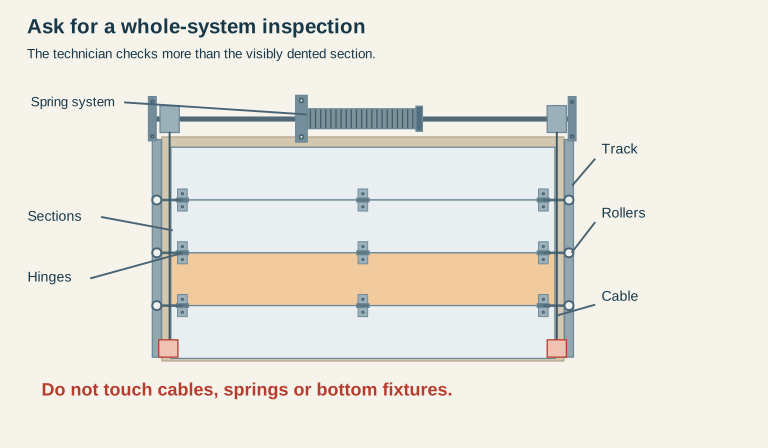
The technician's damage assessment should cover sections and their attachment areas, hinges, rollers, tracks, cables, spring system and supporting frame. DASMA's technician guidance includes a repair-versus-replacement judgment and assessment of stress or fatigue after damage. A dent-only price is not a complete scope if the same impact bent a track or loosened an attachment.
 Open full diagram
Ask which findings are confirmed and which require closer inspection during professional work. If the supporting frame is damaged, ask whether a building contractor or design professional also needs to assess it. Do not tighten or tug at attachments as a homeowner strength test.
Weight and reinforcement cannot be treated as cosmetic details. The spring system must suit the door's weight and size. Wind-rated configurations depend on the exact model, size and installation drawing, including the required reinforcement and hardware. Adding a random brace does not establish a rating or prove that a folded section is repaired.
 Open full diagram
6. Compare the complete options
Request separate written options where feasible: leave an assessed cosmetic blemish alone, perform an approved cosmetic repair, replace the specified section, or replace the complete door. Ask why any option is ruled out. A full replacement recommendation should explain the findings, not just the age of the door.
Compare section price, freight or special-order charges, finish work, related hardware repairs, labor, removal and disposal, balance verification and completion checks. Ask about lead time, parts and labor coverage, and what happens if the manufacturer cannot supply the section. Local installed quotes are more useful than a universal dollar threshold.
A complete replacement becomes more compelling when compatible sections are unavailable, several sections or major system components are damaged, or the total localized repair approaches a suitable new system. Conversely, one damaged section does not automatically justify a new door. Keep optional appearance upgrades separate from work necessary for safe operation.
Before normal use resumes, have the technician explain what was replaced, confirm the completed assembly and balance, and perform the applicable manufacturer-specified operating and opener safety checks. Keep the installed section identification, written findings and invoice with your door records.
Common questions
Can I replace just one garage door panel?
Sometimes. A dealer must identify an approved replacement for the exact door and section position, then inspect the remaining system. A matching color and width are not enough.
Can I keep using a dented garage door?
Do not test a door after a damaging impact or when there is visible deformation, displacement or unusual movement. Have a technician determine whether damage is cosmetic and whether operation is safe.
Will the new section match the old color?
Not necessarily. Weathering can make an original finish differ from a new section. Ask about an approved finish solution and its cost before ordering.
Can a reinforcement strut fix a buckled panel?
Do not assume so. A strut is not a substitute for sound section material, joints and attachment points. Any engineered repair must be approved for that door and preserve balance and applicable wind-load requirements.
Related Posts
 Safety Guide
Garage Door Off Track? What to Do Before Professional Repair
Respond safely to an off-track garage door, protect the area, and understand the inspection needed before normal operation returns.
Garage Door Hinge Replacement: Read the Numbers and Plan the Repair
Identify garage door hinge numbers, document visible damage safely, and plan compatible replacement with a technician without loosening hardware.
 Planning Guide
How to Read a Garage Door Repair Estimate Before Approving Work
Compare the diagnosis, parts, labor, exclusions and approval process in a garage door repair estimate. Ask clear questions before agreeing to changes.
 Practical Guide
How Long Do Garage Doors Last? Repair or Replace
Judge garage-door lifespan by condition, not age alone. Compare safe repairs, compatible replacement sections and complete installed replacement quotes.
Choosing a Garage Door: Construction Types and Tradeoffs
Compare steel, wood, glass and composite garage doors, panel layers, thermal ratings, wind requirements and upkeep before choosing a complete system.
Sources
Manufacturer instructions and references for this guide. Match the document to your exact product.
- Clopay: dent repair or replacementwww.clopaydoor.com
- Clopay: identifying and ordering replacement sectionswww.clopaydoor.com
- DASMA TDS 174: occupant damage inspectionwww.dasma.com
- DASMA TDS 175: technician damage assessmentwww.dasma.com
- Clopay: wind-load configurations and drawingswww.clopaydoor.com
- Clopay: installation, spring balance and model-specific wind drawingswww.clopaydoor.com
Photo credits
- Vehicle-impact damage can extend beyond the panel surface. Have the sections, joints, tracks and surrounding structure assessed before deciding on repair or replacement. More Capp Street Drama. Photo: Brett L. · CC BY-SA 2.0. Brett L. CC BY-SA 2.0