Garage door frozen to the ground: safe thawing and prevention

Stop pressing the opener button if your garage door appears frozen to the floor. Leave the door closed, keep people away from its path, and look at the bottom edge from ground level. An ice bond needs a different response from a damaged spring or a door binding in its tracks. Do not increase the opener’s force setting to overcome either problem.
This guide covers a closed residential garage door with suspected ice where its bottom weatherseal meets the floor. It does not cover freeing an open, crooked, damaged, or off-track door. Those conditions need a qualified garage door technician.
First identify what is stuck
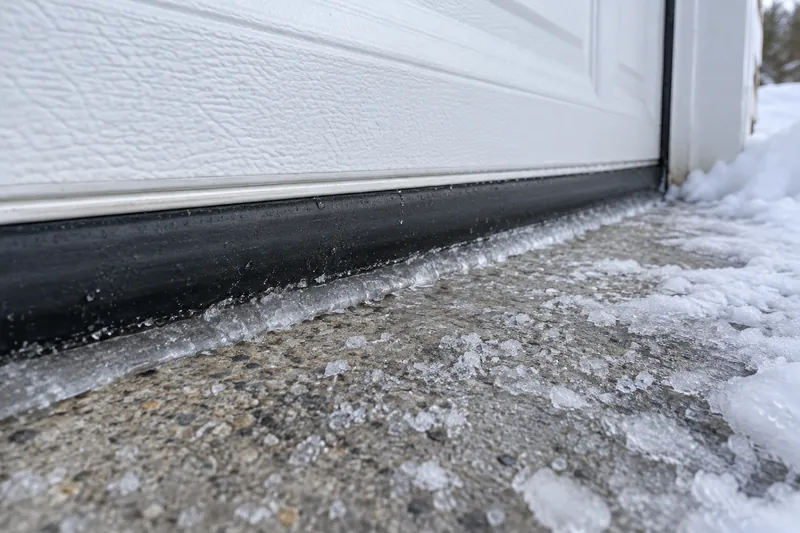
Ice or packed snow along the bottom edge is a clue, not proof that the rest of the door is safe. Water or wet snow can freeze around the weatherseal and hold it against the concrete. [1]
Look without touching the hardware:
- Ice at the floor: A visible frozen strip follows the bottom seal. Keep the door still while deciding how to address that contact area.
- A door that already moved and then stopped: Binding farther up the opening is outside this thawing procedure. Ice in a track, worn hardware, or another obstruction needs separate diagnosis. Do not apply a floor-thaw method to the rollers or tracks. [2]
- A possible spring or cable fault: A visible spring gap, loose cable, crooked panel, or a loud bang before the failure warrants service. Do not operate a door with a suspected broken spring. [2,3]
- No clear cause: Cold weather alone is not a diagnosis. Describe the symptoms to a technician instead of trying successively stronger methods.
Do not pull the emergency-release cord to “see how heavy it is.” This guide does not ask you to disconnect or manually lift an uncertain door. Leave springs, cables, and bottom brackets alone. [4,5]
Prepare the area without moving the door
Put the control remote somewhere it cannot be pressed accidentally and tell everyone in the household not to operate the door. Keep children and pets away. Use a separate pedestrian entrance if one is available; do not crawl under a partly open door.
From a stable, nonslippery position, sweep loose snow away from the approach without striking the door or disturbing its seal. Do not insert a shovel, screwdriver, scraper, or fingers under the bottom edge. Leave hard ice bonded to the seal in place rather than prying it off.
If you cannot reach the affected area safely from ground level, stop. A frozen door is not a reason to climb, reach across a slippery surface, or work from the street.
Choose a thawing approach that fits the actual door
The lowest-intervention option is to leave the door unused and wait for outdoor conditions to thaw the bond naturally. This is an option only when waiting is practical; it is not a guarantee that warming weather will release every frozen area. If access is urgent, arrange qualified service rather than forcing entry through the door.
For an active thaw, first identify the door and bottom-seal material from the owner’s documentation or installer. Ask the manufacturer or dealer which method is approved for that combination, including the finish and any replacement seal. Do not assume a recommendation for a steel door applies to wood, composite trim, or an aftermarket weatherseal.
Clopay’s winter guidance includes warm water as one thawing method, but also cautions that remedies are not interchangeable between doors and environments. That is not blanket approval to pour water onto any garage door. [1]
If the manufacturer confirms a water-based method for your exact setup, follow its instructions for temperature, amount, placement, and drying. Before starting, confirm all of the following:
- The door is fully closed and shows none of the stop signs above.
- The work can stay at floor level without reaching underneath the door.
- Water will stay away from outlets, plugs, cords, opener equipment, and safety-sensor wiring.
- You can collect the runoff and leave a safe walking surface; you will not create a fresh icy approach.
- Nobody will operate the door while you are working.
If any answer is no, or the manufacturer cannot confirm compatibility, do not improvise. Wait or call for service. These checks are conservative work limits, not a substitute for the product instructions.
Methods to leave out
Do not use boiling water, a torch, an open flame, a heat gun, or an improvised heater. Do not run a vehicle to heat the garage. This procedure also excludes hair dryers and extension-cord heating arrangements near meltwater: water contact with a plugged-in hair dryer can present an electrical shock hazard. [6]
Do not add road salt, de-icer, antifreeze, oil, or a household lubricant to the weatherseal as an experiment. Amarr identifies winter ice-melting salt as a possible cause of rust spots on its doors. Product-specific approval matters; a general claim that a chemical is “rubber-safe” does not establish compatibility with your complete door assembly. [3]
Do not kick the bottom panel, lever the door upward, or repeatedly cycle the motor. Do not change force or travel settings, bypass safety sensors, or remove hardware to get past the obstruction.
Before returning the door to use
Remove accessible meltwater without reaching under the door. If the contact area is still bonded, cannot be inspected, or freezes again, leave the door out of service. A clear patch at one end does not establish that the full seal is free.
Once the ice is gone, check the visible seal for tears or displacement and the door for new damage. If anything looks wrong, have it inspected before use. If the door was forced earlier, mention that to the technician even if the ice has now melted.
Only resume normal operation when the obstruction is fully cleared, the area is safe, and there is no reason to suspect a mechanical fault. Follow the door and opener manuals, stand clear, and keep the full opening in view. Stop immediately if the motor strains, the door jerks or rises unevenly, or it stops again. Do not repeat the attempt or disconnect a partly open door. A technician should investigate persistent resistance. [2,5]
Reduce the chance of another freeze
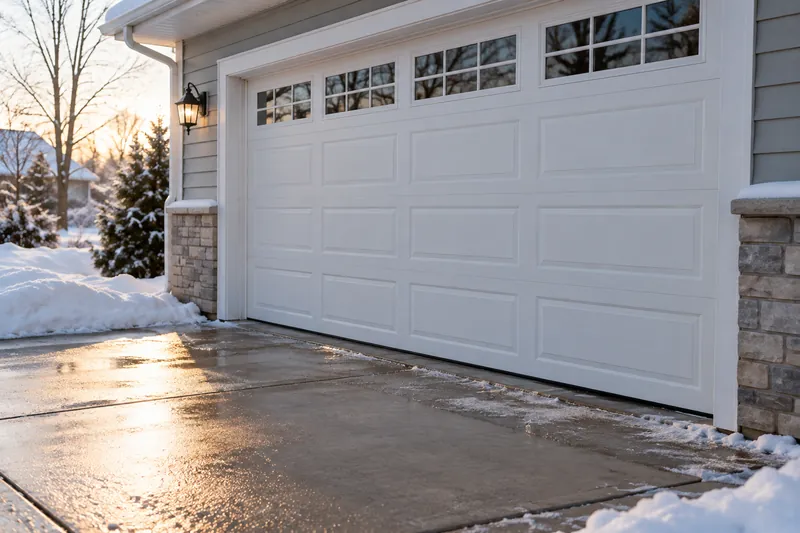
After the event, look for where water collects while the door remains closed. Take photos of puddles, snowbanks, and visible runoff paths to discuss with the installer or an appropriate drainage contractor. Do not assume a new seal will correct water flowing toward the opening.
Keep loose snow and slush away from the threshold when it is safe to do so. Check the visible bottom seal for cracking, missing sections, or a poor fit, and arrange evaluation of any damage. Seal replacement and drainage evaluation are separate decisions; neither requires adjusting spring hardware. [4]
Ask which care product, if any, is approved for your seal. Do not buy a lubricant solely because its label says “garage door.” A product intended for metal moving parts is not automatically a weatherseal treatment.
Keep a short record for recurring problems: outside conditions, where the ice appeared, whether the motor was operated, and photographs taken from a safe distance. That gives the service provider more to work with than “it sticks when cold.”
Common questions
Should I keep pressing the remote if the door moves a little?
No. Partial movement does not prove the seal is free or the mechanism is healthy. Stop and reassess without another powered attempt.
Is warm water always safe?
No. It is a manufacturer-listed option for some circumstances, not a universal procedure. Confirm your materials and manage runoff first; otherwise wait or use qualified service. [1]
Can I replace the weatherseal while the door is frozen?
Do not start a replacement while the door is stuck. Have the immediate obstruction resolved first, then assess the seal and its specified replacement. Do not loosen bottom brackets or cable attachments. [4,5]