Garage Door and Opener Warranties: How to Prepare a Claim

To prepare a garage-door warranty claim, identify the exact product, find its applicable written warranty, collect purchase and symptom records, and contact the named warranty provider before dismantling anything. Do not assume that a long motor warranty pays for the whole opener, installation labor, or the door itself.
This guide covers preparing a manufacturer’s claim, with U.S. examples and one U.S./Canada manufacturer policy. It does not determine whether your particular claim is covered. The warranty supplied with your model, purchase circumstances, and applicable law matter.
First, separate a safety problem from a paperwork problem
If the door is crooked, hanging off its track, has a broken spring or loose cable, or moves unpredictably, stop using it and keep people away. Do not repeatedly operate it to capture a better video. Arrange appropriate professional help; tell the provider you may have a warranty claim before authorizing non-emergency replacement work. Keep a record of urgent safety work and ask what evidence can safely be preserved. A warranty decision is not a reason to continue using an unsafe door.
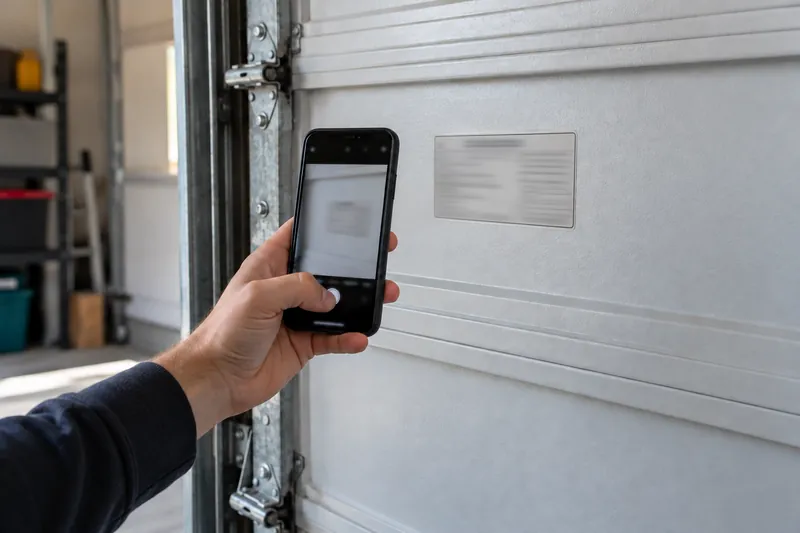
This is a documentation guide, not instructions for opening an electrical housing, adjusting springs, or removing a door panel. Photograph labels only when reachable safely; ask the installer for product records if they are not.
1. Identify which product and promise are involved
Door and opener may be different brands and have separate warranties. An installer may also have made a workmanship promise. Record each provider separately rather than sending everything to whichever brand name is easiest to see.
| What you have | What to find | What not to assume |
|---|---|---|
| Door sections, finish, glazing or hardware | Door maker, model/series, serial or order number, applicable door warranty | A finish warranty covers impact damage or every component |
| Motor, electronics or other opener component | Opener model, serial number and model-specific warranty | A motor term applies to the circuit board, battery or labor |
| A problem following installation | Installation invoice and written workmanship terms | Every installer is enrolled in a manufacturer installation program |
| A separately purchased protection plan | Plan provider and contract | The plan is the same as the manufacturer’s included warranty |
A retailer’s return policy, homeowners insurance, and a home warranty or service contract have their own providers and terms. Keep these documents separate from the manufacturer’s warranty. A manufacturer claim does not automatically start those other processes; check each document’s deadlines.
Use the contact in the manual or on the manufacturer’s official website; do not trust a phone number merely because it appears in an advertisement or unsolicited message. For installation issues, also identify the installer on the invoice.
2. Find the warranty that matches your model
Start with the manual and sales documents you received. Use the manufacturer’s official support site if a copy is missing, and match model, country, product type and purchase period. A current product-page headline may describe a different model or a newer offer.
Write a small coverage worksheet: component involved; claimed defect; applicable term; starting date specified by the warranty; original-purchaser or transfer conditions; required notice process; and known costs or exclusions. Leave uncertain fields marked “ask support,” not guessed.
Clopay’s residential warranty index separates coverage documents by model family. Its installation program is separate: the published program describes one-year coverage for qualifying replacement installations by specified authorized dealer tiers, excludes new construction, and directs installation issues to the dealer first. Do not apply that program to an unrelated installer or product.
3. Build a compact evidence packet
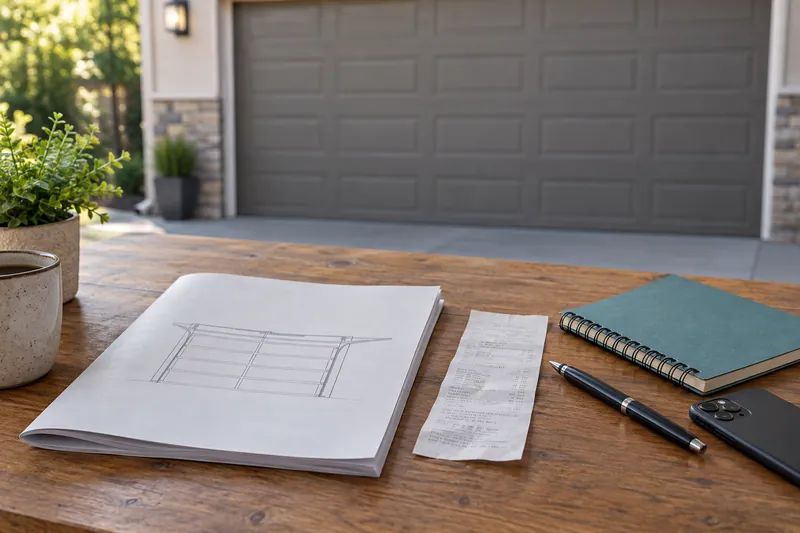
Create a folder with these files, keeping originals unchanged:
- Purchase evidence: receipt, retailer order confirmation and installation invoice, showing the product and dates.
- Product identification: clear label photographs and the model/serial numbers typed into a note.
- Applicable documents: warranty copy, manual and any written installer promise.
- Symptom record: when the problem began, what happens, and whether it is continuous or intermittent.
- Safe photographs: one overall view and close-ups taken without disturbing parts. Include the surrounding condition, not just a tightly cropped defect.
- Relevant service history: invoices and a factual list of maintenance, previous repairs or modifications.
- Contact log: date, provider, case number, response and agreed next step.
These are organizational suggestions, not a universal manufacturer’s checklist. Send only the records the verified provider requests; do not post receipts, addresses or serial numbers in public reviews. If a receipt is missing, ask the retailer or installer for a duplicate. A serial number may help identify a product, but do not treat it as automatic proof of your purchase date or ownership.
Genie’s FAQ specifically asks claimants to have their model number and original sales receipt available before contacting customer service; it sends users to the owner’s manual for the actual warranty details.
A private contact worksheet
Copy these fields into a private file; this is not a manufacturer’s form. Leave unknown items blank and ask support.
| Field | Your private record |
|---|---|
| Door manufacturer / opener manufacturer | [Record separately] |
| Model / serial number | [Copy from records or a safely reachable label] |
| Purchase / delivery / installation date | [List separately with evidence] |
| Manual / warranty version | [File name or date] |
| Symptom / first date / frequency | [Observed facts only] |
| Photos / service history | [Private file names] |
| Official contact / case number | [Verify in manual or manufacturer website] |
| Next step / charges to confirm | [Do not authorize by assumption] |
Before sending receipts or photographs, check for payment details, access codes, faces or unnecessary addresses. Keep originals and share a copy with unnecessary details obscured; do not conceal information the provider needs to identify the purchase.
4. Describe the symptom without inventing a diagnosis
For example, “the door stops about halfway down and the indicator flashes twice” is more useful than “the control board is defective,” unless a qualified diagnosis has established that. Record observed facts and quote an existing service report accurately.
Blank template, for a private message to the verified provider: “I have model [number], purchased [date]. Since [date], it has [observed symptom]. I have attached the receipt, label photo and relevant pictures. Please confirm the applicable warranty, the next safe diagnostic step and any charges before work is authorized.”
Do not dismantle the opener or ship parts just to prove the problem. Chamberlain’s published U.S./Canada policy instructs customers to contact it before dismantling and to follow its return instructions. Its policy also distinguishes a covered product defect from door/hardware problems and states that removal/reinstallation costs remain the owner’s responsibility.
5. Confirm the proposed remedy and costs
Before agreeing to a visit or return, ask for written answers:
- Is this an assessment, an approved claim, or a paid repair?
- Which part or service is approved, and under which warranty?
- Are diagnosis, travel, labor, removal, reinstallation or shipping payable?
- Must the existing part be retained or returned, and who provides return authorization?
- Is a replacement part new, rebuilt or equivalent, and what happens if it is unavailable?
- Who schedules installation, and what is the next communication date?
Do not equate “part covered” with “no expense.” Genie’s FAQ notes shipping/handling charges on parts orders; ask support which charges apply to your specific claim. Keep the original part until the provider confirms its disposition, unless retaining it would be unsafe.
6. Keep the claim open until the result is clear
After a call, save a dated summary and the case number. If a claim is refused, request the reason and the applicable warranty provision in writing. Supply any missing evidence and ask for review if you believe the wrong model, date or component was used.
If the case remains unresolved, ask the provider for its review process and retain the replies. This guide organizes records; it does not decide legal rights or provide individualized advice.

Frequently asked questions
Does a lifetime motor warranty cover the whole opener?
Not necessarily. Check the component-specific terms and labor provisions for your exact model. Do not extend the motor’s term to electronics, accessories, the door or installation.
Can I claim if I no longer have the receipt?
Ask the seller for a duplicate and ask the manufacturer what alternative proof it accepts. Coverage cannot be confirmed from a serial number alone in this guide.
Should I repair the product before contacting the manufacturer?
Contact the warranty provider before non-emergency dismantling or replacement. For an unsafe door, stop use and arrange safe professional assistance while preserving records; do not delay safety measures to wait for claim approval.
Is an installer warranty the same as a manufacturer warranty?
No. Product defects and installation workmanship may be handled by different providers under different terms. Keep both written agreements.