How to Hang Christmas Lights Around a Garage Door Safely

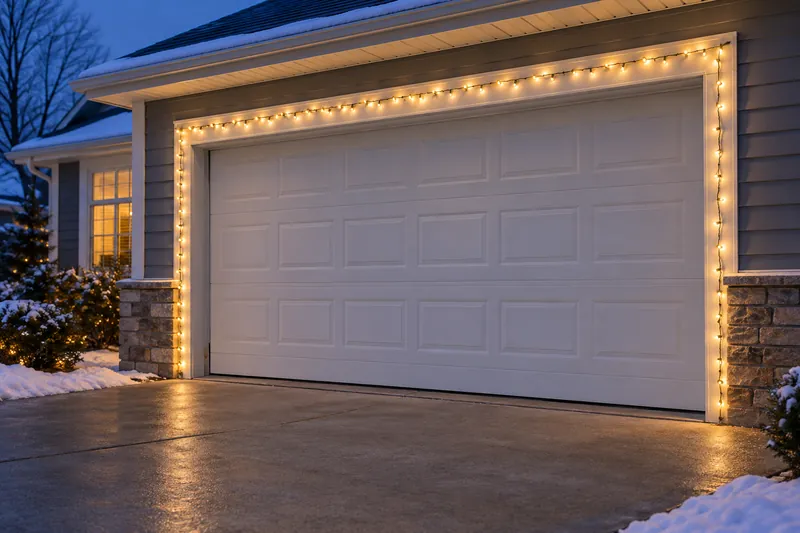
The safest starting point is to decorate the stationary building around the opening, not the moving garage door or its operating hardware. Use outdoor-rated lights and compatible clips, keep cords outside the door's travel path, and leave safety sensors unobstructed. If the only available power route passes under the door, change the display rather than closing the door on a cable.
This guide covers temporary lights, garlands and similar seasonal decorations. It does not cover permanent wiring, roof work or modifications to a garage door. It applies the manufacturer and public-safety guidance below conservatively; your door, light set and attachment instructions still control.
Before you buy anything
Take a daylight photograph of the opening. Mark where the door moves, where the low-mounted photoeyes sit, and where people and vehicles pass. Include the space inside the garage: hardware moves above and beside the opening, not only across its face.
Make a simple plan with three separate lines: the decoration, its supports and the route to power. A display is not ready if any one of those lines depends on the garage door remaining closed. Get the owner's permission before attaching anything to a rented home, shared building or unfamiliar finish.
Choose a smaller display when safe supports or a suitable outdoor supply are unavailable. A ground-level decoration away from the driveway may be easier to maintain than a garland suspended over the opening, provided it cannot topple or blow into the doorway.
1. Separate fixed surfaces from door-system parts
DASMA warns against adding materials to a garage-door assembly without explicit original-manufacturer instructions. The assembly includes tracks, brackets and other hardware—not just the door panels. Added weight and obstructions can affect operation and create dangerous failures. This guide therefore recommends no decorations attached to the moving door, tracks, springs, cables, hinges, rollers, opener rail or track supports. Do not loosen a hardware screw to make an attachment point. [S1]
| Proposed location | Decision for this project |
|---|---|
| Sound, stationary wall or trim outside the travel area | Consider only with a compatible attachment and owner approval. |
| Door panels or section joints | Do not use; keep the moving door undecorated. |
| Tracks, cables, springs or supporting brackets | Never use as decoration supports. |
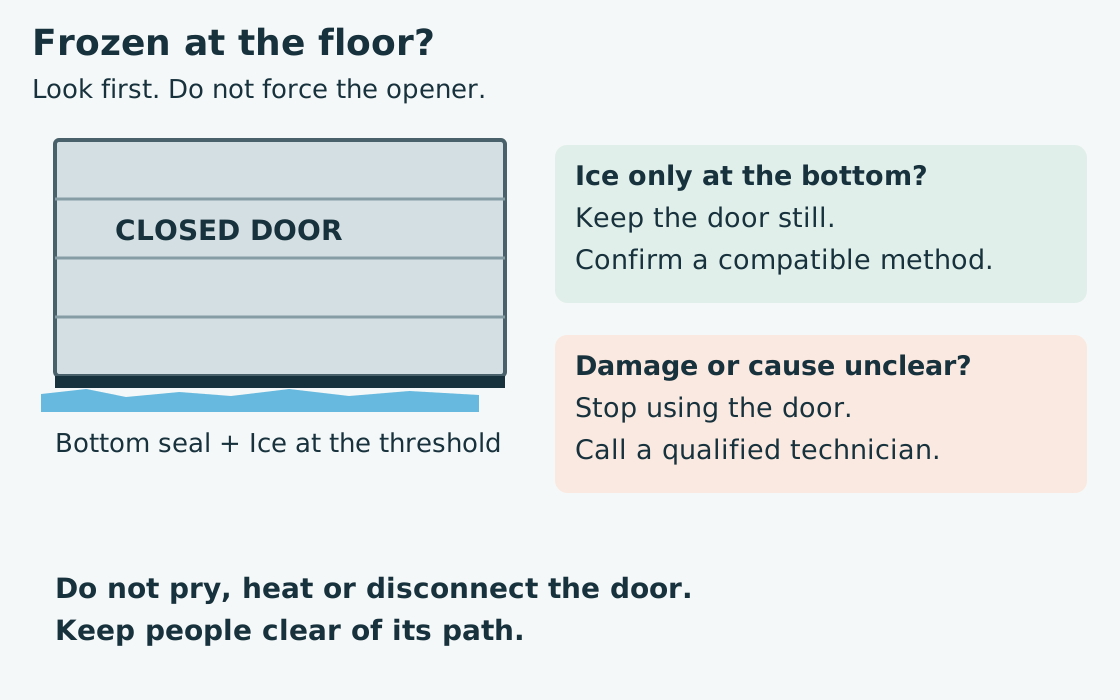
| Bottom seal, side weather seal or threshold | Keep clear; no tucked-in lights or cords. |
| Photoeyes and the beam between them | Keep fully unobstructed. |
“Above the door” does not automatically mean safe. Check whether the proposed support is part of the building or part of the door system.
2. Match the attachment to the actual surface
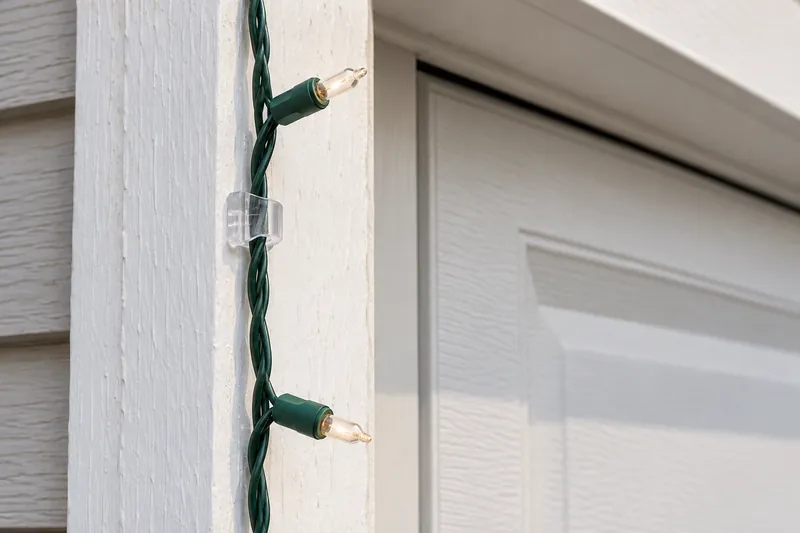
An outdoor adhesive clip is not suitable for every wall. Read the specific product's approved surfaces, load, application temperature, preparation method, waiting time and removal instructions. Do not substitute an indoor strip because it looks similar. Loose paint, dusty masonry, rough wood and wet surfaces need a different approved solution—not more adhesive.
For example, 3M's outdoor rope-light project specifies its own clip spacing and waiting time, and says to follow package preparation and weight instructions. Those directions are product-specific, not a universal rule for all clips or garlands. Check the package in your hand. [S4]
Avoid stretching the light cable tight to bridge a missing support. Use an attachment intended to hold that cable without crushing it. Do not use nails or staples to hang the lights. If installing the display requires leaning over the doorway from an unstable ladder, lower the design or hire a qualified installer. [S5]
3. Plan power without creating a pinch point
Use lights, connectors and any extension cord labeled for outdoor conditions and the intended load. Check for cracked sockets, exposed conductors, damaged insulation and loose connections before use; replace damaged equipment. Use a GFCI-protected outdoor supply, and keep electrical connections above the ground and away from snow or standing water. Follow the light manufacturer's connection and load limits rather than guessing a universal number of strings. Do not join extension cords end to end. [S5]
Route the supply along a suitable fixed surface, away from the threshold, walking route and tires. Never pass it under a closing garage door, through a pinching window or beneath a rug. A soft bottom seal does not make a cord safe to crush. If the route cannot remain clear throughout normal use, relocate the display or have an electrician assess a suitable supply. Do not alter wiring as part of this project. [S6]
4. Install with the door closed and movement prevented
Tell everyone in the household that work is taking place. Keep controls away from children and arrange the manufacturer's prescribed way to prevent unintended operation while working near the opening; an app lockout alone is not proof that every control is disabled. Do not pull the emergency release or work on counterbalance hardware for decorating.
Use a suitable ladder on firm, level ground, away from traffic. Do not stand on the door, its tracks or a vehicle. Install unpowered lights, observing the attachment's required waiting time before loading it. Keep garland ends and loose ribbons short enough that wind cannot carry them into the opening. [S5]
If you notice a frayed lift cable, damaged spring or loose bottom bracket, stop decorating and arrange professional service. These are not convenient fixing points or homeowner adjustment tasks. [S2]
5. Check the completed arrangement
Remove the ladder, tools and loose materials. From a safe position, with everyone clear, restore normal operation and watch a complete opening and closing cycle. The display must remain separate from every moving part. Follow the opener manual's prescribed safety-device checks; never test with a person, pet or body part. If a sensor is obstructed, move the decoration—not the sensor. Never bypass protection or increase force to make the door close. [S3]
Recheck after wind, rain or snow and whenever something sags. Turn seasonal lights off before bed or leaving home. At season's end, disconnect power and remove the display using each attachment manufacturer's method; do not yank a whole string down. Inspect and dry reusable items before storing them. [S6]

Frequently asked questions
Can I put a wreath or magnetic decorations on the garage door?
This guide recommends keeping decorations off the moving door. A magnet does not remove weight, clearance or retention concerns. Ask the original door manufacturer for explicit instructions before considering any door-mounted accessory.
Can an extension cord run beneath the bottom seal?
No. Do not close the garage door on a cord. Choose a power route that avoids the opening or change the display.
What if lights stop the garage door from closing?
Stop and remove the obstruction or sagging decoration with the door safely stationary. Do not move photoeyes, bypass protection or increase closing force. If normal operation does not return, use the opener manual and a trained technician.
Are adhesive clips guaranteed not to damage paint?
No universal guarantee applies to every finish or condition. Confirm that the exact clip is approved for the surface and follow its preparation, loading and removal instructions. Obtain permission on rented or shared property.