What Kind of Light Bulb Does a Garage Door Opener Need?
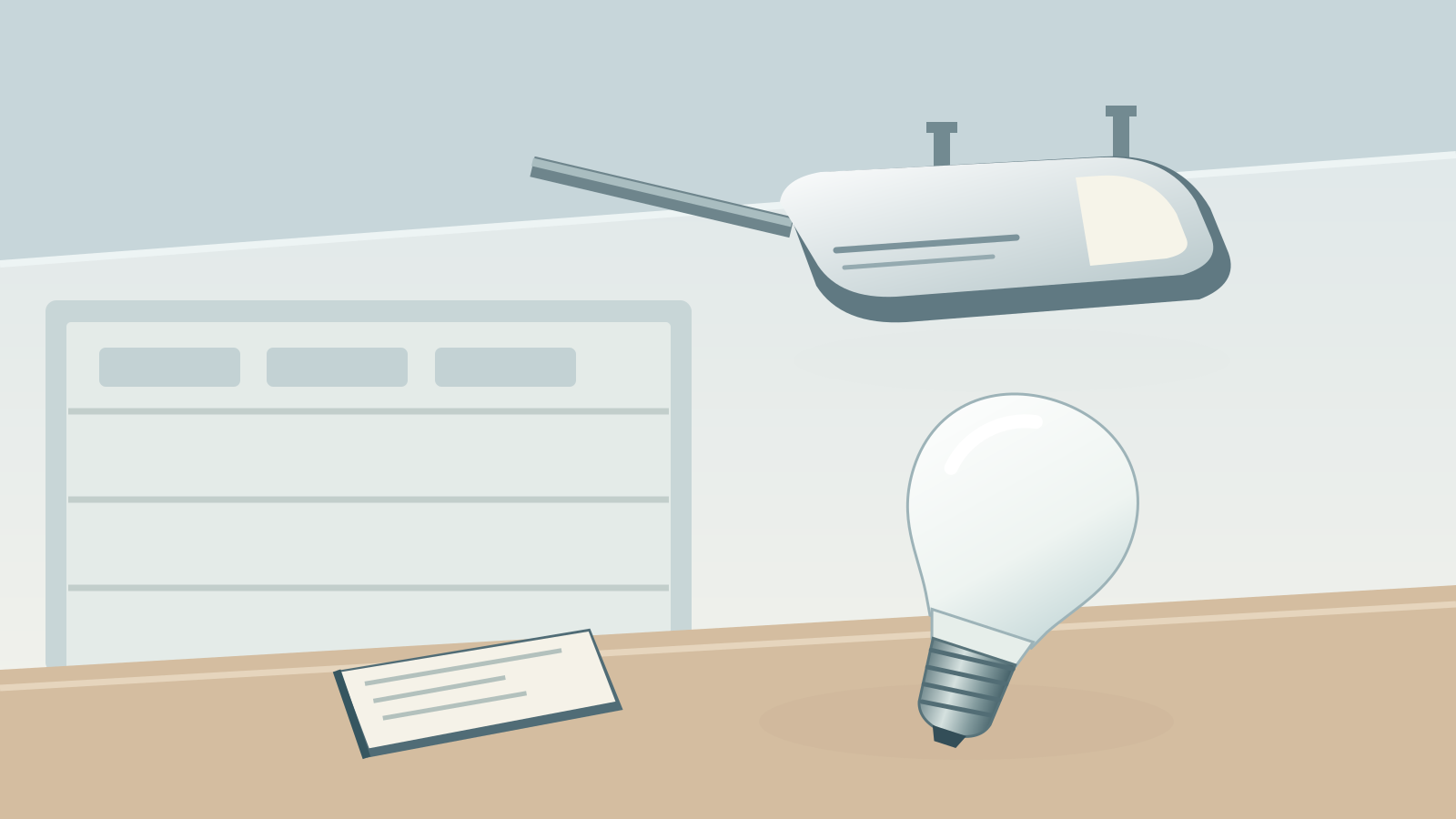
Use the lamp specified for your exact opener—not simply a bulb that screws in. Match its fitting, physical size, permitted lamp type and electrical rating. If the opener has integrated LED lighting, an ordinary replacement bulb is not the answer.
We start with the model number because there is no safe universal wattage or all-purpose LED recommendation. A bulb can fit the socket yet interfere with the remote, touch the lens or fall outside the manufacturer's instructions. This guide helps you choose a replacement; it does not cover socket repairs, wiring or internal LED-module service.
First identify which kind of light you have
Find the opener's model number in your paperwork or on an accessible exterior label. Use that model's official owner manual and look for “lighting,” “light bulb replacement” or the replacement-parts diagram. Do not climb onto the door, track or opener to read a label.
| What the manual describes | Your next step |
|---|---|
| Owner-replaceable bulb behind a lamp cover | Record the allowed lamp specifications before shopping. |
| Integrated LED module or light pod | Find the exact service guidance or contact manufacturer support. Do not buy a screw-in bulb. |
| Separate remote light fixture | Check that fixture's model and instructions, not just the opener's rating. |
| No clear lighting information | Ask the manufacturer to identify the lighting system from the model number. |
For example, Chamberlain lists the B4613T with integrated LED lighting and a model-specific light-pod replacement part. That is different from an opener designed for a removable bulb. “LED” can describe either a screw-in lamp or an integrated assembly; it does not tell you which one you have.
Our tip: Photograph the accessible model label and save the manual's lighting page on your phone. The old bulb is useful as a clue, but a previous owner may have installed the wrong one.
Read these specifications before buying
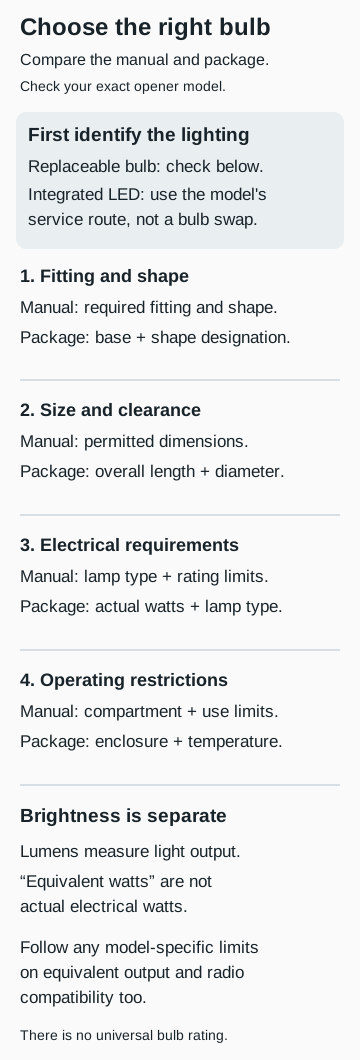
Compare the fitting, size, electrical rating and operating restrictions with your opener manual.
Base and shape are different things
The base is the part that fits the socket. The shape designation describes the bulb envelope. For example, a GE lamp specification lists A19 as the shape and E26/24 medium base separately. Do not treat “A19” alone as a complete socket specification—or assume the same fitting applies to every country or opener.
Write down the fitting required by your equipment and check the bulb packaging. If the manual uses an ambiguous description, ask the manufacturer to identify a compatible replacement. Do not solve a mismatch with a socket adapter.
Size and lens clearance matter
Check the permitted overall length, diameter and shape, where specified. A larger bulb may interfere with the light cover even if its base fits.
Chamberlain's bulb guidance specifically warns against contact between the bulb and lens and excludes halogen, short-neck and specialty bulbs for the openers covered by that guidance. Do not transfer those instructions to a different manufacturer's equipment without checking its manual.
Never force the cover closed, leave it off to accommodate a larger bulb or modify the housing. A lamp that prevents the cover from fitting correctly is not a suitable replacement.
Read actual watts and equivalent brightness separately
These package fields answer different questions:
- Actual watts: electrical power used by the lamp.
- Lumens: light output.
- Equivalent or replacement watts: a comparison with an older lamp's brightness, not the LED's electrical consumption.
For a concrete label-reading example, GE lists its Basic LED Soft White SKU 36993 as 9.5 W, 760 lumens and a 60 W replacement. These are three separate specifications—not three ways of stating its electrical load. This example explains the label; it is not an opener-compatibility recommendation.
Compare actual electrical ratings with the equipment requirements, but also obey any stated limits on equivalent lamp output or specified lamp types. Do not assume that a very bright LED is allowed merely because its actual wattage is low. If the manual's wording does not clearly permit your choice, get a model-specific answer before installing it.
Check operating restrictions too
Read the bulb manufacturer's notes about temperature, moisture, orientation and enclosed fixtures. A lamp's shape and wattage do not establish these ratings. The GE example above, for instance, is listed as not enclosed-rated. Whether your opener's lamp compartment needs an enclosed-rated bulb must be established from the equipment and lamp instructions—not guessed from the presence of a plastic lens.
If you want more light than the opener allows, keep its specified lamp and consider separate, properly installed garage lighting instead of exceeding its rating.
A model-specific example—not a universal maximum
The Genie belt/chain-drive manual currently linked from the Model 2028B support page is document 42598.02135, dated October 2024. Its lighting section on printed page 22 specifies A19-size lamps, rules out short-neck bulbs and describes a 60 W maximum incandescent lamp or CFL/LED equivalent. The 2028B product page also states a 60 W maximum when an incandescent bulb is used.
That manual contains an additional minimum-lamp requirement for the integrated Aladdin Connect models it covers. It also distinguishes integrated LED models, which use specialty replacement kits.
The lesson is to read the whole applicable lighting section, including footnotes. Do not use the 2028B example as the specification for another Genie model, another manufacturer or another market.
Can you use an LED bulb in a garage door opener?
Sometimes, yes—but compatibility is not guaranteed by the word “LED.” Follow your opener manufacturer's guidance for the exact unit and lamp.
Genie offers an opener-specific LED bulb designed to reduce radio-frequency interference. Chamberlain's current guidance also identifies a tested LED option for the equipment it covers. Neither fact means that every LED bulb works with every opener, nor that all LED bulbs must be avoided.
Watch for a change in remote performance
A lamp that illuminates normally can still affect radio reception. Reduced remote range or trouble operating a keypad after a bulb change is useful diagnostic information, not proof that the remote needs resetting.
Record what changed, the lamp's exact model and whether the symptom occurs with the opener light on or off. Keep the doorway clear and the door in sight during any normal control check. Do not repeatedly cycle a malfunctioning door to investigate a lamp.
If the timing points to the replacement bulb, consult the opener's approved-lamp guidance before buying another. Persistent trouble belongs in the intermittent-control troubleshooting process; this article does not recommend disconnecting control wires, clearing remote memory or opening the logic-board compartment.
Before an owner-permitted bulb replacement
We would only proceed when the manual provides an owner replacement procedure and the lamp compartment can be reached safely.
- Prepare independent lighting. You need to see safely while the opener is disconnected. Keep other people from operating the door during the work.
- Follow the exact power-isolation instructions. Switching the light off at the wall control is not electrical isolation. Follow any additional instructions for battery-backed equipment. If you cannot identify a safe owner procedure, stop.
- Let a hot bulb cool. Do not handle a hot lamp or work on a live socket.
- Use only the stated lamp-cover access. Follow the model manual rather than a generic cover-removal method. Do not remove motor covers, probe contacts or alter wiring.
- Restore the cover before testing. Once the specified replacement procedure is complete, clear the work area and follow the manufacturer's directions for restoring power and checking the light.
If safe access would require overreaching or an unstable ladder position, arrange service. A simple bulb is not worth a fall.
Stop and arrange service if you find any of these
- A cracked, loose, scorched or melted socket or cover.
- A burning smell, visible arcing or repeated breaker trips.
- A broken bulb with its base stuck in the socket.
- Water entry or damaged wiring.
- A correctly specified replacement that still does not light, or repeatedly fails.
- An integrated LED assembly with no clear owner-service procedure.
Do not bend socket contacts, scrape inside the socket, fit a higher-wattage bulb to compensate for dimness or keep testing damaged equipment. Give support the opener model, the lamp model and a description of the symptom. A photo taken from a safe position can help them identify the correct next step.
Common buying mistakes to avoid
Matching only the old bulb. Verify it against the manual first.
Reading “60 W equivalent” as actual power use. Check both fields and the equipment's full restrictions.
Choosing by screw fit alone. Lens clearance, lamp type and operating conditions still matter.
Treating any remote fault as a pairing problem. Note whether it began after a lamp change before resetting working controls.
Buying a bulb for an integrated-light opener. A light-pod or module issue needs the exact parts and service route, not an improvised socket conversion.
Your final shopping checklist
Before buying, you should be able to answer all five questions:
- Does this model use an owner-replaceable bulb?
- Does the base, shape and physical size match its specification?
- Are the actual watts and any equivalent-output restrictions satisfied?
- Is the lamp permitted for the compartment and operating conditions?
- Does the opener manufacturer provide compatible-lamp or radio-interference guidance?
If one answer is missing, pause the purchase and resolve it with the model manual or manufacturer. The right bulb is the one that meets all the requirements—not the one with the brightest number on the box.
Sources & manuals7
Match each manufacturer document to your exact product and revision.
- Genie Belt/Chain Drive Programming, Operation & Maintenance Manual
- Genie Model 2028B product/support page
- Chamberlain Light Bulbs That Can Be Used in Garage Door Openers
- Chamberlain B4613T product and parts page
- Genie LED Bulb PRO
- GE Basic LED Soft White General Purpose Bulbs
- Chamberlain Remotes and keypad only work when the opener lights turn off