How to Cover Garage Door Windows for Privacy

For privacy without replacing your garage-door windows, start by looking for a frosted or patterned film approved for your exact glazing. Choose the privacy effect first, then check the door and film manufacturers’ restrictions before buying. A film that works on ordinary household glass is not automatically suitable for acrylic, coated glass or an insulated garage-door window.
We would not choose mirrored film for reliable nighttime privacy. Nor would we hang ordinary blinds on a moving door as a shortcut. This guide helps you choose a compatible, lightweight treatment without removing glazing or altering the door.
Decide what you need to hide
Ask whether you want to obscure stored belongings, prevent a clear view of people, reduce glare, or block almost all light. These are different jobs.
Before covering anything, look at the closed door from outside in daylight and again after dark with the garage lights on. Stay on your own property or another place where you have permission to stand. Note which panes reveal the interior and whether you need privacy across the entire window or only part of it.
Our tip: judge privacy from the observer’s side, not just from inside the garage. An attractive texture can still leave a view through clear areas.
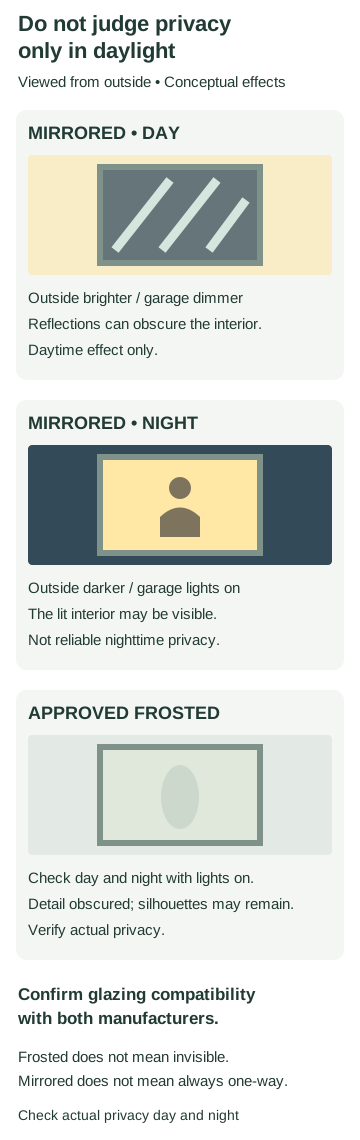
Why mirrored film is not a nighttime solution
Gila describes its Privacy Control Mirror film as a daylight-privacy product. When the garage is brighter than the outdoors, people outside can see in. It is not a reliable choice for hiding a lit workspace at night.
Frosted or densely patterned treatments are worth considering when you need both daylight and an obscured view. Gila’s Frosted Glass Decorative model 50244455, for example, is a removable static-cling product marketed for day-and-night privacy. That is a product example, not approval for your garage door. Inspect a sample under your own lighting; do not assume every frosted pattern eliminates silhouettes or all visible detail.
Identify the window before choosing a covering
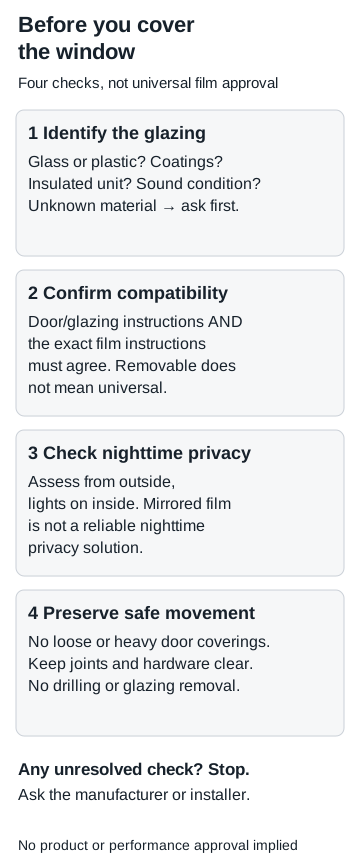
Find the door model and, if available, the original glazing specification or order paperwork. Appearance alone is not enough to distinguish clear plastic from glass or identify every coating.
Record these details:
- Glass, acrylic or polycarbonate, including any protective surface treatment.
- Single-pane or insulated glazing.
- Clear, tinted, coated, textured or already treated surface.
- Window condition, including scratches, cracks, loose retainers or moisture between panes.
- Which surface the proposed film is meant to contact.
Clopay’s current window literature lists different glazing choices, including acrylic, obscure and insulated glass. Their existence is a reminder to identify the actual window—not a reason to treat every option the same.
Stop before applying anything if the material is unknown. Send the door manufacturer or installing dealer a model-label photo, a window photo and the proposed film’s exact product number. Ask for confirmation rather than testing compatibility by sticking film to an unidentified pane.
Compare the practical options
| Option | Useful when | Main limitation |
|---|---|---|
| Approved frosted static-cling film | You want an obscured view, daylight and a removable treatment | Removability does not establish material, coating or thermal compatibility |
| Approved adhesive privacy film | The exact product is permitted and you accept its removal requirements | Do not assume an adhesive product is suitable for plastic glazing |
| Mirrored privacy film | Daytime privacy is the specific goal | Do not rely on it when the garage is lit at night |
| Manufacturer-approved covering accessory | A purpose-made option exists for the exact door/window | Confirm its attachment and moving-door clearance requirements |
| Approved obscure replacement glazing | No compatible surface treatment meets the need | This becomes a separate professional glazing project |
We leave loose fabric, makeshift boards and heavy door-mounted blinds out of this DIY shortlist. A moving sectional door is not a stationary wall window. An unapproved covering can create an attachment, clearance or added-load problem.
Check compatibility in both sets of instructions
You need agreement from the glazing or door manufacturer and the film manufacturer. A general statement on a product listing is not enough when a more specific manual has restrictions.
Plastic glazing needs particular care
Gila’s residential FAQ rules out its adhesive films on plastic, while identifying certain adhesive-free products as possible plastic applications subject to instructions. However, its linked decorative static-cling installation sheet describes specified glass applications. If the paperwork does not clearly authorize your exact plastic window, ask for written clarification. “Static cling” by itself is not a compatibility guarantee.
Heat, coatings and insulated glass
Ask about sun exposure, existing tint or coatings, insulated construction and the required application side. Gila explains that its dark-dyed films absorb more solar energy than lighter products; different products also have different placement rules. Do not substitute a dark privacy film for a specified frosted product or improvise a foil-backed cover.
Keep the exact product instructions and the manufacturer’s answer with the door paperwork. Ask whether the proposed treatment affects applicable warranty coverage. A film warranty is not evidence that the door maker accepts the modification.
Prepare a safe installation plan
This is a selection and preparation guide, not a universal film-fitting recipe. Application fluid, cutting method, edge clearance, temperature and drying time depend on the approved product and surface.
1. Check access and window condition
Work only on a sound window that you can reach safely with the door fully closed. Prevent anyone from operating the door while you work, following the opener’s owner instructions for disabling operation, including any battery-backed or automatic functions. Do not work beneath a raised door or raise it partway just to reach a pane.
If access needs a ladder, removal of a grille, loosening of a retainer or overhead work, use an installer rather than improvising. Do not remove window-frame screws for this project. Stop using the door and arrange service if a pane or retainer is loose or damaged.
2. Measure without dismantling the frame
Measure each accessible pane separately and sketch the layout. Record the exposed area, then use the chosen product’s sizing and edge-clearance requirements. Do not assume adjacent windows are identical. Keep film off seals, retainers and drainage features unless the applicable instructions expressly permit contact.
3. Reconcile the cleaning instructions
Clopay warns against ammonia, abrasives and solvents on specified plastic windows, and against scraping polycarbonate with blades or squeegees. A film kit’s glass-cleaning method must not override the window’s care restrictions.
Use only a preparation method accepted by both manufacturers. If one requires scraping and the other forbids it, stop and ask for an approved alternative. Do not experiment with solvents to remove old adhesive.
4. Follow the approved product method
Gather the specified materials before starting. Do not add glue to a static-cling product or use heat to force an edge to stick. Keep all material within the approved glazing area; never bridge panel joints, hinges or other moving hardware.
Gila’s decorative-film sheet, for example, excludes damaged and certain textured glass. Its instructions are not a workaround for a flawed pane. Have damage assessed instead of hiding it under film.
5. Check the result before returning the door to use
After the product’s required setting period, look for loose edges or material extending beyond the approved area. Clear tools and people before restoring normal operation. Observe from a safe position outside the door’s travel path; do not reach toward a moving covering. Stop if anything catches, shifts or interferes.
Then repeat the outside privacy check after dark. If the result is too transparent, choose a more suitable approved product rather than layering additional film without permission.
Common mistakes to avoid
- Buying “one-way” film without checking its nighttime behavior.
- Treating acrylic, polycarbonate and glass as interchangeable.
- Assuming a removable product cannot harm a surface.
- Copying an installation video’s scraper, cleaner or heat-gun method onto different glazing.
- Covering defects instead of having them assessed.
- Adding hanging hardware, screws or heavy blinds to the moving door.
When to choose professional help instead
Stop if compatibility remains uncertain, the pane or frame is damaged, safe access is difficult, or the proposed covering needs changes to the door. A garage-door dealer can identify glazing and check approved alternatives; a film installer can assess a specific film application. Neither should have to guess the other manufacturer’s requirements.
If no compatible covering provides the privacy you need, ask about approved obscure glazing for your door model. Do not remove the existing pane or drill the panel yourself as part of a privacy-film project.
Our bottom line: choose the privacy effect you need, verify the actual glazing, and obtain a treatment approved for both. The best result is an obscured view with safe door movement—not just a window that looks covered.
Sources & manuals6
Match each manufacturer document to your exact product and revision.